The 47 Files · Power turned against its critics
Retribution.
The price of
getting in his way.
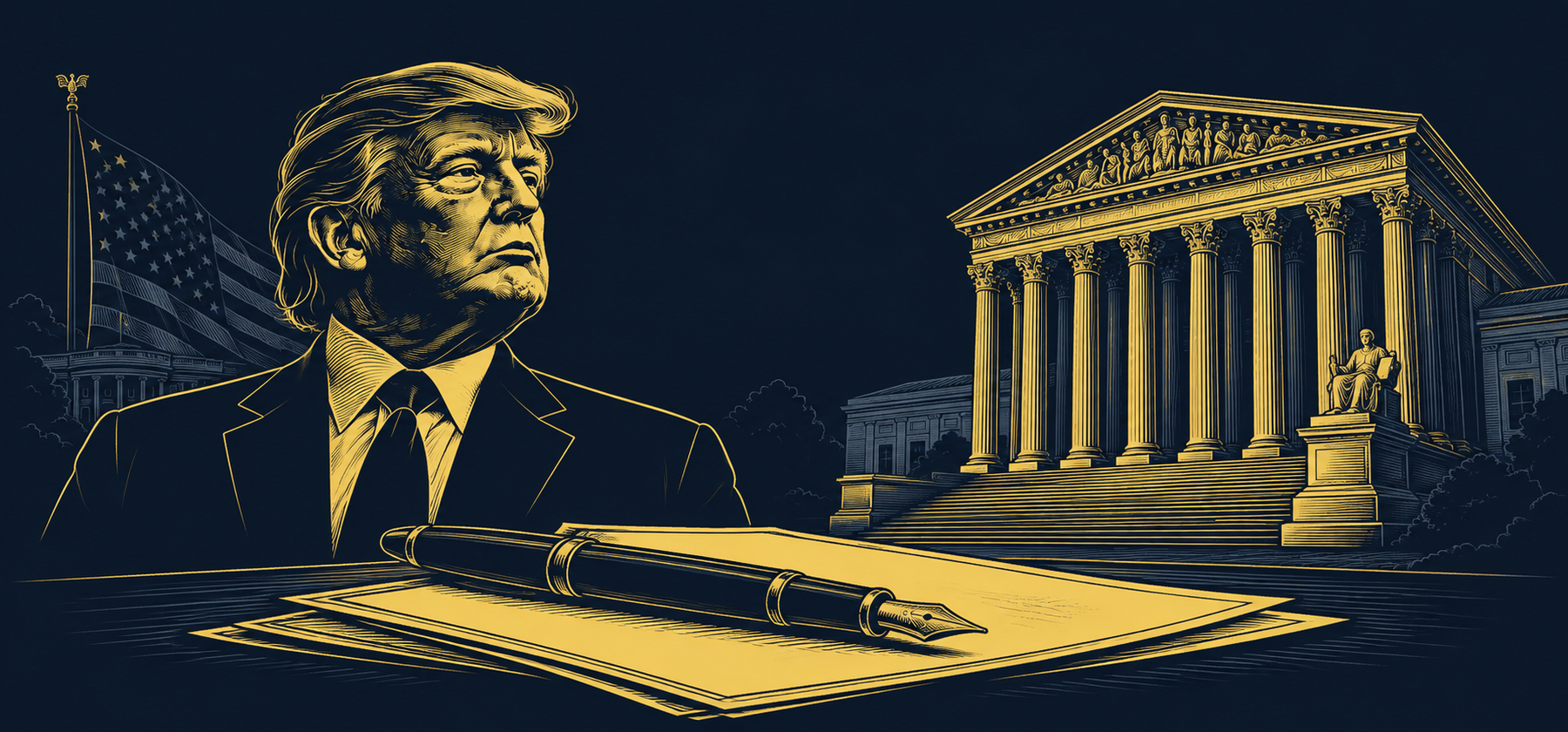
Trump promised retribution before he returned to the White House. Once there, he directed the government against former officials, investigators and lawyers who had crossed him. The people on the receiving end have had to fight back—or bear the cost.
Updated October 28 · Election power
The election fight reaches the counting room.
In California, DOJ is asking the courts to stop the counting of a disputed group of mail ballots. In Alaska, it wants certification blocked in a scenario where Mary Peltola wins. Trump says he personally ordered the Alaska lawsuit.
The cases put the federal government inside contests that will decide the limits of Trump’s power for the next two years. Follow the demands, the filings and the people issuing them.
The Ninth Circuit dismissed DOJ’s California appeal on October 26. In Washington state, election officials say the federal list is catching legitimate citizens. Trump has added a million-dollar reward for reports that lead to election-fraud convictions. Read the court decision and the state’s response
The pressure extends beyond these lawsuits. Read the new reporting on the nationwide subpoena campaign
October 24 reporting · Pardon power
Protection for the people carrying out the orders.
While Trump’s prosecutors pursue his opponents, White House lawyers are reportedly considering broad pardons for junior staff. The Washington Sun describes discussions covering employees involved in deportations, war and trade. Heritage and American Moment have pressed for pardons or legal-defense funding.
Updated October 28, 2026 · The FBI case
They investigated foreign interference.
Now they face Trump’s prosecutors.
Nikki Floris and Bradley Benavides helped lead the FBI’s Foreign Influence Task Force, which examined threats to American elections. On October 23, they appeared in federal court in Washington, charged over what they told Congress about Hunter Biden. The court appearance ↗︎
The criminal complaint was filed on October 20. Prosecutors allege that Floris’s July 19, 2023, interview and Benavides’s September 28, 2023, interview gave false accounts of their knowledge of, and involvement in, the FBI’s Hunter Biden investigations. The accompanying affidavit cites messages, documents and witness accounts that investigators say contradict their answers. Read the criminal complaint ↗︎ · Read the supporting affidavit ↗︎
Floris’s lawyers rejected the allegations as false and politically timed, coming years after the interviews and less than two weeks before the midterms. Both defendants’ lawyers sought a prompt hearing to challenge the case. Their response ↗︎
In court, the origins of the case come into view.
At the October 27 hearing, FBI agent Bryan Witt testified that the investigation followed Trump’s public instruction to Kash Patel in July. Witt had raised concerns about political interference. Judge Zia Faruqui also struck an unsigned obstruction complaint that prosecutors had filed without a judge’s approval. The hearing account
Floris and Benavides returned to court October 28 to challenge the prosecution. Their lawyers were seeking dismissal as the court examined how the case had been assembled. The continuing hearing The connected legal record Inspect the case
New reporting · October 21, 2026
The case fell apart.
Now the watchdog won’t investigate.
David Hearn was charged with damaging the Lincoln Memorial Reflecting Pool. The government eventually conceded that a contractor’s botched work had caused the damage—and that Hearn had committed no crime. On October 1, Judge Todd Edelman closed the case for good.
Trump had kept demanding another prosecution. Edelman’s order explained why that mattered: leaving the charge open would expose Hearn to a fresh case driven by presidential pressure, despite the government’s own conclusion that he was innocent. Read the judge’s October 1 order ↗︎
Getting the charges dismissed has not brought an independent investigation of the people who pursued them. AP reported on October 21 that Justice Department Inspector General Don Berthiaume had declined to investigate, according to a letter from Hearn’s lawyers. He said their professional-misconduct allegations belonged with the department’s Office of Professional Responsibility. The lawyers asked him to reconsider. Read AP’s October 21 report ↗︎
Their October 6 complaint had asked the Justice and Interior inspectors general to investigate the rush to indict, the handling of evidence and possible criminal misconduct. The judge’s ruling had already established the central fact: the prosecution had no crime to prosecute. Inspect the request for an investigation ↗︎
Updated · October 23, 2026
Their work served the public.
Their loan relief became a target.
A lawyer helping immigrant families or a counselor supporting young people could have stopped earning credit toward student-loan forgiveness by continuing that work. The administration’s rule let the education secretary disqualify employers she judged to have a “substantial illegal purpose.” Civil-rights groups challenged a policy that put their employees’ financial futures at the mercy of Washington’s politics.
On June 30, a federal judge in Washington struck the rule down. The Education Department could not rewrite the eligibility Congress had established. The plaintiffs included the Kennedy Human Rights Center, the American Immigration Council, The Door and LULAC. The ruling and the organizations that challenged it ↗︎
On October 21, the Justice Department dropped two appeals without explaining the retreat. Read AP’s report ↗︎ The next day, it abandoned the third: the case brought by Massachusetts and other states. The October 22 filing ended the remaining appeal, leaving the ruling against the employer restrictions in place. Read the final appeal withdrawal ↗︎
The administration had tried to turn student-loan relief into a way to punish employers for work it opposed. All three appeals have now been withdrawn. The states’ October 22 update ↗︎ · The earlier appeal filings ↗︎
01 · Washington · October 12, 2026
For years, he attacked her.
Then federal agents searched her home.
Donald Trump had spent years attacking Ilhan Omar. On Monday, October 12, federal agents searched the congresswoman’s Washington-area home. The Justice Department said Homeland Security Investigations had executed a judicially authorized warrant in a criminal investigation. It did not explain the underlying case. Read the AP account ↗︎
Omar called the search political intimidation and said she would not be silenced. Days earlier, Trump had spoken at a Tennessee rally about Vice President JD Vance and “our people” investigating her. The public record does not yet explain the grounds for the search or establish who directed it. The statements surrounding the search ↗︎
In July 2019, Trump had attacked Omar at a North Carolina rally while his audience chanted “Send her back!” Omar was already an American citizen and a member of Congress. The chant followed his racist suggestion that four congresswomen of color should go back to the places they came from. He later said he disliked the chant; the following day, he defended the supporters. Watch the original rally coverage ↗︎ · The subsequent reversal ↗︎
For Omar, opposing Trump had brought a racist campaign against her right to belong in the country she represented. Now she was facing a federal investigation whose basis the government had not publicly explained.
Trump’s treatment of other critics gives Omar reason to fear the worst. He has signed orders naming the people who angered him, spelling out their supposed offenses and directing the government to act against them. Some had served in his own administration. Others had simply agreed to be someone’s lawyer. And, as television networks were discovering, refusing to abandon a competitor could draw the government’s attention too.
02 · October 2026 · The television press pool
They refused to replace the banned network.
Now DOJ is investigating.
When Trump barred CNN, MS NOW and Politico from the White House in September, the other television pool networks could have stepped into CNN’s place. Instead, they stood together. ABC, CBS, NBC and Fox News refused to replace the excluded network in the shared coverage operation.
The pool puts a small group of journalists and camera crews close to the president, then distributes their reporting and footage to other outlets. Sharing that work makes independent coverage possible in places too small for every newsroom to send a crew. The networks temporarily suspended it rather than let the White House decide which competitor could take part. The original solidarity decision →︎
By October, the Justice Department was examining their response as a possible antitrust violation. NBC reported that the five networks received civil investigative demands on October 9. A DOJ spokesperson confirmed the inquiry, arguing that coordinated boycotts by commercial competitors can violate the Sherman Act. The investigation and the document demands ↗︎ · DOJ’s explanation ↗︎
The pool had resumed full coverage on September 25. The government was now investigating a protest that had already ended. This was an inquiry, not a finding that the networks had broken the law.
The question had widened. First, could the president exclude journalists because he disliked their reporting? Now, could other newsrooms resist that exclusion together without facing a federal investigation? Fox’s participation made this more than a dispute between Trump and liberal television. Competitors had defended a shared right to report—and the department was demanding answers about how they did it.
The original bans and subsequent access disputes had already forced the networks to fight for their place at the White House. Now they also had to answer the Justice Department for the way they had defended one another.
03 · A promise made in public
The promise was retribution.
Well before these confrontations, Trump had been explicit about what a return to power would offer. Speaking to conservatives at CPAC in March 2023, he promised his supporters retribution. He was asking them to elect a president who would settle their grievances along with his own. Read the recorded remarks ↗︎
Back in office, he could do more than denounce someone from a stage. He could order a security clearance suspended, direct a review of government contracts or demand an investigation. People who had angered him would have to deal with the federal government, not just his insults.
Chris Krebs had contradicted his election claims. Miles Taylor had written about the workings of his administration. Lawyers had helped the prosecutor who brought charges against him. None needed to mount a personal campaign against Trump to become a target.
He had demanded loyalty from officials during his first term. In the second, even people who had long since left his administration found themselves within reach.
04 · Chris Krebs and Miles Taylor
He fired Krebs. Four years later, he went after him again.
Chris Krebs had already lost one job for contradicting Trump. As the country’s election-security chief, he defended the integrity of the 2020 vote. Trump fired him. More than four years later, the president was still pursuing him.
On April 9, 2025, Trump signed an order to revoke any active security clearance Krebs held and review his government work. The order named his new employer, SentinelOne, and directed that clearances held by people at associated organizations be suspended pending review.
Trump’s memorandum accused Krebs of censorship and attacked him for rejecting the stolen-election claims. Keeping Krebs on staff now carried a risk for the people working with him. Their clearances were on the line because the president was still pursuing a dispute over the 2020 result. Read the Krebs memorandum ↗︎
Miles Taylor received a separate memorandum the same day. It accused the former Homeland Security official, who had written as “Anonymous” to criticize the first administration, of disclosing classified information and described his conduct as potentially treasonous. It ordered a review of his service and clearance suspensions extending to associated organizations, naming the University of Pennsylvania. Those were the president’s allegations, not findings of guilt. Read the Taylor memorandum ↗︎
Both men had worked inside Trump’s first administration. Leaving it had not ended his interest in them. Nor did the orders stop with them: the president was prepared to make their colleagues answer for the association.
05 · Jack Smith, Robert Mueller and the lawyers
Even defending the investigator could make you a target.
Jack Smith had prosecuted Trump over his efforts to overturn the election and his handling of classified documents. When lawyers at Covington & Burling helped Smith, Trump went after the firm.
On February 25, 2025, the White House announced that security clearances held by Covington & Burling lawyer Peter Koski and potentially other lawyers who assisted Smith would be suspended pending review. It also directed scrutiny of the firm’s government contracts. The administration presented the action as a response to the alleged weaponization of government. Its own fact sheet identified assistance to Smith as the connection. Read the White House’s explanation ↗︎
A month later, an executive order against WilmerHale singled out its association with Robert Mueller, Aaron Zebley and James Quarles. It accused the firm of rewarding lawyers from an investigation Trump condemned. The order called for restrictions involving security clearances, government access and contracts. Read the WilmerHale order ↗︎
The orders threatened something a law firm depends on: clients willing to retain it. A business hiring lawyers would have to consider whether their dispute with the president might become its problem too. Trump could put a price on representing someone he opposed without ever winning a case against that person.
WilmerHale challenged the order, as did Perkins Coie. The dispute had outlived Mueller’s investigation and spread to lawyers who had not been responsible for its findings.
06 · The people who did the work
They investigated a president.
Then they had to fight for their jobs.
Smith was the name everyone knew. Behind him were agents who interviewed witnesses, followed leads and assembled the evidence. When the political leadership changed, those assignments could follow them into the director’s office.
On March 31, 2026, three fired FBI agents brought a proposed class-action lawsuit seeking their jobs back. They said they had been punished for working on the investigation into Trump’s attempt to overturn the 2020 election. Their complaint alleged political retaliation and denial of due process. It was a challenge to their dismissal, not a court finding that their allegations had been proved. Read the AP reporting ↗︎
Other former employees had already sued over their own firings, including senior officials and agents photographed kneeling during a racial-justice protest. The cases exposed a dispute about who could still have a career at the bureau—and whether work that displeased the president could be treated as evidence of disloyalty.
The agents’ election investigation concerned claims that had failed in court and the effort to keep Trump in office anyway. Now some of the people assigned to investigate that effort were asking a court to protect their own livelihoods. The president had returned to power. They had lost their jobs.
October 26, 2026 · Court ruling
They fired James Comey’s daughter. She took them to court—and won.
Maurene Comey had just agreed to take on another major public-corruption trial when Washington ended her career as a federal prosecutor. At 4:57 p.m. on July 16, 2025, an email arrived: she was fired, effective immediately. Nearly ten years in the Manhattan U.S. attorney’s office ended with a one-page memo invoking Article II of the Constitution.
Her bosses had called her a “brilliant lawyer and a gifted supervisor.” The Justice Department later admitted that the dismissal had nothing to do with her performance. When she asked why she was being removed, the answer from U.S. Attorney Jay Clayton was that it “came from Washington.”
On October 26, 2026, U.S. District Judge Jesse Furman ruled that her firing was unlawful. Trump’s Justice Department had violated her statutory and constitutional rights. He ordered retroactive reinstatement and back pay through December 20, 2025, the cutoff tied to her move to another job.
Comey’s lawsuit put the family name at the center of the case. She alleged that she had been targeted because her father was James Comey, the former FBI director Trump fired during the Russia investigation, or because of the political views the administration attributed to her. Her own work included the Epstein and Maxwell prosecutions, along with homicide, racketeering and public-corruption cases.
The complaint also traced the public campaign against her. Trump ally Laura Loomer had repeatedly demanded that “James Comey’s liberal daughter” be fired. On the day the email arrived, Loomer celebrated the dismissal and claimed credit.
DOJ’s defense reached far beyond one prosecutor. It argued that presidential power swept aside the protections Congress had given career prosecutors. Furman rejected that claim, warning that the administration’s position risked a return to the spoils system Congress had spent generations trying to end.
The government’s account said then-Attorney General Pam Bondi directed the dismissal. Todd Blanche later signed a memo seeking to ratify it. Neither maneuver supplied the cause, notice or opportunity to respond that Comey was owed.
By the time the ruling came, she had taken another job and no longer sought to return. The court restored her employment record for the intervening months and ordered the government to pay what it owed. The amount remains for the court to decide.
Made public October 26 · James Comey
They came back for James Comey.
James Comey appeared on camera with another federal case hanging over him. “Well, they’re back—again,” he said. Trump’s administration had returned to a ten-year-old disclosure allegation, giving the former FBI director a third prosecution to fight in thirteen months. Comey said he remained innocent and unafraid.
The new case became public on October 26. The charging document was filed under seal on October 5 in federal court in Washington. It accuses Comey of unlawfully disclosing national-defense information on October 5, 2016, and conspiring to make that disclosure. Prosecutors filed a criminal information, placing their own charging statement before the court without a grand-jury indictment.
Comey’s lawyers say the alleged disclosure to The New York Times had already been investigated twice. Their October 16 motion traces the first inquiry to John Durham, who recommended no prosecution in December 2018. A second inquiry in Washington closed without charges in February 2020. Both decisions came during Trump’s first term.
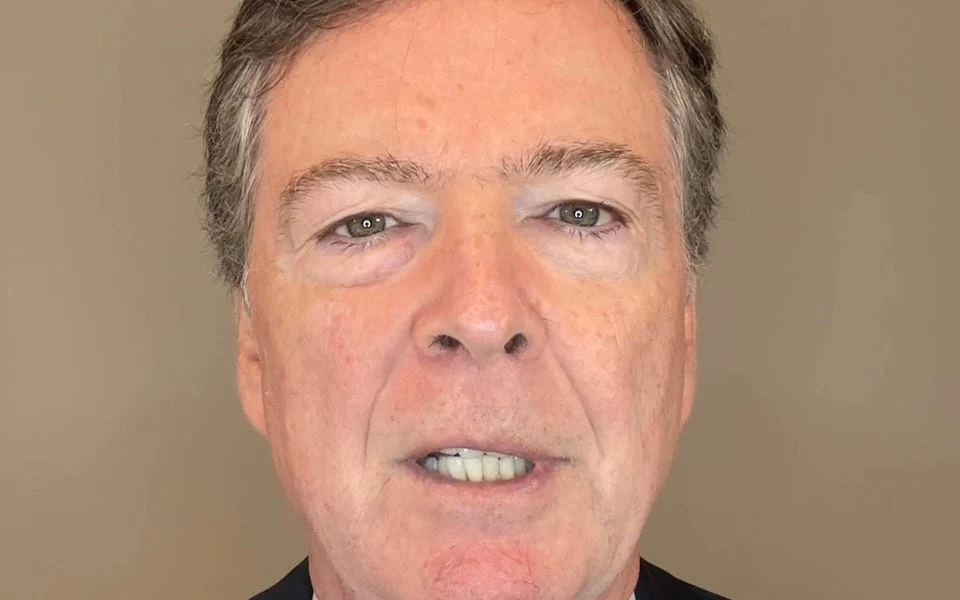 Watch Comey’s response on Substack · 36 seconds
Now the same episode is back, with the calendar at the center of the fight. The defense argues that the ten-year deadline required an indictment, and that the administration cannot preserve the case by filing an information instead. DOJ’s October 23 response disputes that reading. The filings expose a prosecution fighting over whether it arrived in time before the allegations can reach a trial.
For Comey, the history is personal and public. Trump fired him as FBI director in 2017 as the Russia investigation gathered force. The president’s hostility did not end when Comey left government. The new case extends that confrontation into another courtroom, on top of the other proceedings already documented below.
His daughter Maurene has been fighting the same administration over her dismissal as a federal prosecutor. On October 26, she won a ruling that her firing was unlawful. The criminal information against her father had been filed three weeks earlier. Read those two records together: one family, separate cases, and a Justice Department whose decisions keep intersecting with the president’s enemies.
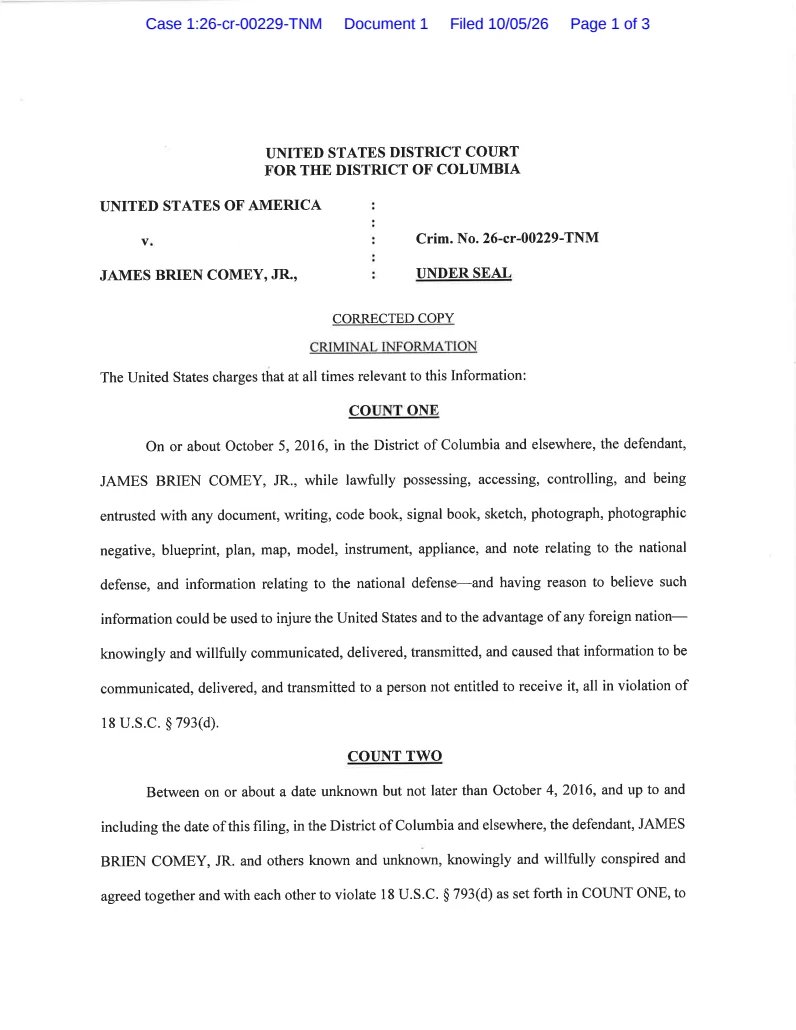
United States v. James Brien Comey Jr. · D.D.C. 1:26-cr-00229-TNM · Filed October 5, 2026.
Read the original document
October 30 · The charging deadline
Comey’s lawyers take the deadline fight to court.
The administration’s third attempt to prosecute James Comey is confronting a question that comes before any trial: did prosecutors run out of time? His lawyers are asking Judge Trevor McFadden to dismiss the case because no grand jury returned an indictment within the ten-year deadline.
The October 30 hearing centers on the government’s use of a criminal information to preserve the case. Comey’s October 27 reply argues that the law required an indictment. The court filings and his original video response show how this latest confrontation developed.
07 · The pressure to prosecute
The people who investigated him faced cases of their own.
Trump fired James Comey as FBI director in 2017. Eight years later, with Trump back in the White House, Comey was indicted over his testimony to Congress. He pleaded not guilty. The prosecutor who brought the case had previously worked as Trump’s personal lawyer.
Lindsey Halligan presented the indictment herself. Other prosecutors had declined to join her because of concerns about the case, PBS reported. Her predecessor, Erik Siebert, had been pushed out amid pressure to charge New York Attorney General Letitia James. The administration had changed the person in charge; a prosecution followed. The reporting on the charging decision ↗︎ · Comey’s plea and response ↗︎
The 2025 indictments of Comey and James were dismissed over Halligan’s unlawful appointment, rather than after trials of the allegations. The government sought to revive them on appeal in September 2026. The dismissals and their basis ↗︎ · September appeal reporting ↗︎
Comey also faced a separate indictment in April 2026, accusing him of threatening Trump. That charge concerned an Instagram post, rather than his congressional testimony. Read the separate charging announcement ↗︎
By then, Comey and James had already had to defend themselves. The dismissal did not end the government’s pursuit of them, and the appeal prolonged it. Trump could lose in court while the people he wanted prosecuted continued to spend their time and money answering the government.
For the earlier confrontations, follow Comey’s dismissal and the New York civil-fraud case brought by James.
08 · Cassidy Hutchinson · Updated October 28, 2026
She testified about January 6.
The grand jury would not indict her.
Cassidy Hutchinson helped expose what happened inside Trump’s White House on January 6. His Justice Department tried to turn that testimony into a criminal case. On October 27, a Washington grand jury declined to indict her, according to reporting by the Associated Press. The grand-jury decision
Republican lawmakers Barry Loudermilk and Jim Jordan had asked prosecutors to pursue her over allegations that she lied to Congress, CNN reported in March. By October 8, prosecutors were presenting evidence to a federal grand jury in Washington. CNN’s account of the referral ↗︎ · The grand-jury reporting ↗︎
The prosecution effort followed a referral from House Republicans and the presentation of evidence to a grand jury earlier in October. It brought the government’s coercive power to bear on a witness whose account had cut through Trump’s version of the attack. Her testimony remains in the record below. The legal pressure on witnesses The documented case
09 · Mark Milley
Milley lost his protection. The threat remained.
Mark Milley had been Trump’s most senior military adviser. In January 2025, Defense Secretary Pete Hegseth withdrew the retired general’s security detail and clearance and sought a review of his conduct that could lead to a reduction in retirement rank.
Hegseth said Milley had undermined the chain of command. The security threat that had justified protecting him had not simply vanished: Republican Senator Tom Cotton said the danger from Iran to people involved in the killing of Qasem Soleimani remained real. PBS reported both the withdrawal and that continuing threat. Read the account and the Pentagon’s position ↗︎
Milley was no longer in a position to frustrate Trump’s orders. He had retired. Yet the administration stripped him of protection against a threat that, according to a senior Republican senator, remained real.
The dispute was personal, but Hegseth could act on it through the Pentagon. The same department responsible for the administration’s military deployments had the power to withdraw a former commander’s guards.
10 · Mark Kelly, Elissa Slotkin and four House Democrats
A video about obeying the law.
A demand that they be put on trial.
The video lasted about a minute and a half. Six Democratic lawmakers with military or intelligence backgrounds reminded service members that they could refuse illegal orders. Trump responded by calling their conduct seditious and invoking the death penalty. He wanted them arrested and tried.
Mark Kelly and Elissa Slotkin had recorded the November 2025 message with Jason Crow, Chrissy Houlahan, Maggie Goodlander and Chris Deluzio. They did not identify a particular order. Their intervention came amid arguments over the administration’s military strikes on boats in the Caribbean. The video and the campaign against them ↗︎
The anger traveled from Trump’s social-media account into government proceedings. Federal prosecutors sought an indictment. On February 10, 2026, a grand jury refused to bring one. The lawmakers learned of the failed attempt through news reports. At their press conference the following day, they were left to ask why prosecutors had tried to turn their speech into a criminal case at all. Their response ↗︎
Kelly faced a second threat. As a retired Navy captain, he was vulnerable to Pentagon action affecting his rank and pension. Pete Hegseth censured him and ordered a review. On February 12, Judge Richard Leon temporarily blocked the punishment, finding that the administration had violated Kelly’s free-speech rights. Hegseth said he would appeal. The injunction and Hegseth’s response ↗︎
A senator could afford lawyers and command a press conference. Retired service members watching the dispute had reason to wonder what speaking out might cost them. Hegseth had made Kelly’s military retirement part of the fight over what he could say as an elected civilian.
11 · Challenging the people who can say no
Lose a ruling. Attack the judge.
Judge James Boasberg ruled against Trump’s deportation plans in March 2025. Trump responded by demanding that he be impeached. Chief Justice John Roberts reminded him that an adverse ruling could be appealed; it was not grounds for impeachment. The demand and Roberts’s response ↗︎
Boasberg had made a ruling the administration could challenge in court. Trump wanted Congress to remove him. The demand made the judge himself a target, rather than leaving government lawyers to contest his decision.
The American Bar Association backed Roberts. A president who loses a ruling has lawyers to argue his appeal. Demanding the judge’s removal challenges the judge’s right to rule against him at all. Read the ABA statement ↗︎
Boasberg was a district judge whose ruling Trump could appeal. The next confrontation would reach the highest court in the country—and justices Trump himself had chosen.
12 · February 20, 2026 · The tariff ruling
Even the justices he chose could become enemies.
Neil Gorsuch and Amy Coney Barrett owed their Supreme Court appointments to Trump. On February 20, 2026, they joined the majority rejecting his use of emergency powers to impose sweeping tariffs. Within hours, he was attacking them in front of the cameras.
The ruling was about the limits of presidential authority under a statute. Trump made it personal. He used “an embarrassment to their families” to describe the decision of the two justices he had nominated. He accused the majority of disloyalty and suggested, without producing evidence, that foreign interests had influenced the court. Read the account of the press conference ↗︎
The vote was 6–3. The court held that the International Emergency Economic Powers Act did not give him the tariff authority he claimed. Gorsuch and Barrett were doing the job their lifetime appointments require: deciding a case in which the president who selected them could lose. Read the Supreme Court’s decision ↗︎
Trump’s answer treated that independence as a betrayal. Having helped put them on the bench, he seemed to expect them to protect his program. When they did not, their families and patriotism became fair game. The public attack could not reverse the judgment. It could tell every judge watching what a ruling against this president would bring.
The economic consequences of the tariffs have their own record here. This confrontation was about whether the man who imposed them would accept a legal limit without trying to discredit the people enforcing it.
13 · Hannah Dugan · Immigration enforcement in the courthouse
The judge became the defendant.
Hannah Dugan’s confrontation with immigration agents began at the Milwaukee courthouse where she worked. A week later, on April 25, 2025, federal agents arrested the judge herself. FBI director Kash Patel publicized the arrest on social media. The reporting from that day ↗︎
Agents had come to arrest Eduardo Flores-Ruiz after a hearing in Dugan’s courtroom. Prosecutors said she sent the agents toward the chief judge’s office and directed Flores-Ruiz and his lawyer through a non-public exit. He was caught outside. Dugan contested the charges, but a jury convicted her of felony obstruction in December 2025. On July 8, 2026, Judge Lynn Adelman imposed a $5,000 fine. The conviction, sentence and prosecution’s account ↗︎
This was not a judge prosecuted for issuing a ruling Trump disliked. The conviction concerned her conduct during an attempted arrest. But the administration also used the case to deliver a wider political warning. In its announcement, Deputy Attorney General Todd Blanche attacked sanctuary jurisdictions and declared that the department would not tolerate local officials putting politics ahead of public safety. Read the administration’s announcement ↗︎
A courthouse is where defendants must appear and witnesses are asked to cooperate. Bringing the deportation campaign through its doors creates a collision with the people responsible for keeping that local system working. Dugan’s case ended with a conviction. The larger fight over immigration enforcement inside courthouses did not end with her.
14 · Jerome Powell · The Federal Reserve
The president wanted lower rates.
Powell received a criminal threat.
On a Sunday evening in January 2026, Jerome Powell released an unusual video. The Federal Reserve chair was not announcing an interest-rate decision. He was telling the country that the Justice Department had served grand-jury subpoenas and threatened a criminal indictment.
The stated issue was his testimony to the Senate about renovations to Federal Reserve buildings. Powell said that explanation was a pretext. The real pressure, he argued, came from the Fed’s refusal to set interest rates according to Trump’s wishes. He had served under presidents of both parties; now he was publicly accusing the administration of trying to intimidate the central bank. Watch and read Powell’s statement ↗︎
The building dispute had been developing for months while Trump demanded rate cuts. Powell had supplied explanations to Congress and asked the Fed’s inspector general to review the renovation project. That did not prevent US Attorney Jeanine Pirro’s office from pursuing a criminal investigation.
On March 13, a federal judge blocked the subpoenas, finding the investigation was an improper attempt to pressure the Fed over rates. On April 24, Pirro announced that she would close the criminal investigation and refer the matter to the inspector general. She left open the possibility of reopening it if the facts warranted. Reuters’ chronology, through the closure ↗︎
The dispute reached far beyond Powell’s office. Interest rates shape mortgages, borrowing costs and jobs. Trump wanted them lower. Powell said the Fed would follow the economic evidence. The official refusing the president now had to defend himself against a criminal investigation—and needed a judge to stop the subpoenas.
15 · Harvard · Research funding as pressure
Harvard said no.
The government went after its research money.
The administration’s demands reached deep into Harvard: admissions, hiring, governance and an audit of the political viewpoints on campus. On April 14, 2025, president Alan Garber refused the proposed agreement. Washington responded by freezing billions in research funding.
Harvard’s wealth made it an easy political target. But a research grant does not simply reward the name above a university gate. It pays for work: experiments, equipment and the people carrying them out. The court record described grants supporting more than a thousand graduate students and postdoctoral researchers, including work on cancer, antibiotics and neurodegenerative disease. Garber’s refusal and the demands ↗︎ · The research described in the judgment ↗︎
The administration invoked antisemitism to justify its actions. In September, Judge Allison Burroughs ruled that the funding cuts unlawfully retaliated against Harvard for rejecting the government’s demands. The ruling restored more than $2.6 billion. The university’s federally backed research, the judge found, had little connection to the discrimination the government said it was addressing.
The money resumed flowing, but the administration appealed. At arguments on October 5, 2026, its lawyer contended that Burroughs lacked authority to order payment and that the dispute belonged in the Court of Federal Claims. Harvard argued that the case concerned retaliation and discrimination, not merely a contract. The appeals panel did not immediately rule. The latest appeal hearing ↗︎
Harvard had the resources to refuse and sue. Researchers still had to live with the uncertainty. That is how a confrontation with a university president reaches a laboratory: work depends on a grant, and the grant becomes a means of demanding obedience. The wider consequences for science and public health reach people who will never set foot on the campus.
16 · Rümeysa Öztürk · A student’s speech
She co-wrote an opinion piece.
Then agents took her off the street.
Rümeysa Öztürk had none of Harvard’s institutional power. She was a Turkish doctoral student at Tufts, studying child development. On March 25, 2025, plainclothes federal agents arrested her in Somerville, Massachusetts. She had co-written a student-newspaper opinion piece about Palestinian rights and the university’s response to the war in Gaza.
Her lawyers argued that she had been detained for that speech. They filed an emergency court petition, but for nearly a day her attorney could not locate her. She had been taken to Louisiana, more than 1,300 miles from her community. It took weeks of litigation to bring the detention before a judge who could order her release. The case history from her legal team ↗︎
Öztürk spent six and a half weeks in detention. In January 2026, an immigration judge terminated the removal proceedings; her attorneys said the government had failed to prove its case. The reporting on that decision ↗︎
There was a later ending that the images of her arrest do not tell. She finished her doctorate in February. In April, her lawyers announced a settlement resolving outstanding federal-court issues and an agreement to seek dismissal of her immigration proceedings. She had returned to Türkiye. She said she was going home on her own timetable, after completing her degree. Her statement and the settlement announcement ↗︎
She left with her doctorate. The government had still taken weeks of her freedom and more than a year of her attention. For other foreign students considering whether to speak about Gaza, the arrest offered a much more immediate warning than any eventual settlement could undo.
17 · International justice
The pressure does not stop at the border.
On October 9, 2026, the administration announced sweeping sanctions against the International Criminal Court. Marco Rubio presented them as a means of preventing the court from proceeding against Americans and US allies. The action extended a campaign against an institution investigating alleged international crimes, including cases involving Israel. Read the sanctions reporting ↗︎
The Treasury’s ICC sanctions program lists the designation and accompanying licenses. Financial restrictions give Washington a way to exert pressure on a court it does not control through appointments or domestic appeals. A sanction can make the court’s work harder even when Washington cannot stop a case in the courtroom. Inspect the Treasury measures ↗︎
The announcement came on the day former ICC judge Navi Pillay won the Nobel Peace Prize. That timing is striking; it does not establish that the award caused the sanctions. The stated confrontation is over the court’s jurisdiction and investigations. Trump also attacked the Nobel decision, returning to his claim that he deserved the prize for ending eight wars.
People seeking accountability for the destruction and deaths in Gaza have an interest in whether those investigations can proceed. They have no comparable power to impose costs on the governments resisting them.
18 · Who stands up—and who bears the cost
A court can stop an order.
It cannot give people back the months.
Some of the firms Trump targeted fought back. Federal district judges blocked the orders against Perkins Coie, WilmerHale, Jenner & Block and Susman Godfrey. The administration pursued appeals; the firms recorded a joint appellate hearing on May 14, 2026. The firms’ account cited here runs through that hearing. Read the firms’ dated statements ↗︎
These were powerful firms, with the money and legal expertise to challenge a president. Harvard had that strength too. Kelly had a Senate office and a public platform. Each still needed a court to intervene. Öztürk had to fight from detention, far from the university where she had been studying.
Others watching these disputes face a choice before any order names them. Should they take the client, contradict the president or speak publicly about what they saw inside his administration? The prospect of having to defend themselves against the government gives them a reason to stay quiet.
Omar’s search still demands answers. In the cases of Krebs, Taylor and the law firms, the president has already put his grievances into official documents and ordered others to act on them.
An agent can lose a career before a lawsuit is heard. A student can lose weeks of freedom before winning release. A laboratory can lose months of work while its university fights for a grant. The eventual ruling matters. So does what the government can take from someone before that ruling arrives. That is the calculation the next critic is being asked to make.
Reporting reviewed: October 12, 2026; Hutchinson section checked October 21, 2026; Hearn section added October 22, 2026; Floris and Benavides charges added and public-service loan appeal status updated October 23, 2026. Individual legal checkpoints are dated in the text. Archival videos retain their original dates; source links lead to the underlying orders, reporting and existing case records.