The 47 Files · Corruption & conflicts of interest
The Trump
Family Business.
Follow the Trump family’s business interests, access to power and the use of presidential clemency. Start here, then explore the evidence in Corruption Metrics.
Begin with the pardon ↓︎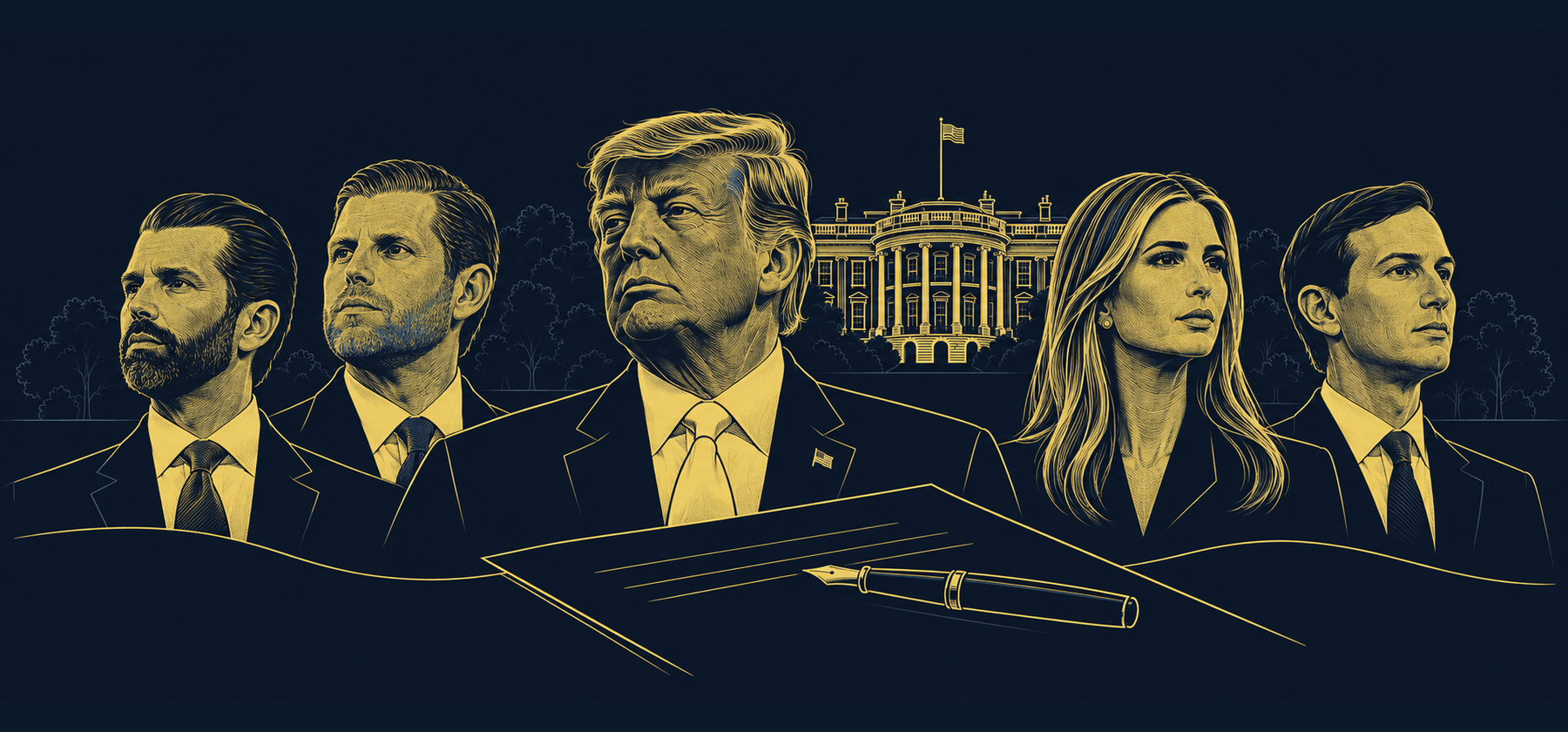
01 · A pardon inside the family
The president’s signature reached his own family.
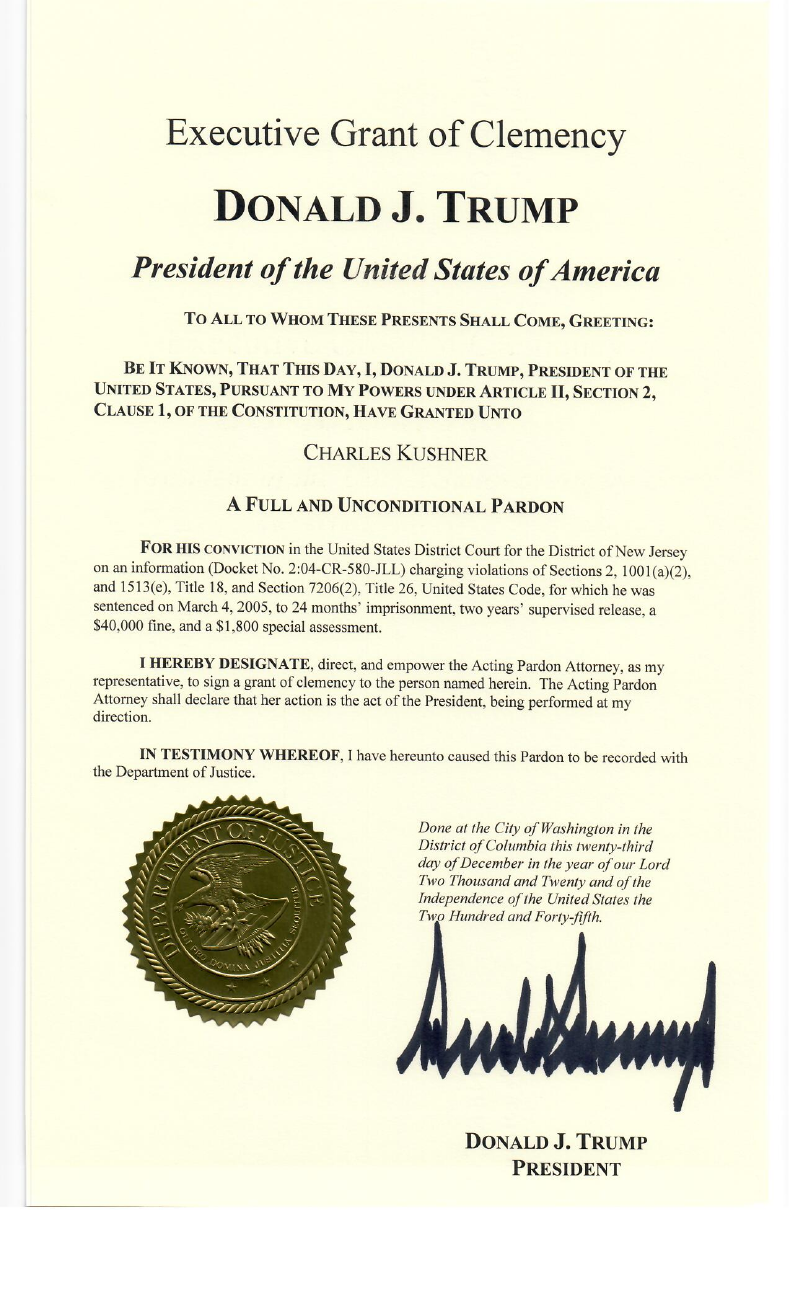
On December 23, 2020, with less than a month left in his first term, Donald Trump pardoned Charles Kushner. Kushner had served time for tax crimes, witness retaliation and a false statement to the Federal Election Commission. He was also the father of Jared Kushner, the president’s son-in-law and senior adviser.
The family relationship made a distant constitutional power suddenly very concrete. A president could intervene in the punishment of a relative. Here, he did. The clemency document ↗︎ names the conviction, sets out the sentence and bears Trump’s signature.
The underlying conduct was ugly. The Justice Department’s sentencing account ↗︎ describes Kushner arranging for his brother-in-law to be secretly filmed with a prostitute, then sending the recording to his sister, who was cooperating with investigators. He pleaded guilty and was sentenced in 2005 to two years in prison.
The White House’s explanation ↗︎ emphasized rehabilitation and philanthropy. The decision placed the president’s judgment above the punishment imposed by the courts, for a man whose son worked down the corridor in the White House.
The story did not end with the pardon. In May 2025, the Senate confirmed Charles Kushner as ambassador to France and Monaco ↗︎. A man whose criminal case once ended in prison had received both presidential forgiveness and a prestigious diplomatic appointment.
The power to pardon belongs to the presidency. The benefit in this case went to the president’s extended family. Elsewhere in these files, the connection runs through a political donation, a government contract or a foreign investment. The people change; the proximity to power keeps recurring.
The records behind those decisions are collected in Corruption Metrics. This investigation follows the family through them, and the people on the other side: investors still trying to recover their savings, taxpayers funding contracts and residents facing a development they did not ask for.
Open Charles Kushner’s pardon
The original instrument, dated December 23, 2020. The complete PDF is available by selecting the page.
The public verdict · Fox News poll · October 9–12, 2026
about corruption in government
Corruption is worrying almost everyone.
Nearly nine in ten registered voters are concerned about corruption in government. And the concern runs deep inside Trump’s own coalition: 85% of Republicans and 88% of MAGA Republicans, alongside 93% of Democrats, told Fox News they were extremely or very concerned.
Explore the full poll Follow the evidence in Corruption Metrics
October 26 · New reporting
The campaign trail has a cash register.
Winning office is one destination for campaign money. The president’s businesses are another. The Washington Post’s new analysis follows Republican political spending at Trump properties through September 2026.
Its published property table records $1,423,926.50 at Mar-a-Lago and $1,098,193.26 at Trump National Doral during the second-term period. The party’s effort to retain power also sends revenue into its leader’s commercial empire.
Follow the spending record alongside the president’s newly documented oil-stock holdings. Both belong in the account of how public office and private interests overlap.
02 · Who is connected to what?
The family name opens more than one door.
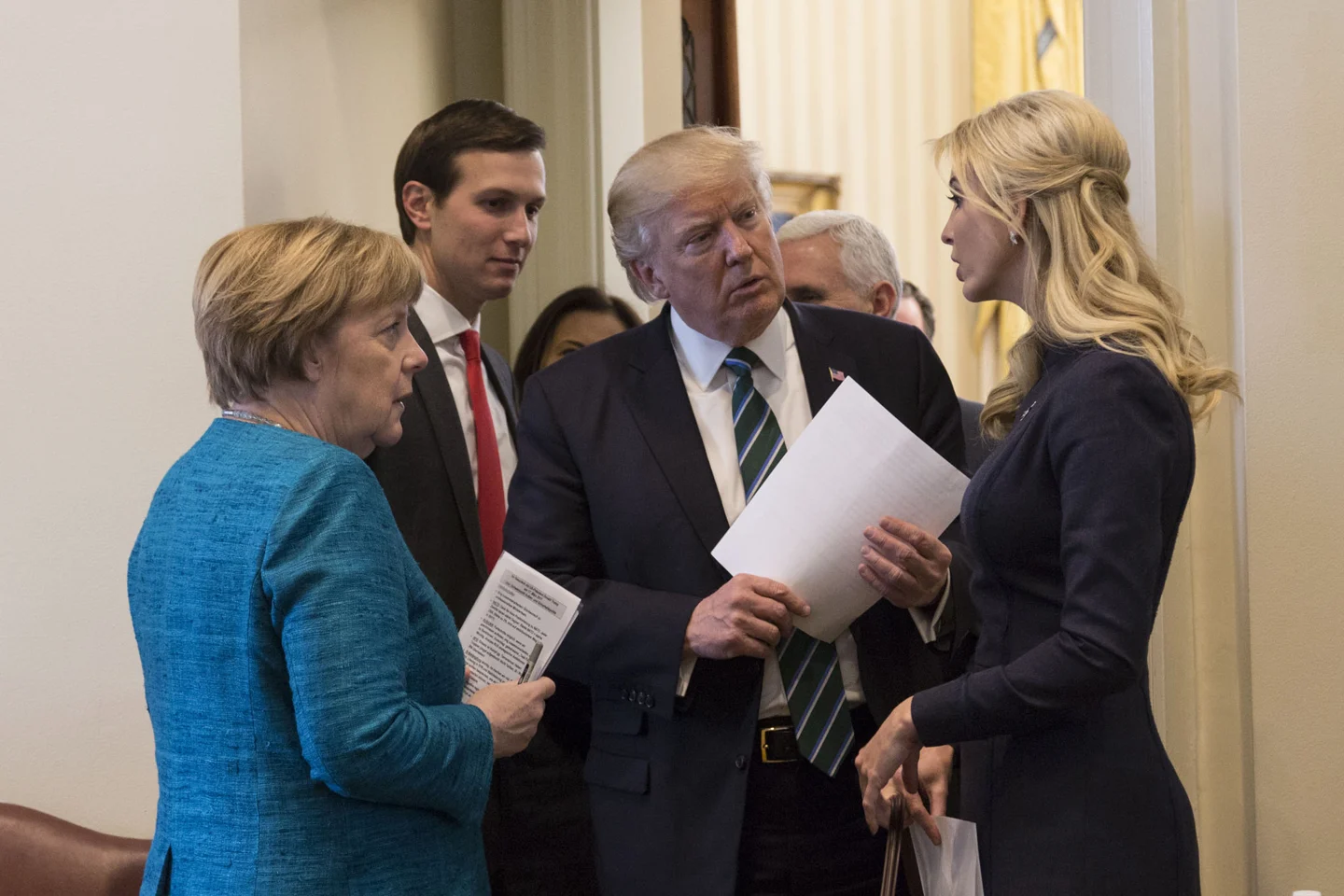
During Trump’s first term, Jared Kushner and Ivanka Trump worked in the White House. Donald Trump Jr. and Eric Trump were identified with the management of the family businesses. That separation was part of the public explanation of how a president could remain connected to a commercial empire while exercising public power.
It was never the end of the question. A business can be managed by a president’s children and still depend on his name, his prominence and customers with interests before his administration. Moving a decision from father to son does not make the family relationship disappear. The business still carries the president’s name, and its partners still have interests in Washington.
The second term adds other relationships. Trump Jr.’s investment work takes the story into companies seeking federal support. Eric Trump’s overseas partnerships put private development alongside trade decisions. Jared Kushner’s investment firm raises a different question: what happens when someone managing foreign-backed funds also participates in American diplomacy?
The family’s commercial reach is broad enough to fill several investigations. The Presidency for Sale follows the products and crypto ventures; Understanding Trump traces the biography behind his approach to power. Here, the story follows the relatives, their business partners and the public decisions that touch their interests.
Donald Trump
Presidential decisions and continuing financial interests.
Read the record →︎Donald Trump Jr.
1789 Capital and investments in government contractors.
Read the record →︎Eric Trump
The family company’s overseas partners and development fees.
Read the record →︎Jared Kushner
Foreign-funded investment management alongside diplomacy.
Read the record →︎Ivanka Trump
The resort proposals promoted with her husband in Albania.
Read the record →︎Charles Kushner
A federal pardon followed by a diplomatic appointment.
Read the record →︎Melania Trump
Branded ventures and the litigation involving token operators.
Read the record →︎03 · The route to a pardon
A donor’s son went from sentencing to clemency in twelve days.
Paul Walczak had been sentenced to prison only twelve days earlier when Trump pardoned him. In the weeks before that intervention, Walczak’s mother had given $1 million to a pro-Trump political committee.
On April 3, 2025, the Federal Election Commission’s records show a $1 million contribution from Elizabeth Fago to MAGA Inc., a pro-Trump super PAC. ABC News identified Fago as Walczak’s mother ↗︎. Eight days later, Walczak was sentenced to 18 months in prison for employment-tax crimes. On April 23, Trump pardoned him.
The Justice Department’s account ↗︎ describes the consequences in dollars as well as months: restitution of $4,381,265.76. The sentence also required him to repay the money.
Then the president intervened. The pardon ↗︎ arrived twenty days after the contribution. The public record does not establish an agreement to trade the donation for clemency. It does establish how quickly a major donor’s son obtained presidential relief.
Who carried his request to the White House, and what persuaded Trump to act? Those questions go to the workings of a presidency in which a personal intervention can undo years of prosecution in an instant.
A May 2026 congressional request sought further clemency records. The Walczak file follows that request, the donation, the sentence and the pardon. The route his application took matters to anyone asking whether presidential mercy is equally available to people without a seven-figure political check.
Clemency can correct an injustice. But when a donor’s family receives it at such speed, the White House owes the public more than a signature. It owes an account of how the decision was made.
04 · The people left waiting
The pardon makes news. The losses remain.
For the investors in GPB Capital, the clemency story began with money they hoped would provide an income. David Gentile’s funds had raised about $1.6 billion. Prosecutors said more than 10,000 investors were defrauded. Money supplied by investors had helped create the appearance of investment returns. The conviction offered a measure of accountability. Then Trump intervened.
A jury convicted David Gentile, and in May 2025 he received a seven-year prison sentence. On November 26, Trump signed a commutation reducing his sentence to time served and removing further financial and other conditions. The signed warrant records the intervention plainly.
The effect reached beyond prison. Prosecutors had sought a $15,581,317 forfeiture money judgment, based on their calculation of Gentile’s personal proceeds from the fraud. After the commutation, both sides agreed that the pending request could no longer proceed. The court terminated it in December.
By June 2026, the receiver reported $400 million in cumulative investor disbursements. Recovery continued through the civil receivership while Gentile’s prison sentence and the pending forfeiture request had come to an end.
Then came allegations about access. At a July 2026 hearing, Senator Richard Blumenthal raised reports of a claimed $2.5 million payment for clemency and an inquiry allegedly stopped. Deputy Attorney General Todd Blanche declined to discuss investigative details and warned against treating press reports as established facts. Senators subsequently requested an inspector-general investigation.
The alleged payment remains unresolved. The commutation’s consequences are already in the court record: Gentile was freed from the remainder of his sentence and the forfeiture request ended.
For investors, there was no equivalent presidential shortcut. Their recovery still depended on the separate process of finding, realizing and distributing assets.
Trevor Milton, the founder of electric-truck company Nikola, received a pardon for his fraud conviction in March 2025. The Milton file records $2,594,600 in political contributions from Milton and his wife to Trump 47 and a pro-Trump super PAC.
Before the pardon, prosecutors had requested roughly $676 million plus interest in criminal restitution. That was the amount sought, rather than a verified final award. Investors’ efforts to recover money continued in other courts.
But the pardon was not the end of the civil cases. Separate proceedings continued over losses, liability and the company’s award against Milton. Courts rejected arguments that the pardon wiped away independent civil findings or prevented particular claims from proceeding. The people trying to recover money still had legal work to do.
That is why clemency deserves a central place in this story. The announcement is about the person forgiven. Its consequences reach people who never asked the president for anything: investors, taxpayers and others pursuing recovery. Following their position after the cameras move on tells us more than treating the pardon as the final scene.
05 · The sons and the public customer
The family’s business partners have business with Washington.
Move from pardons to contracts and the question changes. A president is no longer deciding whether to forgive a conviction. His administration is deciding where public money goes. Donald Trump Jr.’s investment work means that some of the companies on the receiving end also have a connection to his family.
Trump Jr. is a partner at 1789 Capital ↗︎. The firm invested in Anduril’s June 2025 financing round. Anduril’s government-contracting business predates that investment: its federal work dates back to 2019.
On October 6, 2026, Trump appeared at Sparrows Point in Maryland for an announcement about Anduril’s proposed Arsenal-2 submarine-component facility. The company’s announcement ↗︎ put $3.7 billion of private investment beside a Navy contract worth up to $2.9 billion, with payments linked to production.
The president was promoting a project involving a company backed by an investment firm where his son is a partner. Taxpayers would finance the Navy’s side of the arrangement; 1789 Capital held a private stake in the company delivering it.
The Pentagon says political connections and investors do not determine awards. A family spokesperson says the sons do not seek to influence procurement. The public should be able to test those assurances against the selection process, communications and signed terms. A genuine need for submarines does not answer a separate question about how a contractor was chosen.
The Vulcan Elements case follows another company connected to 1789 Capital and a $620 million Pentagon conditional loan commitment. The file traces the investment, the federal financing decision and the denials of improper influence.
Eric Trump’s overseas business brings a different part of government into view. Trump’s annual disclosure records a $2 million development fee in 2025 to Trump Acquisition LLC, connected to Base Co. LTD. In August 2026, the Trump Organization announced a golf project with Base in Hanam, South Korea ↗︎, with statements from Eric Trump and Base’s chairman.
Meanwhile, a Base affiliate, Korea Aluminium, had a trade dispute before the Commerce Department. That puts a company group with a financial relationship to the president’s business alongside an official process run by his administration. Base says the golf transaction and trade dispute are unrelated; the White House denies a conflict.
Senators asked for the agreement, payment timing and relevant communications. The Base case follows their effort to establish whether the private transaction and the government’s trade decisions crossed.
The same administration can be a customer, a lender or a regulator to companies doing business with the president’s family. In each relationship, officials are supposed to serve the public. The family’s financial interests make independent scrutiny essential.
06 · Jared Kushner’s two worlds
The Saudi advisers said no. The crown prince’s board said yes.
Jared Kushner’s route to a $2 billion Saudi commitment ran through the White House. Before joining his father-in-law’s administration, he had run the family property business. He entered private equity with minimal investment experience in that field. Yet within six months of leaving government, his new firm had secured the backing of Saudi Arabia’s sovereign wealth fund.
The fund’s own advisers had objected. Documents obtained by The New York Times ↗︎ showed concerns about Affinity Partners’ inexperience, its operations and its fees. The board led by Crown Prince Mohammed bin Salman overruled the panel and approved the investment.
Kushner had previously served on the board and investment committees of his brother’s venture-capital firm, Thrive. But his new private-equity business lacked an established record. The House Oversight Committee’s June 2022 letter ↗︎ recorded both that earlier involvement and the Saudi advisers’ concerns about his limited private-equity experience.
What he did bring was a relationship with the crown prince and a place inside Trump’s family. His White House title had gone; his access to his father-in-law had not. Affinity’s own investor presentation highlighted his diplomatic work, including his part in resolving the Gulf dispute with Qatar, according to the Senate Finance Committee ↗︎. Government service was part of the business pitch.
Saudi officials’ written explanation, reported by the Times, described the investment as a strategic relationship with Affinity and Kushner himself. That makes the choice of manager central to the story. A new firm received extraordinary backing despite the objections of the people assigned to assess it. Its founder was also the son-in-law of a former president who would return to office.
The $2 billion was investment capital, not Kushner’s personal income. The fees were revenue for his firm: a September 2024 Senate Finance letter ↗︎, drawing on a July briefing, reported $157.5 million in Affinity receipts, including $87 million from the Saudi fund. Its March 2026 regulatory filing ↗︎ reported roughly $6.16 billion in assets managed for clients and identified Kushner as owning at least 75 percent of the adviser.
Trump’s return brought Kushner back into diplomacy while that business continued. The White House named him in its November 2025 account of Ukraine peace talks ↗︎ and included him in bodies associated with its January 2026 Gaza plan ↗︎. Access to Trump was once again access to the sitting president.
Affinity says Kushner was volunteering without an official position, that it complied with applicable laws and that it would not accept additional capital while he volunteered. Existing investors, however, remained part of the business. A foreign government could be funding the firm of a man taking part in American diplomacy at his father-in-law’s invitation.
That is the conflict the public has to live with. American foreign policy should answer to the country’s interests, not depend on private assurances from the president’s family about where business ends and diplomacy begins. The Affinity and diplomacy record follows the official assignments and financial disclosures; the Saudi investment file follows the money and the decision to commit it.
07 · Ivanka, Jared and the people on the ground
A luxury resort looks different from the other side of the fence.
For a developer, the attraction of Albania’s coast is easy to describe: land, sea and the prospect of a luxury destination. For people who live there, the question can be more immediate. Will they still be able to reach the beach? Who owns the ground on which the project is being built?
Jared Kushner and Ivanka Trump have promoted resort development in Albania. At Zvërnec, beside a protected wetland, residents told Reuters that land they claimed had been sold to developers without their agreement or compensation. Some produced deeds and tax records. Their lawyer described a ruling in their favor that remained under appeal.
Reuters’ field reporting ↗︎ could not settle the ownership question and found no evidence that Kushner had wrongfully taken the land. A fence restricting access to the beach had been removed by the time of its June report.
The government supports the investment. Prime Minister Edi Rama has defended the project as lawful and said habitats would be protected. Environmental advocates and residents have raised concerns about development, wildlife and coastal access. A separate proposal would develop Sazan Island.
The family connection makes these decisions internationally significant, but the residents’ concerns would matter whoever the developer was. Public land decisions and environmental safeguards should be explainable to the people whose surroundings are changing. They should not have to compete with the political importance of an investor’s surname to have their claims heard.
The Albania record follows the land dispute, official responses and later reporting about the seller. It identifies what prosecutors alleged against that seller and makes clear that the reviewed files did not accuse Kushner or the project investors of wrongdoing. It also records the developer’s position that the purchases were lawful.
For the residents, the story is about a beach, a boundary and whether their deeds will be honored. They are confronting a development promoted by the American president’s daughter and son-in-law and supported by their own government. Their claims deserve a hearing that carries as much weight as the promises made by powerful investors.
08 · Football’s governing body becomes a tenant
A grand opening. A largely empty office.
Eric Trump welcomed FIFA to Trump Tower with a trophy on display and a celebration of the family building. Football’s governing body was opening a New York office ahead of the World Cup. The Trump Organization’s announcement presented it as another proud moment for the business. The president’s family had acquired a prominent new customer.
What followed was quieter. The New York Times reports a lease worth roughly $4 million over more than seven years for a suite that is largely unused. FIFA says it pays market rent and uses the space for meetings and events. The reporting and FIFA’s response leave a pointed question: why choose the president’s family as your landlord?
The rental commitment is business for the family, whether or not anyone is at a desk. It gives this story a straightforward financial relationship to examine, beyond the photographs of Trump with FIFA president Gianni Infantino. The roughly $4 million is the reported value of the lease, not a verified total already paid.
FIFA’s own opening announcement thanked Eric and President Trump and described the office as part of its American expansion. For the public, the question is whose interests such closeness serves. An organization preparing a tournament in the United States had chosen to do business with the family of the man running its government.
Follow the lease in Corruption Metrics. For the wider commercial operation, Trump’s Ventures follows the property business; this is one customer relationship within it.
09 · Access beyond the family
The ambassador was asked to go. The questions remain.
At Katie Zacharia’s first White House briefing on October 13, 2026, the new press secretary announced the departure of another Trump appointee: the administration had asked Kimberly Guilfoyle to resign as ambassador to Greece. Guilfoyle subsequently announced her resignation and denied wrongdoing. Read the AP account.
Guilfoyle, Donald Trump Jr.’s former fiancée, had reached a diplomatic post through a political world in which she was already well connected. Now her use of those connections was under scrutiny. CNN reported allegations involving money sought for access, gifts and a lobbyist’s attendance at official meetings. Her lawyers rejected the allegations and said she had complied with gift and reporting rules. Read the reporting and response.
An ambassador represents the United States. The allegations raise a different question: was proximity to the president being offered as a private asset? Guilfoyle rejects that account. Her departure closes her tenure, but leaves the dispute over her conduct unresolved.
The existing Guilfoyle case follows the disputed donor-payment request and now records her departure. Her cast entry covers her role; Zacharia’s entry records the announcement from the podium.
10 · Into the evidence
The important question is what power did for whom.
Charles Kushner received a pardon and later an ambassadorship. A donor’s son received clemency shortly after sentencing. Investors in fraud cases were left pursuing recovery through other legal routes. The president’s sons have commercial relationships involving businesses with interests before his government. His son-in-law has combined investment management with diplomacy. These are different stories, but following them together reveals how many ways private relationships can intersect with public power.
The demand here is for government that can account for its decisions. A president’s customers should not enjoy an unexplained advantage over other citizens. Family investment interests should not be hidden behind announcements of public spending. Clemency should be open to scrutiny of who sought it, who advocated for it and what happened to the people harmed by the underlying crime.
Corruption Metrics brings the decisions into one place: the pardon warrants, donation records, court orders, financial disclosures and official responses. The files follow what happened before an announcement and what happened afterwards, when victims were still seeking repayment or a business deal was moving toward approval.
Obtaining those records depends on institutions willing and able to ask awkward questions. The Loyalty Test examines the removal of inspectors general. War on the Free Press follows pressure on independent reporting. Those investigations help explain why the ability to scrutinize the family business is itself a political issue.
The people with the least access to the president often have the most reason to want an answer: an investor awaiting repayment, a resident disputing a development, a taxpayer financing a contract. Their interests should carry weight without a family connection or a political donation. That is the public test running through these files. The records below are where to pursue it.
About this investigation
The story continues in the records.
The FIFA and Guilfoyle records were updated on October 13, 2026. This investigation draws on Corruption Metrics, with links to the underlying documents, reporting and responses. Each case carries its own review date. The header is an editorial illustration; photographs and publisher videos retain their original dates and credits.