Children held beyond 72 hours
Rio Grande Valley · June 2019 inspection snapshot
826 of 2,669 children · 31%The bar shows the share in this inspection snapshot, not a nationwide rate.
Inspector general · figures and context ↗︎The 47 Files · Immigration & the border
Trump made immigration a test of strength. Once in office, that promise became instructions for border agents, prosecutors and immigration officers, with consequences that reached deep into family life. Follow the record from entry bans and family separation to removal fights, and the courts asked to decide where presidential power ends.
Start the story ↓October 30 ruling · Venezuelans
Hundreds of thousands of Venezuelans could regain Temporary Protected Status on November 6 after the Ninth Circuit refused to stay a ruling against the administration. The district court found that Kristi Noem exceeded her authority by undoing an extension and ending the designation.
A Supreme Court stay expires November 6; without further intervention, the protections would resume while the litigation continues. UCLA’s legal team describes the toll of the intervening period: detention, deportation and families separated from their American children.
October 30 · The business of deportation
The companies supplying detention beds, surveillance systems and deportation flights also have a stake in who writes the next federal budget. The Emancipator has traced more than $12 million in political spending linked to CoreCivic, GEO Group, Palantir, NANA and CSI Aviation.
The investigation follows company-linked committees, executives and political organizations through campaign and tax disclosures. It puts the money behind immigration enforcement beside the money seeking influence over the people who fund it.
October 28 complaint · Citizenship and the vote
OCA and Common Cause are challenging a federal initiative that they say treats naturalized Americans as suspect voters. Their October 28 complaint alleges that DHS and USCIS use outdated information and faulty methods to investigate people who have already become citizens.
The lawsuit asks the court to stop the program and the pressure it places on election officials to withhold ballots. Its allegations sit beside the broader federal demands for voter records and California’s fight over a disputed citizenship list.
October 25 · New reporting
Judge Karen Donoso Stevens says superiors pressed her to reverse rulings before she lost her job, the Washington Post reports.
An earlier sworn statement places her removal from the detained docket in January. Retired immigration judge Lawrence Burman said Donoso-Stevens and Raphael Choi were replaced mid-morning by newly appointed judges. His February 14 affidavit describes a bench increasingly worried that decisions against the government could cost judges their careers.
October 23 reporting · Big Bend
Landowners and local businesses have joined the fight over border construction in Texas’s Big Bend region. A judge has paused the work; the administration has asked the Supreme Court to let it proceed.
In an AP interview published October 23, border chief Rodney Scott defended the project despite the opposition. The national wall program has $46 billion behind it. Big Bend now faces a fight over what Washington can build through a landscape its residents are trying to protect.
01 · From speech to state power
Trump built immigration into a story about danger: outsiders threatening the country, and a leader promising to drive them out.
The June 2015 campaign launch linked Mexican immigration to crime. A proposal to exclude Muslims followed that December. These were not passing remarks at the edge of the campaign. They put the identification and exclusion of particular groups at the center of its appeal.
Once Trump took office, the language acquired the force of government. The January 2017 travel order restricted entry and suspended refugee admissions. In April 2018, Jeff Sessions ordered “zero-tolerance” prosecutions for illegal entry. The story moves from what was said at a lectern to what agencies were told to do.
Announcing his candidacy at Trump Tower, Trump associated people arriving from Mexico with drugs, crime and rape, while saying some were good people. He also advocated a border wall.
Read the source ↗︎Full record ↓Executive Order 13769 imposed entry restrictions on nationals of specified countries and suspended the refugee admissions program. The administration presented it as a national-security measure; it triggered immediate legal challenges and disruption for travelers.
Read the source ↗︎Full record ↓Attorney General Jeff Sessions directed southwest-border prosecutors to adopt zero tolerance for improper-entry offenses referred for prosecution. Taking parents into criminal custody separated families when children entered a different federal care system.
Read the source ↗︎Full record ↓The political promise was toughness. The test is what that toughness did to people who encountered the system.
02 · The human consequence
A parent and a child can be separated in minutes. Identifying them, finding them and repairing the damage can take years.
Watchdogs found incomplete family-separation totals, inadequate planning and warnings that had gone unheeded. A court ordered identification and reunification in June 2018. Failures to track families properly made the task of bringing them back together harder.
The custody figures make the consequences concrete. The Rio Grande Valley inspection reported in July 2019 recorded 826 of 2,669 children held beyond 72 hours. Those are children in an inspection snapshot—not an abstract border-pressure statistic.
Rio Grande Valley · June 2019 inspection snapshot
826 of 2,669 children · 31%The bar shows the share in this inspection snapshot, not a nationwide rate.
Inspector general · figures and context ↗︎The aftermath carried on into the next Trump term. A family-separation settlement was approved in December 2023. In June 2025, the court found breaches and ordered legal services restored. The chapter did not close simply because the administration changed—or because the policy dropped out of the headlines.
HHS identified 2,737 separated children within the court-defined group in ORR care on June 26, 2018. Officials estimated thousands more had previously entered and left care. Missing cross-agency tracking made the full number difficult to establish.
Read the source ↗︎Full record ↓The review found senior HHS officials did not act on repeated staff warnings and that established interagency channels were not used to notify HHS before zero tolerance. Inadequate planning and tracking hindered care and reunification.
Read the source ↗︎Full record ↓The district court granted the families’ renewed enforcement motion and ordered the government to reinstate its Acacia task order. The ruling found breaches involving required legal services, individualized consultations and independent assistance with parole and work-authorization applications.
Read the source ↗︎Full record ↓03 · A wider reach
The January 2025 orders sought an enforcement reset. What followed tested how far the executive could reach—and how much opportunity people would have to challenge it.
The program joined border restrictions to a refugee suspension and a broader removal drive. The Alien Enemies Act disputes brought the right to notice and a hearing into focus. In April 2025, the Supreme Court said people facing removal under that law needed notice and a chance to challenge it through habeas proceedings. Further litigation followed.
Kilmar Abrego Garcia’s case made the consequences of a wrongful removal unusually visible. The Supreme Court preserved the requirement to facilitate his release from Salvadoran custody. The administration’s portrayal of him also became part of the story, including Trump’s insistence that added “MS-13” labels in an image were literal tattoos.
The reach extended into information held by government. The September 2026 IRS–ICE appeal concerned the use of tax information in enforcement. The D.C. Circuit’s decision kept limits in place. The question was no longer just who was stopped at a border: it was what records could be used against someone inside the country.
In Trump v. J. G. G., the Court vacated the Washington district court’s restraints and held that challenges belonged in habeas proceedings in the district of confinement. It also required notice and a genuine opportunity to seek judicial relief before removal.
Read the source ↗︎Full record ↓The Court recorded the government’s acknowledgment that removing Kilmar Abrego Garcia to El Salvador violated a withholding order. It upheld the requirement to facilitate his release and handle his case as if he had not been improperly removed.
Read the source ↗︎Full record ↓The court upheld preliminary restrictions on the IRS disclosure procedure after 47,289 records had been shared with ICE. It concluded the plaintiffs were likely to succeed on the merits.
Read the source ↗︎Full record ↓Inspect the tattoo-image dispute ↓ · The later Supreme Court intervention ↓
Afghans detained in the United States could be sent back to a country ruled by the Taliban. Court filings reviewed by AP describe flights expected Monday, November 2, from Louisiana to Pakistan, followed by onward transport to Afghanistan.
An ICE declaration filed in Virginia on October 30, 2026 described the onward journey; a separate Oklahoma filing had disclosed plans earlier in the week. The route through Pakistan is central to the legal fight. The destination at the end of it is Afghanistan.
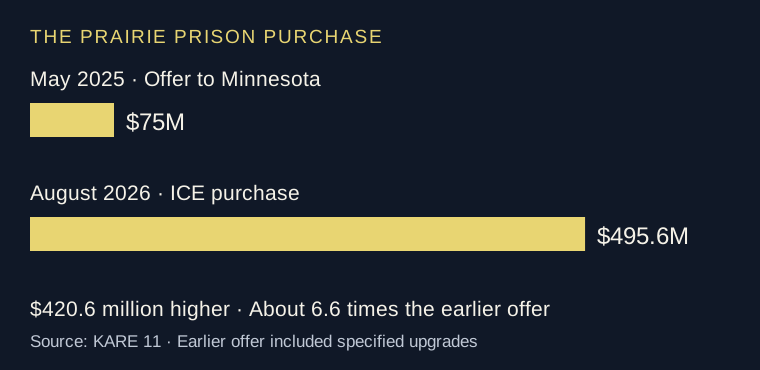
The detention expansion has produced a remarkable property deal in Appleton, Minnesota. KARE 11 reports that CoreCivic offered the closed Prairie Correctional Facility to the state for $75 million in May 2025, with specified upgrades included. In August 2026, ICE paid about $495.6 million for it.
That is roughly $420.6 million above the earlier offer—more than six times the price. Minnesota’s corrections commissioner had passed on the property because of concerns about staffing and its remote location. The federal purchase turned an idle prison into a major payday for its owner.
The earlier offer included specified upgrades. The difference between that offer and the federal purchase puts the administration’s detention spending under fresh scrutiny.
04 · The enforcement encounter
In Minneapolis, the enforcement story became a struggle over deaths, official accounts and who could investigate them.
Renée Good was killed by an ICE officer on January 7, 2026. Alex Pretti was killed during a CBP encounter on January 24. The agencies, events and evidence need to be examined separately. Together, they put the use of force at the center of scrutiny of the administration’s immigration operations.
The effort to establish what happened became a story of its own. Minnesota authorities sued federal agencies for evidence in March. In July, prosecutors announced that federal evidence had been supplied after months of dispute. Access to that material was a necessary step in the investigations; it was not a final disposition of them.
Renée Good, a 37-year-old US citizen and mother of three, was shot and killed by an Immigration and Customs Enforcement officer while in her vehicle. Her death brought scrutiny of federal enforcement tactics and the official account.
Read the source ↗︎Full record ↓Alex Pretti, a 37-year-old US citizen and intensive-care nurse, was killed during an encounter with federal immigration officers. A CBP notice to Congress said two federal officers fired shots.
Read the source ↗︎Full record ↓Minnesota prosecutors announced that federal authorities had supplied evidence sought for the Good and Pretti investigations after months of dispute.
Read the source ↗︎Full record ↓Read the evidence-access lawsuit and its context ↓
Accountability requires more than an official description of an encounter. It requires the records that let that description be tested.
05 · Claims and measurement
Border encounters, removals and expulsions measure different things. Treating them as interchangeable turns a statistical claim into a political shortcut.
Encounters count enforcement events and can include repeat encounters with one person. Removals record departures under immigration enforcement procedures. Title 42 expulsions were a separate public-health measure.
None is a complete count of people who crossed undetected. Before accepting a “zero crossings” claim, ask which period, geography and measurement it describes.
ICE definitions & statistics ↗︎Recorded removals, fiscal years ending September 30.
Shared zero baseline and a 300,000 scale. These are selected annual benchmarks, not a continuous trend or totals for the presidencies. COVID, resources and enforcement priorities affected them.
Immigration and Customs Enforcement conducts interior enforcement, detention and removal operations.
Customs and Border Protection includes Border Patrol and officers at ports of entry. It is a separate agency within DHS.
The Office of Refugee Resettlement cares for unaccompanied children referred into its custody; it is not the agency that arrests parents.
The complete researched record
The story above connects the turning points. This searchable record retains the dates, sources, court decisions and agency findings behind them, including the entries not singled out in the chapters.
The court upheld preliminary restrictions on the IRS disclosure procedure after 47,289 records had been shared with ICE. It concluded the plaintiffs were likely to succeed on the merits.
The opinion enforces statutory safeguards for taxpayer information and leaves the interim restrictions in place while the legal challenge continues.
Read the source ↗︎Minnesota prosecutors announced that federal authorities had supplied evidence sought for the Good and Pretti investigations after months of dispute.
The evidence transfer gave Minnesota investigators material they had sought for months. The linked interview discusses what that material could reveal; the record here does not include a final disposition.
Read the source ↗︎AP · evidence-transfer reporting ↗︎PBS Almanac · Good and Pretti evidence interview ↗︎Hennepin County, Minnesota and the BCA sued DOJ and DHS for evidence concerning Good, Pretti and the nonfatal shooting of Julio Sosa-Celis. The county announced the Washington, DC case as 26-CV-01007.
The plaintiffs alleged improper withholding. Their announcement is a party account, not a judicial finding. This evidence-access lawsuit is separate from a prosecution of the shootings; the July transfer is recorded separately.
Read the source ↗︎AP · lawsuit and federal response ↗︎Alex Pretti, a 37-year-old US citizen and intensive-care nurse, was killed during an encounter with federal immigration officers. A CBP notice to Congress said two federal officers fired shots.
This case concerns Customs and Border Protection, not simply a second ICE shooting. Early administration characterizations were disputed by witnesses and video reporting. DOJ announced a civil-rights investigation; neither the announcement nor this entry establishes the final legal outcome.
Read the source ↗︎County prosecutor · state investigation, January 24 ↗︎PBS · reporting and video, January 27 ↗︎Renée Good, a 37-year-old US citizen and mother of three, was shot and killed by an Immigration and Customs Enforcement officer while in her vehicle. Her death brought scrutiny of federal enforcement tactics and the official account.
DHS defended the officer’s actions as self-defense, alleging that Good used her vehicle as a weapon. Those assertions are disputed and are not presented here as court findings. Later evidence-sharing developments appear separately below.
Read the source ↗︎AP · investigation dispute and DHS response, March 24 ↗︎PBS · reporting and video, January 26 ↗︎The district court granted the families’ renewed enforcement motion and ordered the government to reinstate its Acacia task order. The ruling found breaches involving required legal services, individualized consultations and independent assistance with parole and work-authorization applications.
The court rejected the argument that attempted pro bono referrals met the relevant obligations. It continued a requirement to notify plaintiffs’ counsel within 24 hours of covered detentions. This records the June order, not subsequent compliance or the final outcome of later enforcement disputes.
Read the source ↗︎In A. A. R. P. v. Trump, the Court barred Alien Enemies Act removal of the named plaintiffs and proposed class while further proceedings continued. It sent questions about statutory authority and adequate notice back to the Fifth Circuit.
This was interim protection for the covered group, not a final nationwide merits ruling. The order expressly allowed removal under other lawful authorities; further proceedings would determine the scope and duration of the protection.
Read the source ↗︎During an ABC interview, Trump repeatedly said Kilmar Abrego Garcia had “MS-13” tattooed on his knuckles. The photograph he relied on showed four real symbols with the characters M, S, 1 and 3 added above them as labels; those characters were not tattoos on the hand.
That image does not establish gang membership. Experts interviewed by several outlets said the underlying symbols were not recognized proof of MS-13 membership. Abrego Garcia denied the government’s gang allegation. The separate court record documents his wrongful removal.
Read the source ↗︎PolitiFact · image assessment and gang experts ↗︎Guardian · video of the ABC exchange ↗︎The Court recorded the government’s acknowledgment that removing Kilmar Abrego Garcia to El Salvador violated a withholding order. It upheld the requirement to facilitate his release and handle his case as if he had not been improperly removed.
The Court required clarification of the lower court’s broader “effectuate” language and noted its deadline had expired. This entry describes the April order, not his later custody or case outcome. The government’s gang allegation and his denial were competing positions, not resolved by this order.
Read the source ↗︎In Trump v. J. G. G., the Court vacated the Washington district court’s restraints and held that challenges belonged in habeas proceedings in the district of confinement. It also required notice and a genuine opportunity to seek judicial relief before removal.
The order concerned the route and venue for judicial review. It did not resolve every challenge to the administration’s invocation of the Alien Enemies Act or find every detainee removable.
Read the source ↗︎An order cutting assistance to South Africa directed State and Homeland Security to prioritize refugee relief and resettlement for Afrikaners described as victims of racial discrimination.
The instruction prioritized refugee resettlement for Afrikaners, using the administration’s allegations against South Africa as its rationale. Compare Trump’s later confrontation with President Ramaphosa.
Read the source ↗︎AP · first arrivals and disputed rationale ↗︎PBS · video of the May 21 Ramaphosa confrontation ↗︎Trump’s initial orders sought renewed border-wall construction, a return to Remain in Mexico and expanded enforcement. Other measures targeted birthright citizenship and ended the CBP One appointment pathway.
An announcement is not proof that every measure took effect. Implementation, legal challenges and later outcomes must be followed separately. The AP report describes the initial package, not a current legal-status determination.
Read the source ↗︎Trump ordered suspension of entry through the US Refugee Admissions Program effective January 27, subject to specified exceptions and review. The order invoked security, assimilation and resource concerns.
Refugee resettlement from abroad differs from applying for asylum in the United States. This entry records the order and its planned effective date, not a comprehensive account of subsequent court proceedings.
Read the source ↗︎District Judge Dana Sabraw approved the agreement from the bench, with it to take effect on December 11. It provided reunification assistance, an asylum pathway and access to work authorization, housing, legal and medical support.
The ACLU reported the hearing as counsel for the families. Approval established obligations; it did not establish that all promised services had been delivered. The agreement barred reinstating zero tolerance for eight years.
Read the source ↗︎Hearing transcript · December 8, 2023 ↗︎The government announced an agreement in Ms. L v. ICE covering reunification, immigration relief and support services for separated families. It proposed new restrictions on future separations.
Court approval was still required. This was a settlement seeking nonmonetary relief, not an award of damages or proof that every family had been reunited.
Read the source ↗︎The CDC issued an order suspending the introduction of covered people at the border on COVID-19 grounds. It became the basis for expulsions outside the ordinary immigration-removal process.
Title 42 expulsions and Title 8 removals are different measures. Repeat encounters may involve the same person. The policy continued into the Biden administration; COVID and operational restrictions also affected enforcement totals.
Read the source ↗︎The review found senior HHS officials did not act on repeated staff warnings and that established interagency channels were not used to notify HHS before zero tolerance. Inadequate planning and tracking hindered care and reunification.
The report reviews the response to the 2018 policy. Its publication date is not a new separation order. The linked page tracks subsequent recommendations separately from the original findings.
Read the source ↗︎June inspections found overcrowding at four of five Border Patrol facilities and prolonged detention at all five in the Rio Grande Valley. Of 2,669 children in the reported custody data, 826 had been held beyond 72 hours. Inspectors also identified gaps in showers and hot meals.
Published July 2, describing June 2019 conditions. The 72-hour standard generally applied, with specified exceptions; these observations are not a current nationwide detention count. The report also describes transfer bottlenecks involving ICE and HHS capacity.
Read the source ↗︎The Migrant Protection Protocols required certain people seeking admission at the southern border to wait in Mexico during US immigration proceedings. The policy changed where people waited for hearings, rather than resolving their asylum claims.
The linked DHS archive describes the program and later court-ordered reimplementation. Historical material should not be read as a statement of today’s operating rules.
Read the source ↗︎HHS identified 2,737 separated children within the court-defined group in ORR care on June 26, 2018. Officials estimated thousands more had previously entered and left care. Missing cross-agency tracking made the full number difficult to establish.
This is the report publication date. The 2,737 figure is a defined subset, not a lifetime total or a count of children still separated today.
Read the source ↗︎In Trump v. Hawaii, the Supreme Court upheld the entry restrictions in Proclamation 9645. The majority accepted the statutory authority and national-security rationale under its standard of review; the dissenting justices challenged the treatment of evidence of anti-Muslim animus.
The ruling upheld the challenged proclamation. The earlier restrictions and other parts of the immigration program faced separate legal challenges.
Read the source ↗︎Supreme Court · oral argument audio ↗︎The district court in Ms. L v. ICE ordered the government to identify and reunify families meeting the class criteria. Later oversight exposed serious gaps in tracking children across agencies.
HHS’s subsequent count of 2,737 covered children in ORR care on this date was a defined subset, not the total number ever separated. Officials estimated thousands more had already entered and left care.
Read the source ↗︎Attorney General Jeff Sessions directed southwest-border prosecutors to adopt zero tolerance for improper-entry offenses referred for prosecution. Taking parents into criminal custody separated families when children entered a different federal care system.
The Justice Department announced the prosecution policy. DHS carried out border enforcement, while HHS’s Office of Refugee Resettlement received children. These agencies had distinct responsibilities.
Read the source ↗︎HHS inspector general · consequences and tracking failures ↗︎Executive Order 13769 imposed entry restrictions on nationals of specified countries and suspended the refugee admissions program. The administration presented it as a national-security measure; it triggered immediate legal challenges and disruption for travelers.
This is the original order, later replaced. The Supreme Court’s 2018 ruling concerned a subsequent proclamation, not wholesale approval of every part of this first order.
Read the source ↗︎Trump’s campaign called for a complete temporary shutdown of Muslims entering the United States, citing security concerns and polling.
This was a religion-based campaign proposal, not an executive order in force. The 2017 country-based travel restrictions and the 2018 Supreme Court ruling are separate records. The campaign’s assertions about Muslim attitudes are attributed claims, not adopted findings.
Read the source ↗︎Announcing his candidacy at Trump Tower, Trump associated people arriving from Mexico with drugs, crime and rape, while saying some were good people. He also advocated a border wall.
The campaign speech cast immigration as a threat through claims about nationality and crime. The later enforcement orders gave that rhetoric the force of government policy.
Read the source ↗︎