The 47 Files · The Understanding Trump Investigation
Understanding
Trump.
The father’s money. The lawyer’s methods. The television invention. How a manufactured image became an instrument of power.
Begin with the boy from Queens ↓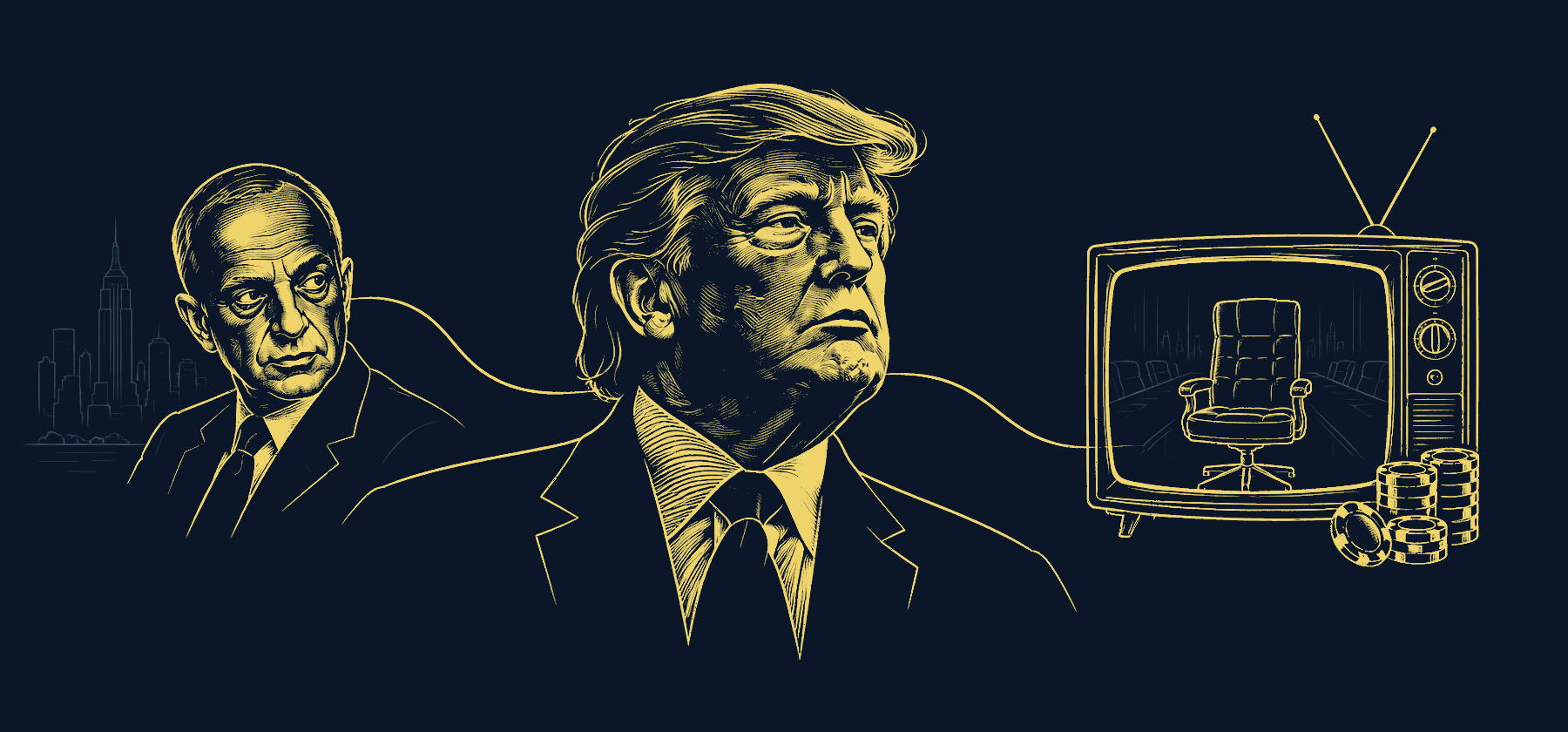
The image and the record
The character is familiar.
The construction deserves a closer look.
There is a reason the same arguments keep coming back: who is winning, who is loyal, who is allowed to contradict him. Long before the presidency, Trump was building a public version of himself that could survive bad numbers, bitter disputes and unwelcome evidence.
Follow the story from military school to Roy Cohn, from casino debt to a television boardroom, from private family conversations to public displays of praise. The point is to put the performances beside the records—and see what the distance between them reveals.
The uniform
A cadet’s yearbook portrait, before the celebrity image.
Read the chapter ↓The counterattack
Federal housing allegations meet Cohn’s combative defence.
Read the chapter ↓The rescue
Fred’s representative buys $3.5m in casino chips.
Read the chapter ↓The restructurings
Corporate Chapter 11 filings puncture the success narrative.
Read the chapter ↓The television boss
The Apprentice supplies a new version of commercial authority.
Read the chapter ↓The room of praise
Cabinet footage gives the public performance a government setting.
Read the chapter ↓
01 · Queens, 1946–1968
Before the gold letters, there was Fred.
Trump did not emerge from nowhere. He grew up inside a property business, a hierarchy and a family in which winning mattered.
Donald Trump was born in 1946, the fourth of Fred and Mary Trump’s five children. Fred’s apartment buildings supplied the money and the model: business was a family institution, with the father setting the terms. The later story of a lone entrepreneur climbing to the top leaves out the structure already underneath him.
He attended Kew-Forest School before his parents sent him to New York Military Academy at 13. FRONTLINE’s interviews with classmates describe an intensely competitive teenager, quick to assert himself and attentive to rank. The uniform, the sporting contests and the command structure offered visible ways to establish who was above whom. School contemporaries remember a personality already determined to dominate.
Those recollections matter more than a tidy origin myth. Military school did not invent everything the adult would become. It gave a young Trump another setting in which status could be performed, defended and displayed. In the yearbook photograph, the future celebrity appears in a cadet’s uniform, decades before the red tie became his own uniform of authority.
He later moved from Fordham to the University of Pennsylvania, graduating from Wharton in 1968. The university’s commencement programme is the straightforward record. His education, like his business career, would become part of a public sales pitch: the name of the institution standing in for an argument about his exceptional ability.
Mary Trump’s account of the family describes Fred’s approval as something to compete for, with weakness punished and aggression rewarded. She writes both as a psychologist and as a member of that family. Her interpretation gives this childhood a particular emotional shape; classmates’ memories and the financial record supply other windows. Together, they make the supposedly self-contained man look much less self-contained.
02 · The money behind the mythology
The father who could make failure disappear.
When the public image needed a self-made winner, the private business still had access to Fred’s money.
The New York Times’ 2018 investigation reconstructed the transfers behind Trump’s origin story. Its estimate was at least $413 million received from his father’s property empire, expressed in 2018 dollars. That is a cumulative lifetime estimate, not a single inheritance cheque. The reporters also identified at least $60.7 million in loans, much of which they found had not been repaid.
The most cinematic rescue involved no glamorous deal at all. On 17 and 18 December 1990, a representative of Fred Trump bought $3.5 million in chips at Trump’s Castle casino. They were not gambled. The casino got cash at a moment when a bond payment loomed. It was financing dressed up as a visit to the gaming floor.
New Jersey’s signed stipulation and penalty order strip away the theatre. The casino admitted violations, and regulators imposed a $65,000 civil penalty. The injection and the fine are different numbers: one kept money moving through the business; the other was the regulatory consequence. Corruption Metrics holds the documents together so the rescue can be inspected rather than merely repeated.
That episode changes the meaning of “survival”. A business rescued by a wealthy parent may still survive, but its survival does not demonstrate that the owner’s judgement was vindicated. Access to another person’s balance sheet can postpone the moment when a bad bet finally becomes visible.
The family fortune also makes the branding easier to understand. The name was presented as a guarantee of extraordinary competence. Behind the name were transfers, guarantees and interventions that ordinary borrowers could not call upon. The public was sold independence while the private record shows dependence.
Russ Buettner and Susanne Craig’s Lucky Loser follows the distance between that financial history and the image television later made familiar. Their central question belongs here: how did repeated difficulty become a reputation for mastery? The answer runs through Fred’s resources, the press, and eventually a television production team.
03 · The mentor
Roy Cohn taught him how to turn an accusation around.
The formative relationship was with a lawyer who treated confrontation as a weapon and an opponent’s credibility as a target.
Roy Cohn had already helped make Senator Joseph McCarthy’s investigations a national spectacle before he entered Trump’s world. He understood the combination of public accusation, private pressure and personal connections. For the young property developer, he offered access to power and a method for responding when power was challenged.
The 1973 federal housing case makes the method tangible. The Justice Department sued Donald Trump, Fred Trump and Trump Management over racial discrimination in renting apartments. Cohn’s response was not confined to disputing individual evidence. His affidavit attacked the government’s investigation, portraying it as harassment and abuse. The defence went on the offensive.
A $100 million counterclaim against the government was dismissed. The underlying case ended in a 1975 consent order requiring measures including nondiscriminatory advertising and rental practices. This was a concrete obligation, whatever victory language surrounded it. In January 1978, a Justice Department letter addressed to Cohn complained about substantial compliance and said officials believed discrimination was continuing.
There is the pattern in miniature: turn scrutiny into persecution, attack the scrutiniser, and leave the audience with a battle over who deserves to be believed. The documents are a better guide than the famous three-rule version popularised by the dramatised film The Apprentice. Movie dialogue can capture an idea; it is not a recording of Cohn giving Trump a lesson.
Kai Bird and Susan Goldmark’s American Scoundrel places Cohn at the centre of this history. Their account describes the closeness of the relationship and the extent of Trump’s emulation. Trump himself, asked about Cohn in a 2016 interview, praised him as “a really good lawyer”. The influence was practical as well as personal: whom to call, how to apply pressure, and how to prevent an embarrassing fact from becoming the accepted story.
Cohn matters because these techniques did not remain inside a Manhattan legal dispute. When the target becomes a journalist, a prosecutor, an election official or a former aide, the stakes change. A private instinct to win every confrontation can become a public campaign against the institutions capable of contradicting the president.
04 · Atlantic City and the comeback story
The name stayed on the building. The trouble stayed on the books.
A casino can glitter while its finances deteriorate. The spectacle and the balance sheet tell different stories.
Trump’s public persona turns setbacks into proof of resilience. The business record asks a less flattering question: who had to absorb the setback so that he could stage another comeback? A list of corporate restructurings is not a personality test, but it is a necessary check on the story of effortless commercial brilliance.
Trump Media’s own 2026 securities filing lists the history: the Taj Mahal’s Chapter 11 in 1991; Trump Plaza, Trump’s Castle and New York’s Plaza Hotel in 1992; Trump Hotels & Casino Resorts in 2004; and Trump Entertainment Resorts in 2009. These were corporate bankruptcies. They show repeated distress in businesses associated with Trump, rather than a personal bankruptcy filing.
The Taj Mahal’s financing also supplies a sharp example of the response to unwelcome information. Analyst Marvin Roffman questioned whether it could meet its debt burden. Trump demanded a retraction or Roffman’s dismissal. Corruption Metrics follows the intimidation, the subsequent proceedings and the casino’s financing: $675 million in bonds carrying 14 per cent interest.
Roffman’s $750,000 arbitration award was against his employer; his settlement with Trump was confidential. Keeping those outcomes straight strengthens the story. Criticism was met with pressure before the financial forecast could be tested by events. This is an early business version of a familiar political manoeuvre: punish the messenger who spoils the picture.
The Securities and Exchange Commission later found that Trump Hotels & Casino Resorts issued a misleading 1999 earnings announcement. The company’s adjusted presentation excluded an $81.4 million closure charge while retaining an undisclosed $17.2 million one-off gain. The favourable result was polished by choosing what the audience would see.
Other records add consequences the comeback narrative tends to leave outside the frame. Trump University’s settlement totalled $25 million, covering a class fund and the New York case. The Trump Foundation case produced $2 million in court-ordered damages. Those are separate cases with separate findings and remedies, not ingredients to add into an invented grand total.
The recurring editorial question is not whether a man can fail and try again. It is whether the version of success being sold acknowledges the money, the losses and the people left behind. Trump’s name remained the central product even when the venture beneath it could no longer sustain the promise.
Inspect the numbers
Different cases.
Different consequences.
Each measure opens its own Corruption Metrics record. These figures are not an aggregate total.
Fred’s casino rescue
Cash injected through ungambled chips · 17–18 December 1990
A separate $65,000 regulatory penalty followed.Inspect the evidence →T10 · Corruption Metrics$25mTrump University settlement
$21m class fund + $4m New York case · funded January 2017
A settlement amount, not a measure of personal profit.Inspect the evidence →C06 · Corruption Metrics17Corporate tax-fraud convictions
Trump Corporation and Trump Payroll · December 2022
The two companies were fined $1.61m in total in January 2023.Inspect the evidence →C08 · Corruption Metrics$2mFoundation damages
Court-ordered payment · confirmed December 2019
Separate from distribution of the Foundation’s existing funds.Inspect the evidence →05 · The made-for-television billionaire
The boardroom was a set. The authority was an edit.
Millions watched Trump play the person who knew who deserved success. The people making the programme knew how much work that image required.
The Apprentice gave Trump something a balance sheet could not: a weekly demonstration of apparently unquestionable judgement. Contestants waited. The camera watched. The boss arrived and pronounced. The format made his authority the organising fact of the room before any decision had been examined.
Producer Bill Pruitt has described the effort required to create that performance. In his first-person account, discussed on CNN in May 2024, he explained the need to make Trump sound “sharp, dignified, and clear”. Editing could select the coherent moment, remove the detour and make a messy decision look decisive. Viewers saw the finished character, not the hours of material that failed to fit him.
NBC executive John D. Miller has been even more direct about the result. Writing about the programme he helped promote, he said that he made Trump appear to be a legitimate businessman. He described the real boardroom as shabby. The television version supplied the visual grammar of success: polished space, expensive transport and a man who never had to ask permission.
Look, too, at the photographs of Trump’s actual Trump Tower office. They show a desk crowded by papers and memorabilia, with framed coverage and objects competing for space. The published photographs make a useful visual comparison with the expansive television boardroom. They cannot give us a reliable floor measurement. What they can show is the difference between a working room and a room designed to persuade an audience.
That difference is the heart of the facade. Television did not simply report that Trump was successful. It built a repeatable scene in which other people behaved as if his success and judgement were beyond question. The candidates’ dependence on him became evidence of his importance. The edit converted performance into apparent experience.
The political value was enormous. Voters did not all meet him first through the casino filings or the housing litigation. Many met the familiar boss on television. When he later promised to apply his business instincts to government, the programme had already supplied a vivid, emotionally convincing picture of those instincts.
FRONTLINE’s Rebranding Trump goes back through that transformation. Watch the interviews alongside the financial chapter, rather than in isolation. The distance between the two is where the story becomes revealing: the public image did not have to repair every failure. It had to make the failures less memorable than the character.
“People thought he would be a good president because I made him seem like a legitimate businessman.”
06 · Behind the family brand
The relatives who knew the man behind the performance.
Inside the family, the story involved inheritance, insurance, recordings and lawsuits. Affection was not the only thing at stake.
Mary Trump’s book punctured the warm family portrait with an account of competition, money and cruelty. She was not an outside commentator discovering the name on a tower. She was Fred Trump Jr.’s daughter, describing the system in which her father and his siblings had lived. Her later legal case challenged the value placed on her own interests in that system.
The dispute around Fred Trump Sr.’s estate also reached the medical coverage of Mary’s brother Fred III and his family, including his infant son William. A 2000 court decision records the insurance conflict and the agreement to continue coverage during the litigation. Mary alleged that its withdrawal was retaliation for contesting the will. That charge is hers; the documentary fact is that a sick child’s coverage became part of a bitter family legal struggle.
Mary’s 2020 inheritance complaint alleged that Donald, Maryanne and Robert Trump had concealed transfers and misrepresented the value of what she owned. The case was dismissed in 2022 because releases signed in the 2001 settlement barred it; that decision was affirmed in 2023. The outcome concerns the reach of those releases. It did not produce a trial resolving her account of the family’s financial dealings.
Then there are the recordings. Between 2018 and 2019, Mary recorded conversations with her aunt Maryanne Trump Barry, Donald’s older sister and a former federal judge. These were private conversations, not a single late-night telephone call. In excerpts broadcast in 2020, Barry’s criticism was devastatingly plain: “He has no principles. None. None.”
Hearing the voice matters. This was someone who had known him since childhood, speaking outside the flattering setting of a campaign appearance. The broadcasts offer excerpts, not every hour of their conversations. They nevertheless let the reader encounter a family assessment that is starkly different from the public celebration of the Trump name.
The dispute did not stop with the book. Donald sued Mary over disclosure of tax records, with the confidentiality claim surviving an attempt to dismiss it. Reuters reported in June 2026 that the lawsuit had been settled, with terms undisclosed. The family’s private history had once again become a fight over what the public was allowed to know.
This chapter connects with Cohn’s because control of the story and control of the resources keep appearing together. A relative who contests the valuation, a producer who describes the edit, an analyst who questions the debt: each threatens a different part of the image. The response tells us something about how that image is defended.
“He has no principles. None. None.”
07 · From the brand to the presidency
When a personal story becomes everybody else’s problem.
The question is what happens when the man defending his image also commands the machinery of government.
The methods do not have to be identical in every episode to form a recognisable pattern. An awkward fact arrives. The person who supplied it becomes the problem. A competing version is repeated. Supporters are invited to show their loyalty by accepting the preferred account.
The crowd-size dispute after the 2017 inauguration made that pattern visible almost immediately. The site’s crowds investigation follows the photographs, the claims and the argument over what the images showed. It is a small incident with a large implication: an institution was being asked to help protect a flattering picture of the president.
After the 2020 election, the distance between desired outcome and verifiable result became much more consequential. Our election investigation collects the allegations, the lawsuits and the evidence. The January 6 chapters follow the people and meetings through which those claims were pushed. Repetition could build political allegiance without making the underlying allegations stronger.
The Loyalty Test takes the story into personnel. James Comey and Chris Krebs appear there through their recorded actions and Trump’s responses. The press investigation documents access restrictions and lawsuits. These are different events, but they expose the cost of a governing culture in which contradiction can be treated as betrayal.
Vanity projects show another side of the same public identity: buildings, a presidential library and an arch as monuments to a name. That investigation deals with the proposals and their money separately. Here, they belong to the larger story of a man for whom visibility, praise and the appearance of victory have repeatedly become ends in themselves.
This is the page’s interpretation of the connected record. The individual links let you test it against particular events. Cohn’s influence is a powerful thread, not a magic explanation for everything. Fred’s money, the family hierarchy, commercial setbacks, television and the rewards of political celebrity also shaped the conditions in which these habits flourished.
08 · The room around him
When a Cabinet meeting becomes a tribute
Watch who speaks, who receives the credit, and who is expected to applaud. The performance around Trump can reveal as much about his power as the performance he gives himself.
On June 12, 2017, Trump invited his full Cabinet to introduce themselves by name and position. What followed included repeated expressions of gratitude and praise for his leadership. Chief of staff Reince Priebus thanked him for the opportunity and blessing of serving his agenda. The public record shows a procession of praise; Trump’s opening instruction did not explicitly order it.
The ritual survived into his second term. At the April 30, 2025 meeting, Elon Musk suggested the administration could be the greatest since the country’s founding. Attorney General Pam Bondi declared its first hundred days better than any previous presidency’s. These expansive claims came from people inside the administration, before its leader and television cameras. The full official recording lets viewers judge the words and atmosphere together.
Our reading is that such performances turn a working meeting into a demonstration of personal allegiance. A Cabinet secretary has authority, access and a responsibility to explain decisions. When that platform becomes an occasion to honour the President, scrutiny can be displaced by appreciation. The question is what a person willing to disagree would have to overcome in that room—and what voters lose when public accountability begins with a tribute to the man at the centre.
In October 2026, author Michael Wolff reported that aides used “How’s the weather?” as code for checking Trump’s mood. The question, in his telling, was how volatile the day might become before somebody walked into the room.
That is a striking way to describe the working environment around a President. The people advising him are supposed to bring information, including facts he may dislike. Wolff’s account invites a different question: how much energy goes into managing the man before the work can even begin?
Flattery is revealing even when we cannot know whether a speaker believes it. The transaction is public: an official offers praise, and the audience sees proximity to power expressed as gratitude. Watch for the difference between credit for an achievement and sweeping personal acclaim. That difference matters when officials are supposed to answer to the public.
“We thank you for the opportunity and the blessing that you've given us to serve your agenda and the American people.”
09 · The phone and the news cycle
The presidency that keeps posting
A midnight post invites jokes about the President’s bedtime. The more consequential questions concern its target, its timing, and what the rest of the country is made to discuss the following morning.
The habit has a documented history. A 2017 Current Biology study examined @realDonaldTrump from December 2014 to March 2017, spanning the campaign and opening months of his first presidency. Android posts peaked in the early morning and late at night. It also identified different users or groups operating the account. These findings concern account activity during that period, rather than Trump’s present sleep.
Isobelle Clarke and Jack Grieve’s 2019 linguistic study covered tweets from 2009 to February 2018. They found a feed with several communicative styles, and warned against identifying an author from a device alone. Travel also complicates the clock: an account’s displayed time and the President’s location need not coincide. The posting record is valuable evidence about communication; it is not a sleep diary.
The content still deserves serious attention. Clarke and Grieve found changing styles serving different communicative purposes across the account’s history. This complicates the comforting assumption that the feed is simply uncontrolled noise. An informal voice can make political messaging feel personal, immediate and unmediated. Readers should examine the words and their effects even where the authorship of an individual post remains uncertain.
In a separate study published in Nature Communications in 2020, Stephan Lewandowsky, Michael Jetter and Ullrich Ecker examined the first two years of his presidency. Increased coverage of Mueller and Russia was followed by more tweeting about unrelated subjects; that activity was then followed by reduced coverage of the investigation. The researchers found a pattern consistent with diversion. The study concerns the first-term Twitter record; its authors’ interpretation gives us a reason to examine what a burst of posts pushes out of the news cycle.
For people opposing Trump, there is a trap here. A shocking post is easy to share, mock and turn into the day’s argument. Doing so may grant it attention while a less spectacular decision slips away. Keep the post beside the surrounding record: what was being reported, what action was taken, and what received less attention. Justified outrage can still consume time needed to follow power.
The official record provides another useful test. The National Archives advised the first Trump administration that posts made in the course of presidential duties must be preserved, including deleted tweets. The reason to retain them is accountability. A post can be informal in tone while remaining part of how a President communicates and governs; deleting it does not erase its place in that history.
Read the sources behind this chapter 4
10 · Interpretations and evidence
Narcissism, praise and the politics of the self
The boasting, the demand for loyalty, the appetite for acclaim: psychologists have spent years examining these patterns. Their work helps explain what happens when the self becomes the centre of political life.
Dan P. McAdams’s The Strange Case of Donald J. Trump, published by Oxford University Press in 2020, interprets him as the “episodic man”: someone organised around the present encounter, with winning supplying an immediate purpose. McAdams combines biographical material and personality research to examine temperament, relationships and self-presentation. His framework puts the drive to win an encounter at the centre of the story.
McAdams had already drawn a useful distinction in a 2016 CNN interview. He described narcissism in terms of goals and values directed towards promoting oneself, and explicitly distinguished that discussion from narcissistic personality disorder. That gives readers a way to examine the name on the building, the praise in the room and the constant claims of exceptional achievement without making a medical label carry the whole argument.
Bandy X. Lee’s edited collection The Dangerous Case of Donald Trump, first published in 2017 and expanded in 2019, takes an urgent position: contributors argue professional responsibility requires warning about danger. Its contributors use the public record to argue that behaviour at the top can endanger people far beyond the room. Their emphasis is on the consequences of power, not merely the spectacle of an unusual personality.
Psychiatrist Robert Jay Lifton directs attention outward as well as inward. In his interview with Bill Moyers, he describes “malignant normality”: destructive conduct becoming accepted because it is repeatedly performed and defended. His interpretation offers a bridge between personality and institutions. The subject becomes the people who accommodate, excuse and reproduce a leader’s conduct, as well as the leader himself.
The need for admiration also offers a way to connect the early and later stories. Fred’s approval, a television contestant waiting for judgement, a Cabinet official offering tribute: the settings change, while affirmation keeps returning to the centre. That connection is our reading of the history, rather than a claim that one childhood incident explains every later decision.
Speech can be studied more directly. Coutanche and Paulus’s 2018 analysis of unscripted interviews from 2011–2017 found increasing filler words but no change in unique-word count. The authors expressly warned that their measures could not establish cognitive change. To investigate later claims about decline, comparable recordings and methods matter: a stumble, a digression or a selected viral clip cannot settle what has changed or why.
Later work has studied the political language itself. David Savin and Daniel Treisman’s 2024 working paper found increasing violent vocabulary in Trump’s rhetoric across 2015–2024, particularly around crime. That is a finding about language and politics, rather than a medical explanation for it. Put dated recordings beside each other and the change can be examined instead of merely asserted. The strongest question here is how these patterns affect other people. Does a demand for acclaim crowd out criticism? Does an attack redirect attention? Does an institution accommodate conduct it once challenged? Those questions connect interpretation to records we can inspect. The praise, the attacks and the institutions that adapt to them belong in the same account of power.
Read the sources behind this chapter 6
- McAdams, 2020 · The Strange Case of Donald J. Trump, Oxford University Press
- McAdams, August 8, 2016 · CNN interview on narcissistic goals
- Lee, editor · The Dangerous Case of Donald Trump, expanded 2019 edition
- Lifton & Moyers, 2017 · Professional concern and malignant normality
- Savin & Treisman, 2024 · Violent political rhetoric, 2015–2024
- Coutanche & Paulus, 2018 · Linguistic change and its limits
Keep reading
The books behind the argument.
Biography, financial investigation, a family memoir and professional interpretation offer different ways into the same public life.
Kai Bird & Susan Goldmark · 2026
American Scoundrel
Roy Cohn’s career, relationships and lasting influence.
Mary L. Trump · 2020
Too Much and Never Enough
A family member’s account of the household, money and hierarchy.
Russ Buettner & Susanne Craig · 2024
Lucky Loser
The financial reporting behind the self-made mythology.
Dan P. McAdams · 2020
The Strange Case of Donald J. Trump
A psychological biography organised around personality and the pursuit of victory.
Bandy X. Lee, editor · 2017 / expanded 2019
The Dangerous Case of Donald Trump
Named mental-health professionals’ arguments about public behaviour and danger.
Follow the connected record
The biography continues
in the decisions.
Vanity & branding →
The monuments, the name and the money.
The Loyalty Test →
What happens when people contradict him.
War on the free press →
Access, pressure and retaliation.
Stolen Votes: The Evidence →
The desired result beside the evidence.
Truth Social archive →
The original words and posting dates.
Corruption Metrics →
Inspect the individual cases and original sources.