A difficult question. An unwelcome story. A press pass taken away. Follow how Trump turned his hostility to independent reporting into a battle over who gets access, who gets sued and who gets to question the president.
CNN, MS NOW and Politico have expanded their court challenge over exclusion from the White House press pool. Their credentials were restored October 13, but the outlets say they remain shut out of assignments aboard Air Force One and inside the Oval Office.
The amended complaint describes missed reporting opportunities after the credential restoration. The battle is now over the places where reporters can question the president and witness government decisions as they happen.
October 26 · New reporting
Trump barred the reporters. Now readers are suing.
The next challenge to Trump’s press crackdown comes from the people who rely on the reporting. On October 26, six members of the public sued the president and his aides, arguing that punishment of critical journalists denies the public independent coverage of its own government.
The plaintiffs are Kenneth Roth, Daniel Froomkin, Beverly Gage, Peter Schmidt-Nowara, Benjamin Wittes and Ethan Young. Represented by the Knight First Amendment Institute and Yale’s media-law clinic, they are asking a federal court in Manhattan to stop the exclusion policy.
The complaint traces a widening pattern: the Associated Press pushed out of the pool, credentials revoked from CNN, MS NOW and Politico reporters, and an Independent correspondent kept off an Air Force One pool assignment after unwelcome questions.
Their argument reaches beyond restoring individual passes. A reporter who knows that one critical question could cost access works under a threat. The public receives the reporting shaped by that threat.
Litigation and reporting
Trump’s lawsuits against the press.
The pressure does not stop at the briefing-room door. Trump has taken broadcasters, newspapers and even a pollster to court over their work. A newsroom facing a presidential lawsuit has to defend its reporting while absorbing the cost of the fight. For readers, the stakes are just as clear: can journalists investigate the people in power without being punished for what they find? The five cases below trace the reporting Trump challenged and what happened next. Some ended in settlements; others were dismissed or remained in court. Read the claims, the outcomes and the source documents together.
· Suit filed
BBC · edited January 6 speech
Trump sought $10 billion across defamation and unfair-trade-practices claims concerning a Panorama edit of his January 6 speech.
Recorded step: August discovery disputes included requests involving Trump’s family. On October 22, Magistrate Judge Enjoliqué Lett ordered Trump to sit for a deposition by December 11 in the $10 billion case he brought. If he does not comply, sanctions could include dismissal, unless the court extends the discovery schedule.
Trump sought $15 billion over New York Times reporting and “Lucky Loser: How Donald Trump Squandered His Father’s Fortune and Created the Illusion of Success”. The book was written by Times reporters Russ Buettner and Susanne Craig and published by Penguin Random House. He said the work damaged his reputation as a businessman.
Recorded step: The original complaint was struck on September 19, 2025, for improper pleading, with permission to refile. A revised filing was reported in October.
Trump sought at least $10 billion over reporting about a birthday letter bearing his name, denying he wrote it.
Recorded step: The April 13, 2026, order dismissed the complaint with leave to amend for insufficient allegations of actual malice. Refiling was reported on May 28.
A suit filed before the second term challenged editing of a Kamala Harris interview. Trump characterized the editing as election interference.
Recorded step: Paramount agreed to a $16 million settlement in July 2025. It included no apology; the payment was designated for Trump’s future presidential library, with legal costs included.
Trump alleged a pre-election poll favoring Harris in Iowa constituted consumer fraud and election interference. The litigation continued during his second term.
Recorded step: The original federal case was dismissed without prejudice after appellate intervention; Trump pursued a state-court action. Arguments on dismissal were reported in July 2026.
Natalie Harp. The information reaching the president.
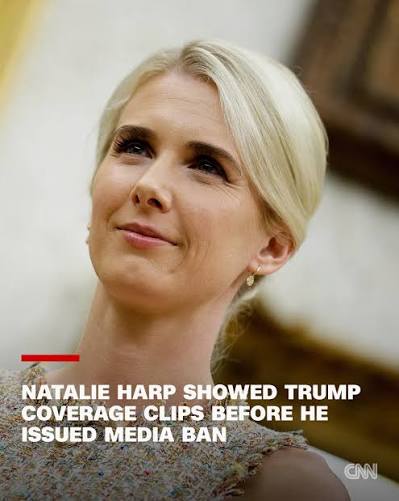
Who gets to show the president what the press is saying about him? CNN reported that Natalie Harp showed Trump coverage shortly before he banned three news organizations from the White House. That places an aide who filters information for him close to a decision that shut reporters out. The reporting below examines her role and the coverage that reached him before the ban.
Natalie Harp entered the second administration as Special Assistant and Executive Assistant to the President. Her public financial disclosure lists prior compensation from Save America and the 2024 campaign.
Multiple accounts describe Harp as the aide who travels with a portable printer, supplies Trump with favorable online material and helps relay posts and messages. Accounts have used the nickname “human printer” for her.
CNN reported, citing people familiar with the matter, that Harp showed Trump a Politico graphic and television coverage shortly before the ban; a second account identified clips of MS NOW anchors criticizing the administration. The reporting says the material angered Trump and helped inform his decision. Trump did not identify one triggering story, and the White House has not publicly confirmed that Harp caused the ban.
The pattern began with campaign blacklists and followed Trump into government: reporters lost access, outlets faced public attacks, and courts were asked to intervene. Each incident below shows how the pressure was applied, how journalists responded and what the documentary record establishes. Together, they tell the story of a presidency repeatedly trying to control the terms of its own scrutiny.
· Access restriction
CNN barred from its scheduled Air Force One pool assignment
CNN reported that the White House barred its team from traveling aboard Air Force One for Trump’s planned September 26 trip to Tennessee, where it was scheduled to provide pooled television coverage.
Context & sources
The decision was reported on September 25, ahead of the trip. The television pool shares footage with other networks, so excluding its assigned team affects access beyond CNN’s own broadcasts. The restriction followed the court-ordered restoration of general White House credentials.
Judge orders immediate restoration of the three outlets’ passes
US District Judge Timothy Kelly ordered the administration to restore the three outlets’ credentials and blocked enforcement of the ban for fourteen days, finding the outlets likely to prevail on their constitutional claims. Reporters were still turned away that morning, with some passes confiscated, before being admitted around noon.
Context & sources
TheWrap reported that the outlets sought an emergency hearing after journalists were initially denied entry despite the order. Access was restored later that day. The temporary restraining order preserved access while litigation continued and was not a final judgment on every issue; subsequent restrictions on particular events and travel are recorded separately below.
CNN and MS NOW journalists excluded from state-dinner arrivals
Hours after general White House access was restored, CNN and MS NOW reported that journalists were prevented from covering arrivals for the state dinner honoring Chinese President Xi Jinping.
Context & sources
CNN correspondent Kristen Holmes said officials would admit a photographer and an audio staff member but no CNN editorial presence. This restriction concerned coverage of the arrivals, following the restoration of general credentials; restoring those credentials had not ended the dispute over access to presidential events.
The White House promoted an official continuous stream of speeches, announcements and selected highlights days after the press bans.
Context & sources
An official stream can provide primary-source footage. It is curated by the administration and does not replace independent questioning, verification or editorial selection.
Trump said the three organizations would be barred because of coverage he called fake. Reporters arrived the next day to find badges deactivated or confiscated.
Context & sources
The action targeted organizations over editorial content rather than an identified security violation. The outlets sued under the First and Fifth Amendments.
News organizations rejected new conditions that could punish reporters for seeking information not formally authorized for release; many vacated workspaces rather than sign.
Context & sources
The department said the rules protected sensitive information. Press groups argued existing laws already covered classified material and the policy chilled ordinary reporting.
Associated Press restricted over “Gulf of America” wording
The White House curtailed AP access to smaller presidential events after the outlet continued using Gulf of Mexico while noting Trump’s renaming order.
Context & sources
A district court found viewpoint retaliation and ordered access restored. The administration appealed, and the appeals court stayed that relief while the case continued.
The White House suspended Karem’s hard pass for thirty days after an exchange with Sebastian Gorka. Courts found he was likely to succeed because no clear rule had warned that the conduct could trigger that punishment.
Context & sources
The D.C. Circuit affirmed the preliminary injunction with a narrow adjustment; it did not grant journalists an unlimited right to disrupt events.
Jim Acosta’s hard pass revoked, then restored by a court
The White House revoked CNN reporter Jim Acosta’s credential after a contentious press conference. A federal judge ordered temporary restoration because the process likely violated due-process requirements.
Context & sources
The court’s immediate ruling addressed due process rather than issuing a final broad First Amendment judgment.
Trump labeled named news organizations the enemy of the American people, elevating a campaign complaint into presidential rhetoric.
Context & sources
Criticism of reporting is protected political speech. The concern recorded here is the president’s use of the office to delegitimize independent scrutiny as an institution.
Security escorted the Univision anchor out after he tried to question Trump about immigration without being called on. Trump told him to “go back to Univision”; Ramos was later allowed back and continued questioning him.
Context & sources
The full sequence matters: removal, return and exchange are all part of the record.