Netanyahu brought a promise of regime change into the Situation Room. Trump took America to war. Months later, the bill is measured in lives, exhausted sailors and fuel prices far beyond the battlefield.
The president’s own announcement: military action, an offer of immunity and a call to overthrow Iran’s government. Read the transcript ↗︎
01 · SELLING THE WAR
A foreign leader. America’s Situation Room. A promise of a quick victory.
This was more than a request for support. Netanyahu came to sell Trump a transformation of Iran.
On February 11, Benjamin Netanyahu sat opposite Trump in the White House Situation Room. Behind the Israeli prime minister, a screen connected Mossad director David Barnea and Israeli military officials. A room rarely used for face-to-face meetings with foreign leaders became the setting for an hour-long case for war.
Jonathan Swan and Maggie Haberman’s reconstruction describes a pitch in which Iran’s missile capacity could be crippled within weeks, retaliation would be manageable and the government could collapse. Netanyahu also showed possible successor leaders, including Reza Pahlavi. Closing the Strait of Hormuz was presented as a danger Iran would struggle to deliver.
In their subsequent interview, the reporters describe US intelligence challenging the regime-change case, warnings about the Strait of Hormuz and munitions supplies, and Vance’s opposition. Trump’s response to Netanyahu’s presentation was reported as: “Sounds good to me.”
Trump’s February 28 announcement did not stop at military targets. He addressed the Revolutionary Guard, armed forces and police, offering “complete immunity” if they laid down their weapons and threatening “certain death” if they did not.
Then came instructions to civilians: shelter while the bombs fell, and seize power when the attack was over. Regime change was no longer simply an ambition discussed behind closed doors. It was part of the president’s message to the people being bombed.
“When we are finished, take over your government.”“Whenwearefinished,takeoveryourgovernment.”
Rubio subsequently said the US expected an Israeli attack to bring Iranian retaliation against American forces, so it struck first. The public rationale kept shifting; the deployment, destruction and costs did not wait for a consistent explanation.
People do not get to leave when a president declares victory.
Behind each total is a family. Behind each extension of a deployment are people still working, waiting and wearing down.
19
US military deaths recorded
Pentagon tally reported in the week of September 23. Includes hostile and nonhostile deaths across Operation Epic Fury and subsequent overseas operations.
The combined Pentagon tally as of September 23. Reporting also identified discrepancies in the death count; these are dated recorded totals, not a final accounting.
Including 1,701 civilians, as of April 7. Human Rights Activists News Agency figures cited by the Congressional Research Service; this earlier count does not cover the months that followed.
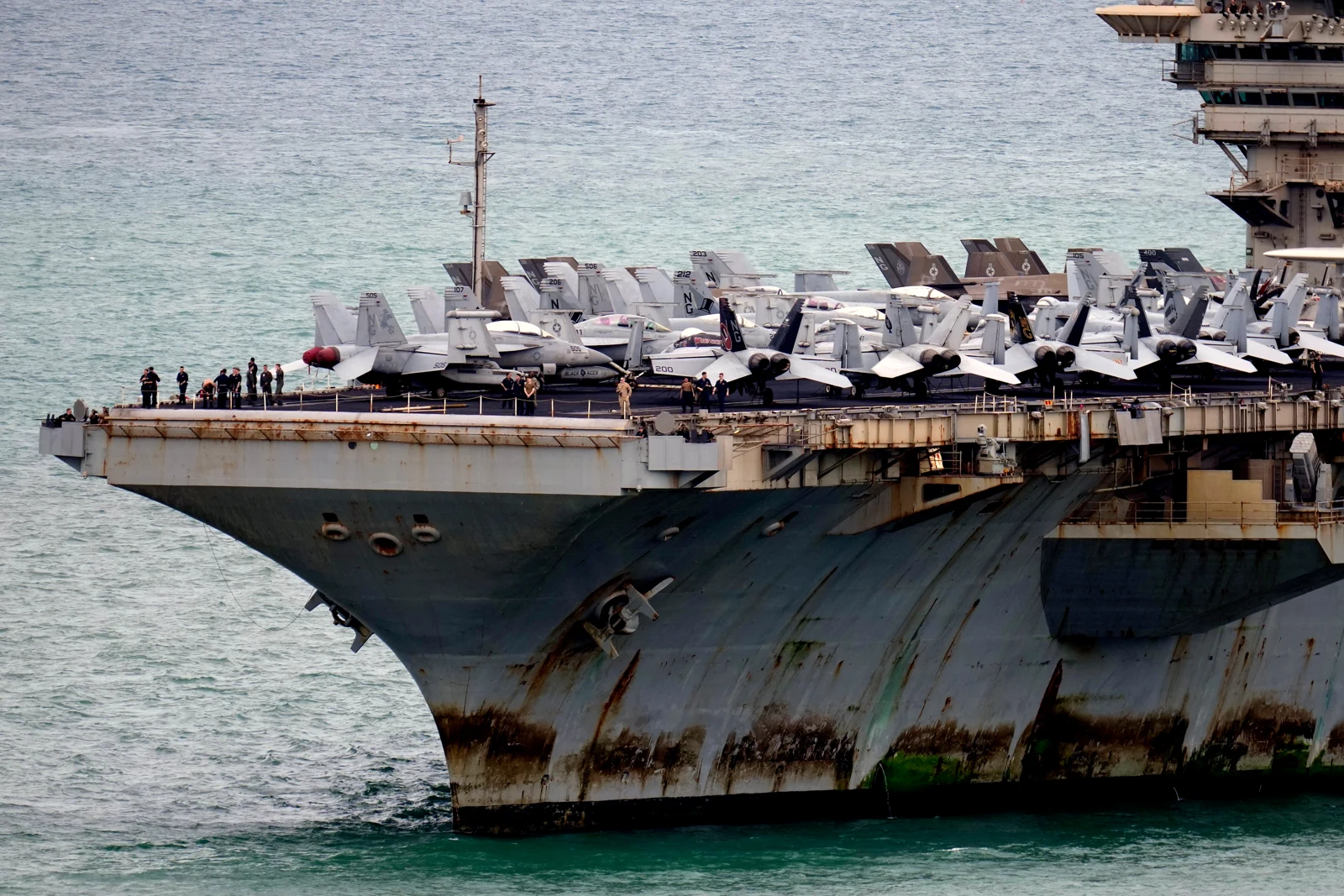
The USS Abraham Lincoln reached Thailand on September 2 after 286 days deployed, including 264 consecutive days at sea before the port call. This was a break from a prolonged deployment, not a homecoming. AP · arrival in Thailand ↗︎
Families raised alarms about exhaustion, food and water, plumbing and mental health. Senators demanded answers from Hegseth about conditions aboard. Read the senators’ demand for accountability ↗︎
In a September 22 letter, acting Navy secretary Hung Cao confirmed eight suicide attempts across the Lincoln carrier strike group. The group includes the carrier, its air wing, staff and escorting ships. Cao reported no deaths by suicide in the group. Navy Times · the letter and its scope ↗︎
On August 14, a reporter raised families’ concerns about conditions on the Lincoln, then asked about the length of deployments and sailors’ mental health. Trump’s answer set the distance between the commander in chief and the people carrying out his war in a few words.
USS Abraham Lincoln, Thailand, September 2, 2026. Photograph: Sakchai Lalit / AP. Los Angeles Times ↗︎
Reporter, after raising concerns about the USS Lincoln:“Have deployments gone on too long? Are you worried about the mental health?”
“No, no, no. Not nearly long enough.”“No,no,no.Notnearlylongenough.”
Washington disclosed on October 30 that it had ordered nonemergency U.S. government staff and their families to leave Saudi Arabia a week earlier. The October 23 order cited security risks as missile and drone threats spread across the region.
That is the backdrop to Trump’s renewed promise that the Iran war would end soon. Embassy families were being moved out while the president was still selling an approaching finish.
October 30–November 3 · The promise and the strikes
He promised to wait until after the election. The strikes came first.
“It’s going to get wrapped up soon,” Trump told KCMO radio on October 30. He said he needed a guarantee that Iran would not develop nuclear weapons and would not launch strikes before the election.
U.S. forces struck Iran’s Qeshm Island on November 2, the night before Americans finished voting. CNN cited three U.S. officials confirming the operation; one said it followed Iranian fire at an American aircraft. Officials described the strikes as limited and defensive. Trump’s stated timetable had not survived until Election Day.
On Fox the following morning, Trump said, “There’s no war raging.” His administration had just used military force again. The blockade and the costs of the conflict continued while he talked about the prospect of a deal.
No strikes before the electionTrump gives his timetable in a radio interview.
U.S. forces strike QeshmOfficials confirm the operation to CNN.
Americans finish votingTrump plays down the fighting in his Fox interview.
The public promise and the reported operation. Sources: the Reuters interview and CNN reporting linked above.November 1 updateA day later, “soon” becomes “no hurry.”
One day after saying the Iran war would be wrapped up soon, Trump told reporters at Mar-a-Lago that the United States was in “no hurry” for a deal. Asked whether fighting would resume the following week, he declined to say.
Those October 31 remarks, reported November 1, left open when the next strike might come. The video records that intervening position, between his radio promise and the November 2 operation.
Trump speaking at Mar-a-Lago, October 31. Video published November 1 · Al Jazeera. Open the source video
November 2 updateNetanyahu presses for strikes after the vote.
Benjamin Netanyahu urged Trump to renew strikes on Iran after the midterms, AP reported November 2, citing two regional officials and a person briefed on their October 31 call. Trump had not committed. The pressure follows his shifting promises about when the war would end.
October 29 · Planning for the next strikes
Allies are being warned about what may follow the vote.
American officials have warned regional allies to prepare for possible renewed U.S. attacks on Iran after the midterms and for retaliation, according to diplomats who spoke to the Associated Press. The warnings take Trump’s open-ended remarks into the preparations of other governments.
At the Pentagon, Hegseth has removed Lt. Gen. Brett Sylvia, the Joint Staff’s chief planner, citing an investigation into alleged disclosures. The departure comes as military options are being readied for a president who has yet to issue a final order.
October 28 · War after the vote
“Anything’s possible.” The war has already cost more than $47 billion.
Trump was asked whether there would be more strikes on Iran after the midterms. “Anything’s possible,” he replied. Six days before Americans vote, the president was keeping another round of military action on the table.
Reuters reports that Pentagon data put the war’s cost above $47 billion—about 25% higher than the estimate it reported in July. The question about the next attack comes with a bill for the war already fought, alongside the energy-price shock and the pressure on U.S. borrowing documented elsewhere on the site.
October 26 · New reporting
The war raises the fuel bill. Trump owns the stocks.
The president has a financial stake in the industry benefiting from the energy shock. Congressional Democrats’ October 26 report estimates that his oil and gas holdings were worth $22.5 million to $81.6 million on October 19, up from $12.6 million to $45.8 million at the end of 2025.
The Joint Economic Committee’s Democratic analysis tracks both rising share prices and fresh money entering the portfolio. It says 94% of his 2026 oil and gas stock purchases came after the Iran war began, with up to $17.5 million bought from March through August.
The president’s oil and gas holdings Estimated value · millions of U.S. dollars
End of 2025$12.6m–$45.8m
October 19, 2026$22.5m–$81.6m
$0m$45m$90m
JEC Democratic estimate, using disclosure ranges and market prices. October values include purchases, sales and price changes.
Trump’s decisions can move the market in which he has invested. The report puts the conflict of interest in dollars, beside the fuel costs borne by families far from the White House.
04 · A WAR WITH NO BORDER AROUND ITS BILL
The consequences travel further than the missiles.
Shipping disruption becomes a fuel problem. A fuel problem becomes a household bill, a refinery decision and a diplomatic argument.
Another peace offer. Another threat of bombing.
On October 1, AP reported Trump rejecting Iran’s latest peace offer and raising the possibility of renewed bombing after the US midterm elections. The earlier ceasefire rhetoric had not produced a durable end to the conflict.
On October 2, the G7 committed to release 100 million barrels of oil and petroleum products over four months, with a substantial diesel release in the first 20 days. Its statement also rejected energy export restrictions between G7 members. These are commitments to relieve the supply squeeze, not 100 million barrels already delivered.
Trump said he would consider restrictions as domestic prices attracted political pressure. Europe and Latin America buy much of the diesel the US exports.
S&P Global’s full-ban scenario projected refinery cuts of roughly 1.9 million barrels a day, around 12%, and a possible 750,000-barrel daily fall in gasoline output. A domestic diesel glut could push refineries to process less oil. These were modelled risks of a ban.
As the G7 announced its release, Trump said export restrictions would not happen. The proposal belongs in the record as a threatened response to the price squeeze, not a ban currently in force.
The displacement estimate, changing Pentagon cost figures, oil and pump-price charts, congressional votes and full chronology remain below. Their dates matter: a spending request, an estimate and an observed price each tell a different part of the story.
What the administration said it would achieve, what the record shows, and what remains unverified.
A ceasefire announcement did not settle the conflict.
The White House declared military success in April. CENTCOM reported further strikes in September, while nuclear-verification and shipping questions remained unresolved. Follow the gap between the administration’s claims and documented outcomes.
HOW THE DECISION WAS MADE
From Netanyahu’s presentation to an American war
The public rationale shifted between nuclear danger, an anticipated Israeli strike and broader regime-change claims. Reporting by Jonathan Swan and Maggie Haberman describes internal objections before Trump approved the operation. The chronology below keeps those accounts beside the administration’s own explanations and the intelligence record.
FEB 11Netanyahu’s presentation
A rapid-victory case in the Situation Room, including expectations about retaliation and regime collapse.
FEB 12US advisers push back
Officials challenged assumptions behind the Israeli proposal; J. D. Vance was reported as the clearest opponent.
FEB 23The targeting call
Netanyahu supplies intelligence about a senior Iranian gathering; a CIA check confirms the location.
FEB 28The strikes begin
US and Israeli forces launch the war before the administration presents one stable public explanation.
Rubio said the administration knew Israel would act and expected Iran to respond against US forces, so the United States struck first. That explanation sits uneasily beside Trump’s separate claims of an imminent nuclear danger and assassination threats.
1.9–3.2mestimated people displaced · Iran government figures via UNHCR · March 11
Estimated from 600,000–1 million households reported by Iran’s government, using a census average of 3.2 people per household. Published by UNHCR · March 12 report ↗︎. No independently verified current casualty total is established in this collection. Military claims, humanitarian estimates and observed prices are different kinds of evidence.
War costs: estimates, requests and what remains unknown
Dated Pentagon cost estimates, $bn · not a consistent audited expenditure series
April 29, 2026
25
May 12, 2026
29
July 21, 2026
37.5
Officials presented the first two figures in congressional hearings. The May revision included equipment repair and replacement plus operating costs. Defense News · dated estimates ↗︎
The July figure requires extra care: some reporting described a cost to date, while specialist reporting described “certain aspects” through September. It should not be read as an audited total already spent, or compared mechanically with the earlier figures. Scope and qualification ↗︎ · Full July hearing recording ↗︎
These are the government’s estimates, not this site’s independently verified September total. They do not establish all future veterans’ costs, interest or wider economic losses.
$87.6bn requested is not $87.6bn spent on the war
The White House’s June 24 supplemental request covered several departments and purposes. A funding request is not enacted budget authority, an obligation or a cash outlay. The total therefore cannot simply be added to the estimates above.
Recording date stays attached. This is historical reporting, not a live cost counter.
Oil and the price at the pump
Observed prices from EIA via FRED. Conflict, shipping risks, production, inventories, demand, refining and taxes all affect prices. Changes here are not an estimate of the war’s isolated effect.
Brent crude
$130.802026-09-15 · US dollars per barrel
+83.4% since last observation before February 28, 2026 (2026-02-27).
Daily spot observations; weekends and missing observations have no data point. Dashed marker: April 8 ceasefire announcement.
Assessment: destruction and diversion cannot be inferred from missing inspections.
The safeguards record leaves crucial questions about nuclear material unanswered.
Outcome still developing
Secure shipping and a durable settlement
AP reported only a partial Hormuz reopening on September 11. AP reporting ↗︎
Assessment: partial reopening is progress on access, not proof of lasting peace.
Track actual shipping flows, continued attacks and enforceable diplomatic commitments separately.
Congressional checks
Senate · March 4 · motion to discharge
For advancing the constraint
47
Against advancing it
53
House · March 5 · resolution passage
Yea
212
Nay
219
Not voting
1
Counts, not percentages. Both measures failed. Their rejection was not the enactment of an authorization for use of military force. Senate record ↗︎ · House record ↗︎
MS NOW’s JM Rieger puts Trump’s repeated declarations of victory beside missed deadlines, his earlier attacks on the Iran nuclear deal and his 2024 promises to avoid new wars. The comparison also exposes reversals over sanctions and Iran’s frozen funds. The contradictions can be absurdly funny; the consequences are harder to laugh off. Watch the words collide, then follow the dated decisions below.
US intelligence says Iran is not building a nuclear weapon
Director of National Intelligence Tulsi Gabbard told Congress that the intelligence community continued to assess that Iran was not building a nuclear weapon and that the supreme leader had not reauthorized the suspended weapons program. This was a dated intelligence assessment, not a guarantee about future intent.
The earlier June conflict and nuclear-site attacks
The IAEA’s September 2025 report documents the June 13–24 attacks and interrupted verification. This earlier conflict is separate from the war launched in February 2026.
Trump says the nuclear sites were “completely and totally obliterated”
After US bunker-buster and cruise-missile strikes on Fordow, Natanz and Isfahan, Trump described total destruction. Later intelligence and IAEA reporting required a more qualified assessment: major damage was documented, while the location and status of nuclear material and the program’s longer-term capacity remained verification questions.
Netanyahu makes the case for war in the Situation Room
Reporting by Jonathan Swan and Maggie Haberman describes Netanyahu presenting a rapid-victory and regime-change case to Trump. US advisers challenged parts of the presentation the next day, including assumptions about Iran’s capacity to retaliate and the likelihood of political collapse.
Netanyahu’s target-intelligence call accelerates the timetable
Axios reported that Netanyahu called Trump with intelligence that Iran’s supreme leader and senior advisers would gather in one place. A CIA check confirmed the location information. The call became a pivotal operational trigger; it did not by itself establish every broader claim used to justify war.
The White House presented the campaign as a response to Iran’s nuclear and regional threats. Its release is evidence of the administration’s justification, not independent confirmation that every threat claim was established.
The Senate rejected the motion to discharge S.J.Res.104, which sought to constrain unauthorized hostilities. This was a procedural vote, not passage of an authorization for the war.
The House rejected H.Con.Res.38 on roll call 85. One member did not vote. The tally records the outcome on that measure, not each member’s view of every future military action.
UNHCR reproduced an Iranian government estimate that 600,000–1 million households had temporarily left home. Using the national census average of 3.2 people per household gives approximately 1.9–3.2 million people. The report describes conditions as of March 11 and was published on March 12; it is not a current total or an independent UNHCR headcount.
Counterterrorism chief Joe Kent resigns over the war
Kent said Iran posed no imminent threat to the United States and that pressure from Israel and its American supporters drove the war. His resignation is direct evidence of high-level dissent; his letter is one participant’s assessment rather than the complete classified record.
Gabbard says Iran made no effort to rebuild enrichment before the war
Gabbard’s prepared Senate testimony said the 2025 strikes had obliterated enrichment capacity and that Iran had made no effort to rebuild it. She omitted that sentence from her oral opening statement, then faced questions about how the finding fit the administration’s imminent-threat rationale.
White House declares success as a ceasefire begins
The administration said the operation had achieved its military objectives and announced a ceasefire. Later renewed operations mean that this statement cannot be treated as proof that the conflict permanently ended.
The Pentagon revised its estimate to include updated repair, equipment replacement and operational costs. This is not a complete account of future costs.
White House requests $87.6bn across several purposes
The supplemental request covered defense and other departments. Requested funding is not spending already incurred, and the entire package is not a single Iran-war cost.
Specialist reporting identifies a figure for certain costs through September, including anticipated costs. It should not be treated as an audited cash-spending total at the hearing date.
Trump says the Lincoln’s deployment is not nearly long enough
Asked whether the carrier’s prolonged deployment had gone on too long, Trump replied: “No, no, no. Not nearly long enough.” Families and lawmakers had raised concerns about crew welfare and conditions aboard.
CENTCOM announced strikes against IRGC targets, describing them as a response to attempted attacks on shipping and US forces. The claimed justification and damage assessment require independent checking.
The carrier arrived for a port call after a deployment of 286 days, including 264 consecutive days at sea. The stop gave its crew a break; it was not a return to the ship’s San Diego home port.
AP reported a 23-member vote in favor on the 35-member board, concerning Iran’s cooperation with the safeguards investigation. Iran denies seeking nuclear weapons.
Quad statement published on the nuclear verification gap
Delivered on September 9 and published by the UK on September 10, a joint statement by France, Germany, the UK and US says the IAEA has lost visibility over Iran’s highly enriched uranium stockpile. This is the governments’ account of the watchdog’s findings; missing access is not proof that material has been destroyed or weaponized.
AP described pressure on Saudi Arabia and experts weighing military and diplomatic options, alongside Trump’s reluctance to widen the conflict. The report did not establish a Saudi decision to escalate.
Navy leader confirms eight suicide attempts across the Lincoln strike group
Acting Navy Secretary Hung Cao’s letter to Senator Kirsten Gillibrand records eight attempts across the carrier strike group, including the carrier, air wing, staff and escorting ships. Cao reported no deaths by suicide in the group. Navy Times published its report on September 24.
S&P Global reported Trump considering restrictions as domestic diesel prices attracted political pressure. Its analysis describes how a full ban could reduce refinery runs and gasoline output, while tightening diesel supplies for importers. The modelled effects are forecasts, not observed consequences of an implemented ban.
Reporting records 19 US military deaths and 861 wounded
The Washington Post reported a Pentagon total of 861 wounded as of September 23 and a death tally increased to 19 that week. These combine Operation Epic Fury and subsequent overseas operations, including hostile and nonhostile deaths. Reporting also identified unresolved discrepancies in the death count.
AP reported Trump rejecting the latest Iranian offer and raising the possibility of further bombing after the US midterm elections. The report describes a continuing diplomatic impasse, not a completed peace agreement.
AP-NORC finds 69% say the Iran war was not worth fighting
Seventy-one percent disapproved of Trump’s handling of Iran. The probability-based nationwide poll interviewed 2,140 adults from September 24–28, with an overall sampling margin of error of ±2.9 percentage points.
G7 commits to release 100 million barrels of oil and fuel
G7 leaders committed to a coordinated release over four months, including substantial diesel releases in the first 20 days, and rejected energy export restrictions between G7 countries. AP reported Trump backing away from diesel export restrictions that day. The release is a commitment, not a volume already delivered.
Verified access to nuclear material, reliable measures of shipping recovery, independently corroborated civilian-impact data, durable ceasefire implementation and the precise legal record would materially improve this assessment.
Sources are linked beside each finding. Official accounts establish what authorities claimed or ordered; they are weighed alongside the IAEA record, UNHCR estimates, congressional records and independent reporting.