The 47 Files · Investigation
Trump and the Evangelicals.
The pulpit.
The power.
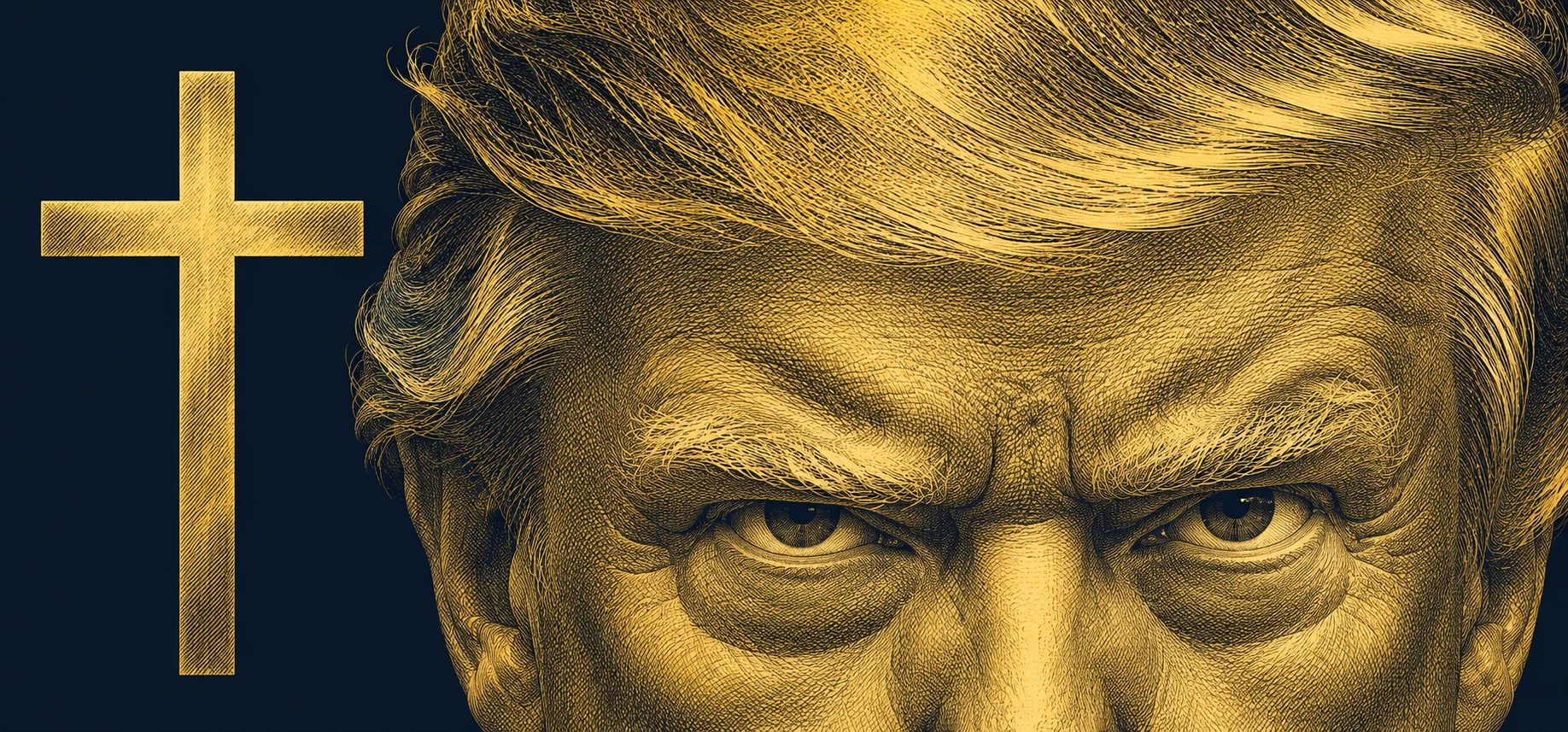
The pastors who made him God’s instrument. The churches that became political organizing grounds. The access, money and influence that followed.
Jump to a section
01 · The candidate
He had a favorite book. Just don’t ask for a verse.
Donald Trump had an answer ready when the conversation turned to his favorite book: the Bible. Asked to name a verse, he suddenly found the subject too intimate. In an August 26, 2015, Bloomberg interview, he declined to offer one. Asked whether he preferred the Old Testament or the New, he settled on “probably equal.”
It was an awkward audition for the religious right. It was also an early indication of how little biblical fluency would matter. Trump offered something more useful to leaders who believed they were losing control of the country: a politician willing to fight their enemies, appoint their judges and treat their access to power as a personal bargain.
That bargain grew into an organizing system. Pastors introduced him to congregations. Activists registered voters through churches. Wealthy donors financed legal and electoral projects. Preachers supplied a religious explanation for his behavior, casting an abrasive, scandal-ridden candidate as an instrument chosen by God. By the time Trump returned to office in 2025, one of his most extravagant spiritual advocates was heading the White House Faith Office.
The most revealing evidence is spread across campaign speeches, church services, internal strategy documents and government orders. Put together, it shows how political allegiance acquired the authority of faith—and how a president learned to collect the benefits.
02 · The bridge
Pence made the introduction. Trump collected the votes.
Mike Pence gave Trump a religious credential he could not supply for himself. At the Republican convention on July 20, 2016, the Indiana governor introduced his identity in a carefully ordered list: “I’m a Christian, a conservative and a Republican, in that order.”
Pence was familiar to evangelical activists. His anti-abortion record and public profession of faith made him a reassuring figure beside a candidate whose marriages, boasts and business history required considerably more explaining. Religious-right leaders welcomed the choice. Trump already had substantial evangelical support; Pence helped make that support easier to defend from the pulpit.
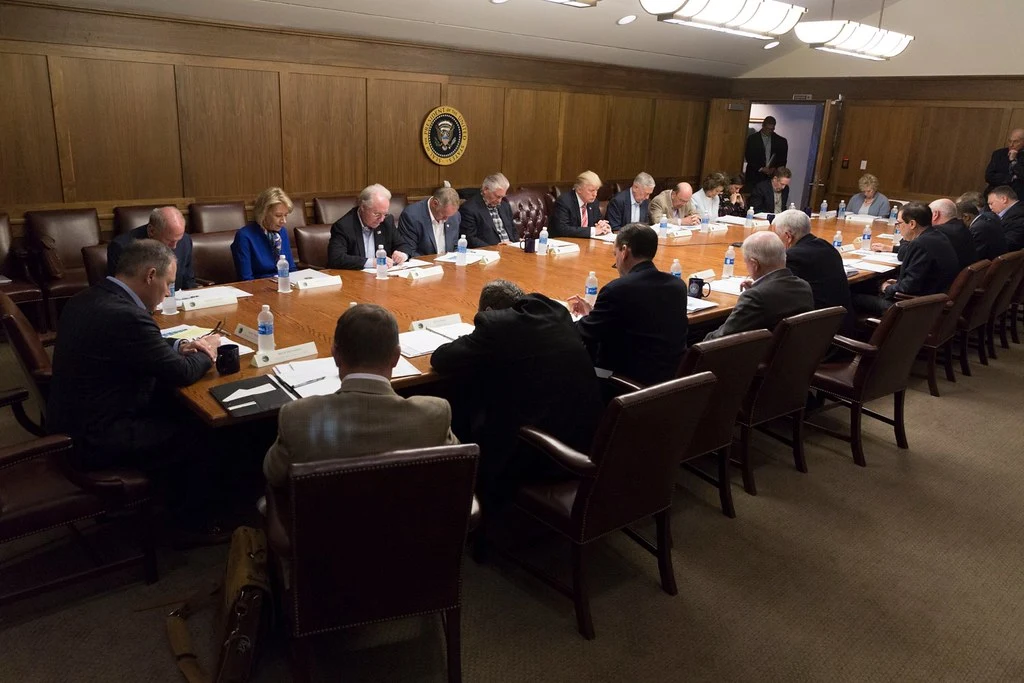
There was a concrete offer underneath the reassurance. Trump promised conservative judges and delivered three Supreme Court appointments: Neil Gorsuch, Brett Kavanaugh and Amy Coney Barrett. All three joined the majority that overturned Roe v. Wade in June 2022. In August 2018, hosting evangelical leaders at the White House, Trump recited his administration’s record on judges, religious liberty and the move of the U.S. Embassy to Jerusalem. Access came with reminders of what he expected in return: political support.
Pence’s usefulness had a limit. On January 6, 2021, he refused Trump’s demand to obstruct certification of the election. A vice president who had spent four years offering loyalty was suddenly branded a traitor by the president’s supporters. His constitutional duty collided with the demand for personal obedience. Trump chose obedience.
03 · The bargain
The standard moved. The loyalty hardened.
The religious right had spent years insisting that character mattered. In the election that made Trump president, its most dependable Republican constituency became strikingly more forgiving. PRRI found that the share of white evangelical Protestants willing to separate private immorality from ethical public service rose from 30 percent in 2011 to 72 percent in 2016.
For some Trump allies, the answer was theological. Lance Wallnau compared him to Cyrus, the ancient Persian ruler whom the Bible credits with allowing the Jews to return from exile. Trump did not have to be a model believer. He could be the powerful outsider through whom God restored his people’s fortunes. In a November 2016 CBN interview, Wallnau described Trump as a “wrecking ball” against political correctness.
The Cyrus story turned a liability into a qualification. The same conduct that might discredit another politician could be recast as the roughness required for the job. It also elevated an electoral preference into a claim about divine purpose. A voter could disagree with a candidate. Defying a man presented as God’s instrument carried a different emotional weight.
The moral standard
What changed when Trump became the candidate?
White evangelical Protestants who said an official could act ethically in public office despite immoral behavior in private.
The relationship survived Trump’s first defeat, the effort to overturn it and his return to the ballot. Pew’s validated-voter study found that he won 81 percent of white evangelical Protestant voters in 2024. In that same series, his 2020 share was 83 percent. The coalition was not unanimous. It was, however, extraordinarily durable.
The electoral return
Four in five.
04 · Turning Point
A campaign that already had a congregation.
A church offers a political organizer something an advertising campaign must buy: a regular audience, trusted messengers and a network of relationships that extends well beyond Sunday. Turning Point’s faith operation built around that advantage. Its public materials invite pastors into a national network, promote church events and offer training that ties civic participation to religious obligation.
The organization’s Freedom Nights bring political and cultural speakers into churches. Its materials promote voter registration and Biblical Citizenship courses. This makes the church more than a place where someone happens to express a political opinion. It becomes a venue where political identity can be reinforced repeatedly, through people the congregation already trusts.
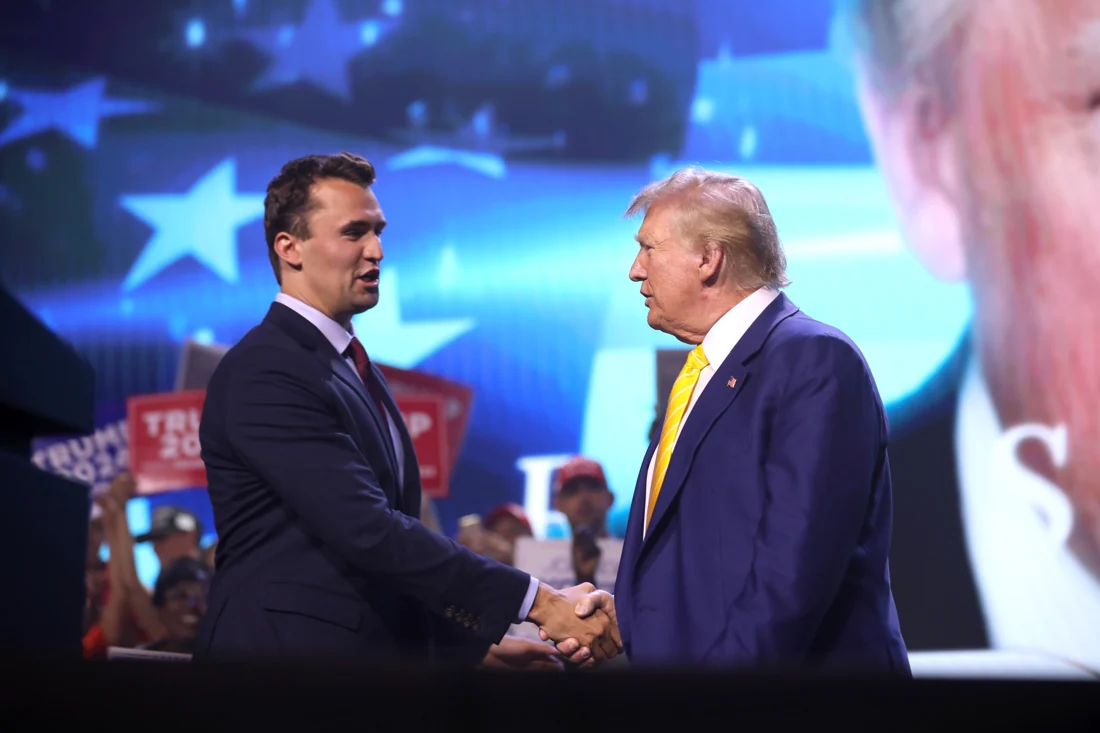
During the 2024 campaign, NPR followed Charlie Kirk’s effort to reach voters through campuses and churches. Turning Point Faith’s church network and Turning Point Action’s electoral operation were distinct organizations within that wider movement. The proximity of worship, political messaging and turnout work was central to the strategy. A rally asks people to show up once; a congregation can be reached week after week.
Journalist Tim Alberta examined the consequences inside evangelical communities in The Kingdom, the Power, and the Glory. His reporting described pastors who profited from political outrage and others who struggled to keep it from consuming their churches. At his own father’s funeral, Alberta encountered anger about his critical reporting on Trump. Even mourning could become a test of political allegiance.

The pressure does not always arrive as an explicit instruction to vote Republican. It can come through a steady account of a country under siege, with secular institutions, Democrats and cultural change gathered into a single hostile force. Once the congregation is taught to understand politics that way, the choice at the ballot box has already been narrowed.
Worship became the organizing language.
After Kirk was killed at Utah Valley University on September 10, 2025, his widow, Erika, took over Turning Point USA. Religion became still more prominent in the organization’s public identity. Its Make Heaven Crowded tour began in January 2026, bringing worship, testimony and altar calls into church gatherings. By September, Religion News Service reported nearly 30 such events. At a July gathering, Erika Kirk described the struggle as a “battle against Satan.”
The political organization had acquired the language and rituals of a religious revival. That gave its appeals a reach beyond an election calendar: members were being asked to understand participation as part of their spiritual lives.
From the worship stage to the Capitol.
Sean Feucht took a related message on the road. The worship musician’s Kingdom to the Capitol tour partnered with Turning Point, carrying religious rallies to state capitals. Religion News Service traced the Washington relationships behind his rise: congressional allies, Republican strategists and a Capitol Hill townhouse used to gather supporters.
On March 9, 2023, Feucht led worship in the Capitol Rotunda, where Rep. Lauren Boebert knelt among the participants. His ambition went beyond the right to worship. In a recorded discussion, he described a government in which “Christians are making the laws.” The music drew people together; the project was control over public institutions.
Greene, Boebert and the politics of public prayer
A prison cell built for the cameras.
At CPAC in Dallas on August 5, 2022, Marjorie Taylor Greene climbed into a mock jail cell and knelt with Brandon Straka, who wore an orange jumpsuit and a MAGA cap. People outside joined in the Lord’s Prayer. The performance cast January 6 defendants as persecuted patriots, with a member of Congress lending the scene her authority.
Straka was a real January 6 defendant playing a prisoner in a fake cell. He had pleaded guilty to a misdemeanor and received three years of probation, including 90 days of home confinement. The exhibit offered a spectacle of imprisonment where his own sentence had spared him prison. Prayer helped turn criminal accountability into a grievance the crowd could share.
“The church is supposed to direct the government.”
Boebert had spelled out the political ambition at Cornerstone Christian Center in Basalt, Colorado, on June 26, 2022. Two days after the Supreme Court overturned Roe v. Wade, she celebrated the decision before the congregation and dismissed the separation of church and state. A sitting lawmaker was telling worshippers that religious authority should govern the institutions she had been elected to serve.
05 · The online congregation
The sermon moved into the feed.
A pastor has to get people through the door. An influencer can reach them while they make dinner, commute or put a child to bed. The language is often more intimate than a campaign speech: parenting, health, marriage, the anxieties of raising a family. Political instruction arrives through a voice the audience has already invited into its home.
Allie Beth Stuckey built Relatable around a conservative Christian reading of public life. Her own description places theology at the center of the show. The title of her 2024 book makes the argument especially plain: Toxic Empathy: How Progressives Exploit Christian Compassion. Compassion itself becomes something the audience is warned may lead it astray. That framing helps turn disputes over abortion, immigration and sexuality into tests of whether Christians are being faithful or manipulated.
Alex Clark approaches the audience through another door. A Turning Point affiliate, she shifted her podcast toward health and wellness in 2024 under the name Culture Apothecary. Religion News Service’s November 2025 investigation described how food, vaccines and family life could draw listeners into the politics of MAGA and its Make America Healthy Again offshoot. Stuckey and Clark offered different styles of guidance, but both linked everyday choices to a wider struggle against liberal institutions.


A political movement’s model of womanhood.
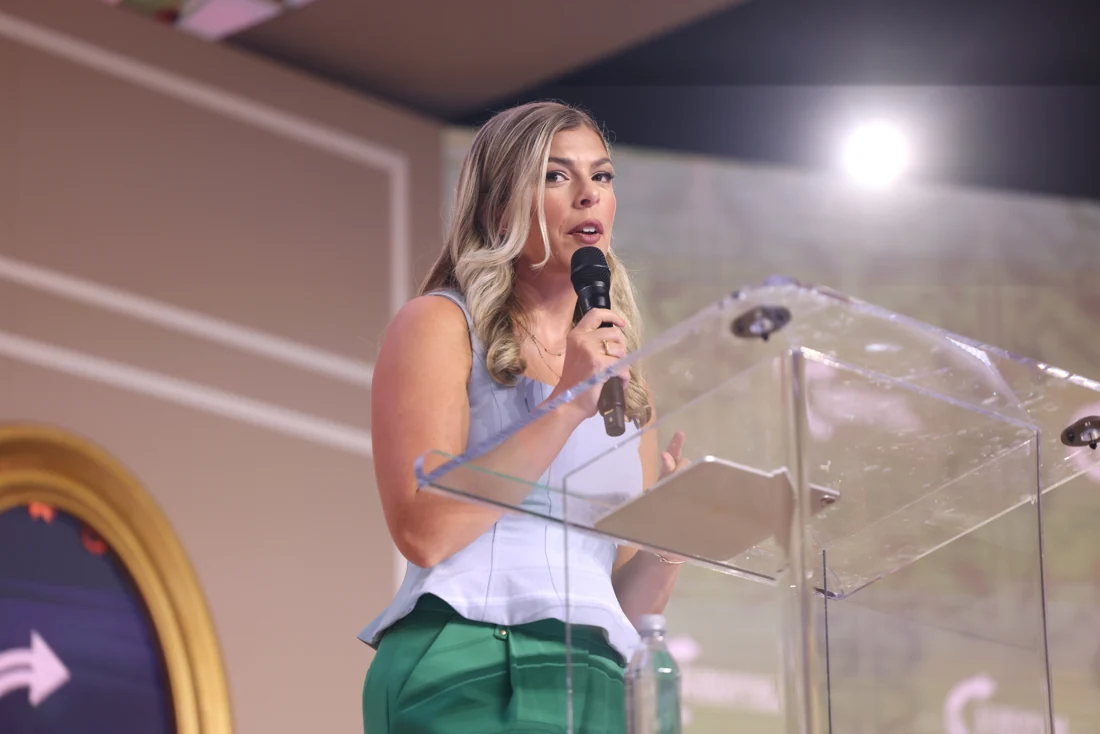
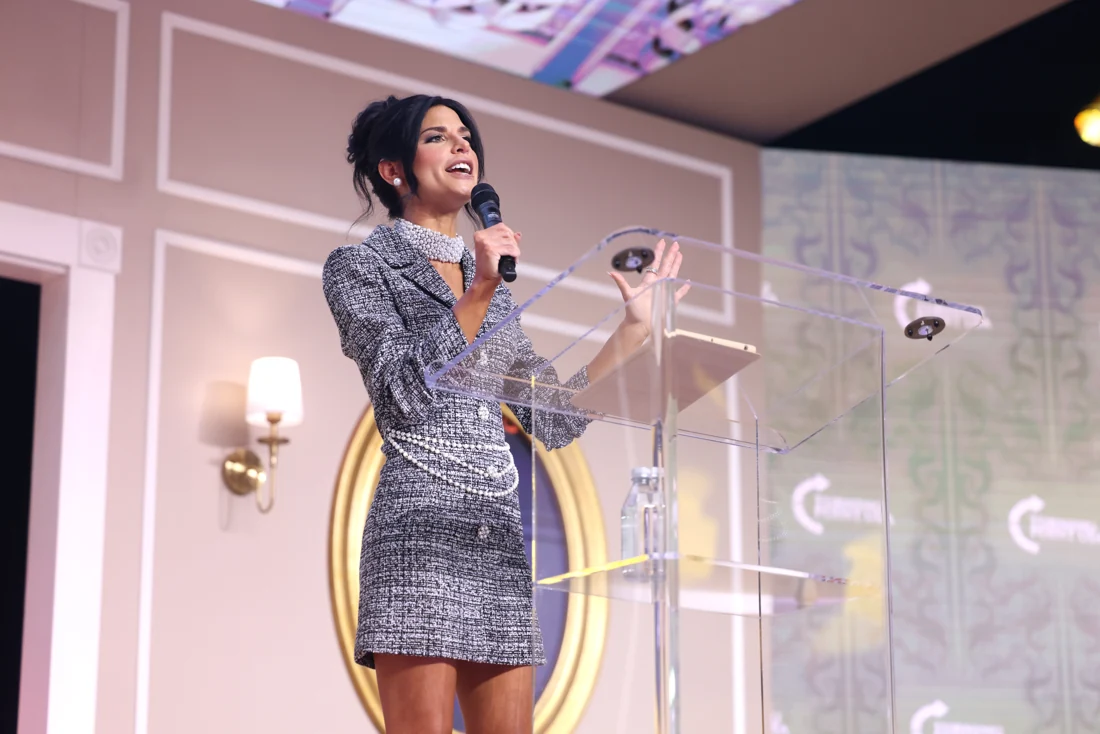
Turning Point brought those voices together at its June 5–7, 2026, Young Women’s Leadership Summit in San Antonio. Religion News Service reported an audience of about 3,000. Erika Kirk presented feminism as a threat to motherhood. Stuckey described abortion and gender as “soul-level issues.” Isabel Brown invoked Mary as a woman who “never had a corporate career.” Clark and anti-transgender activist Riley Gaines were among the other prominent voices in this overlapping religious and political world.
These were women with public careers, substantial platforms and political influence. Their message placed marriage and motherhood above the independence associated with feminism, while inviting the audience into a movement that would fight over those priorities in schools, law and government.
Trad culture’s political undertow.
The broader “tradwife” scene offers a more picturesque entry point: homemade meals, gardens, children and an ideal of the submissive wife. Some creators attach an explicit political explanation to the domestic imagery. Media Matters documented posts by Jasmine Dinis and Gwen Milkmaid that mixed traditional family life with claims about hostile elites, threatened children and a collapsing social order.
Its researchers also tested what TikTok recommended to one fresh account after it followed seven tradwife creators and interacted with their videos. Of 327 recommendations, they classified 100—30.6 percent—as conspiracy-related or apocalyptic. That was the experience of one test account, but it showed a route from lifestyle content into a much darker political feed.
Candace Owens made faith part of the brand.
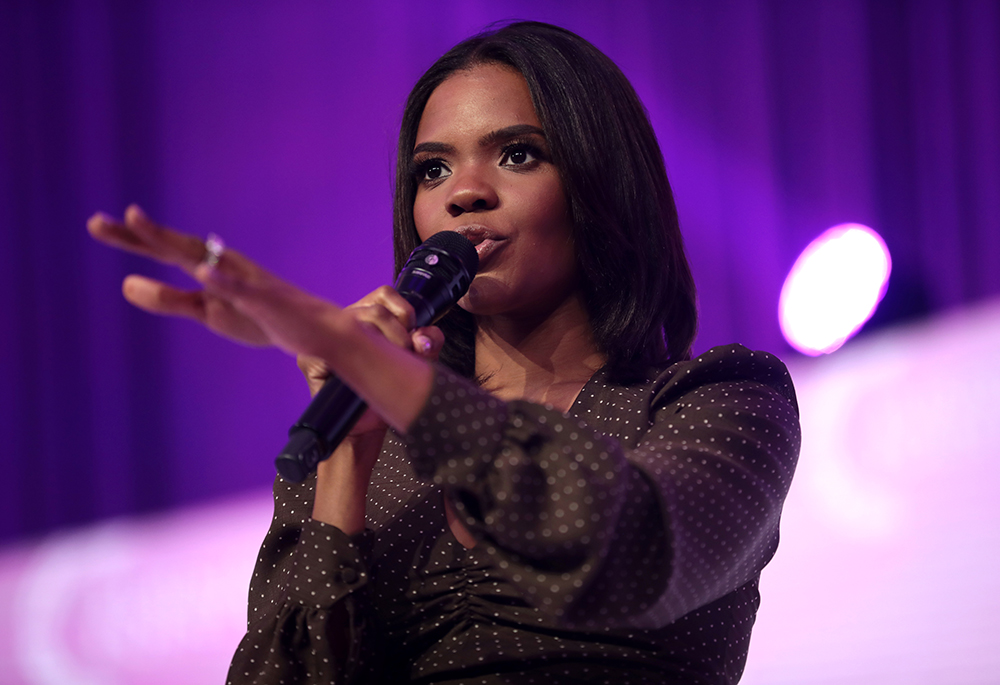
Candace Owens had already spent years selling a political departure: leave the Democrats. She cofounded BLEXIT in 2018 and supported Trump in the 2020 election. In April 2024, the former evangelical announced that she had become Catholic. Her audience offered a route between religious traditions inside the same right-wing media world.
At a Catholics for Catholics event in Phoenix on May 30, 2024, she described evangelicalism as “starting to feel like a political party.” Her own explanation of history was more sweeping: “it has forever been a holy war that is being waged against goodness.” She presented her platform as a religious calling. A political celebrity was asking followers to see her public battles as part of a sacred struggle, with criticism folded into an account of persecution.

The men who would take away the vote.
Alongside the lifestyle influencers were men spelling out what patriarchal government would require. Doug Wilson, the Idaho pastor behind an influential network of churches, schools and publishing, used Canon Press and online broadcasts to promote a Christian political order. In the country he advocated, non-Christians would be barred from public office. His reach extended to Pete Hegseth, who belonged to a church in Wilson’s denomination.
Joel Webbon carried the argument into podcasts and conferences through Right Response Ministries. In an interview on Eschatology Matters preserved by Right Wing Watch in May 2024, he argued that a Christian nation could not survive if women voted. He treated politics as warfare assigned to men and compared women’s exclusion from voting with the exclusion of children. His conferences brought together figures including Wilson and Oklahoma state Sen. Dusty Deevers to discuss biblical patriarchy.
Hegseth brought the pulpit into the Pentagon.
Pete Hegseth gave this religious network access to the institution he now led. His Tennessee congregation, Pilgrim Hill Reformed Fellowship, belonged to the Communion of Reformed Evangelical Churches, Wilson’s denomination. On May 21, 2025, he brought his pastor, Brooks Potteiger, into the Pentagon auditorium to preach at a service broadcast on the department’s internal television network. Potteiger described Trump as “sovereignly appointed.” Hegseth announced that the gatherings would become monthly. The secretary’s pastor was preaching divine authority for the president to an audience inside the military’s headquarters.
On August 7, 2025, Hegseth shared a CNN report featuring Wilson and other pastors discussing restrictions on women’s voting rights. His caption read: “All of Christ for All of Life.” The pastors’ ideas had acquired a powerful amplifier inside the government.
At the National Religious Broadcasters convention in Nashville on February 19, 2026, Hegseth presented the administration’s agenda in the language of religious duty. He celebrated the removal of transgender service members and diversity programs, then described border enforcement as “not political, it’s biblical.” The political opposition became an enemy of the faith; Trump became its defender.
By March 25, with the United States at war with Iran, the message from the Pentagon pulpit had become more brutal. Hegseth prayed for “overwhelming violence of action against those who deserve no mercy.” He said he was reciting a chaplain’s prayer delivered to the troops who captured Venezuelan President Nicolás Maduro. The defense secretary was invoking God’s blessing on American firepower while another war was underway.
Follow the war and the decisions behind it in the Iran investigation.
Across podcasts, conferences and short videos, the religious right built ways to reach people who might never attend a campaign rally. A familiar voice could turn a discussion of family life into a warning about political enemies. Hegseth carried that fusion of faith and politics into the Pentagon, where the consequences reached far beyond an online audience.
06 · The money and the plan
Behind the sermons, a legal strategy.
The project extended beyond winning an election. In October 2023, Documented published an investigation into a proposal presented to the conservative donor network Ziklag. Alliance Defending Freedom sought backing for litigation intended to redirect education toward parents and private choices. An internal presentation described an ambition to “take down the education system as we know it today.”
The proposal called for roughly $2 million to $3 million and an initial run of four to six cases. It envisioned five lawyers working over an estimated 18 months to three years. Documented reported that Ziklag had already made substantial grants to ADF. The plan supplied a revealing connection between the language of religious freedom and an organized campaign against the existing public-school system.
This was an effort to change who controlled education and where public support could flow. Litigation offered a route beyond the limits of a single election: find plaintiffs, develop cases and pursue rulings with consequences for many more families than the original dispute involved.
ProPublica and Documented later traced Ziklag’s 2024 church-turnout and voter-roll operations, connecting donor wealth to electoral machinery.
The public performance and the private planning served the same broader objective: religious conservatives securing greater control over the institutions that shape American life. The sermon supplied urgency. Donors, lawyers and organizers supplied the means.
07 · Paula White
The prayers reached the West Wing.
Paula White-Cain gave Trump’s political fortunes the language of spiritual warfare. As votes were being counted on November 4, 2020, she led a prayer service declaring victory and calling for angels from Africa and South America. She also spoke in tongues, moving between rhythmic syllables and declarations of an approaching victory. The performance traveled far beyond her congregation. The president’s spiritual adviser was presenting his reelection as a struggle with supernatural enemies.
The clip is often remembered as an internet spectacle. Its political message was less comic: Trump’s victory was treated as the outcome heaven intended. Ballots still being counted were absorbed into a story of demonic opposition and promised deliverance. When the result went against him, that story offered believers a ready reason to distrust what had happened.
White had already described her own service to Trump in religious terms. A frequently circulated 2019 remark equated saying no to Trump with saying no to God. In context, she was describing what she believed was her personal assignment to advise him. Even with that context, the claim placed her relationship with a politician under divine authority.
On February 7, 2025, Trump established the White House Faith Office, which White-Cain was appointed to lead. The executive order placed it within the Executive Office of the President and assigned it work across federal agencies, including consultation on policy and help for faith-based organizations navigating grants. The relationship now had an office, an administrative mandate and routes into government.
That is the consequential part of White’s story. The woman calling for angels to secure Trump’s victory did not remain on the television screen. She gained a position from which religious networks could seek access to the federal government.

His political return became a resurrection story.
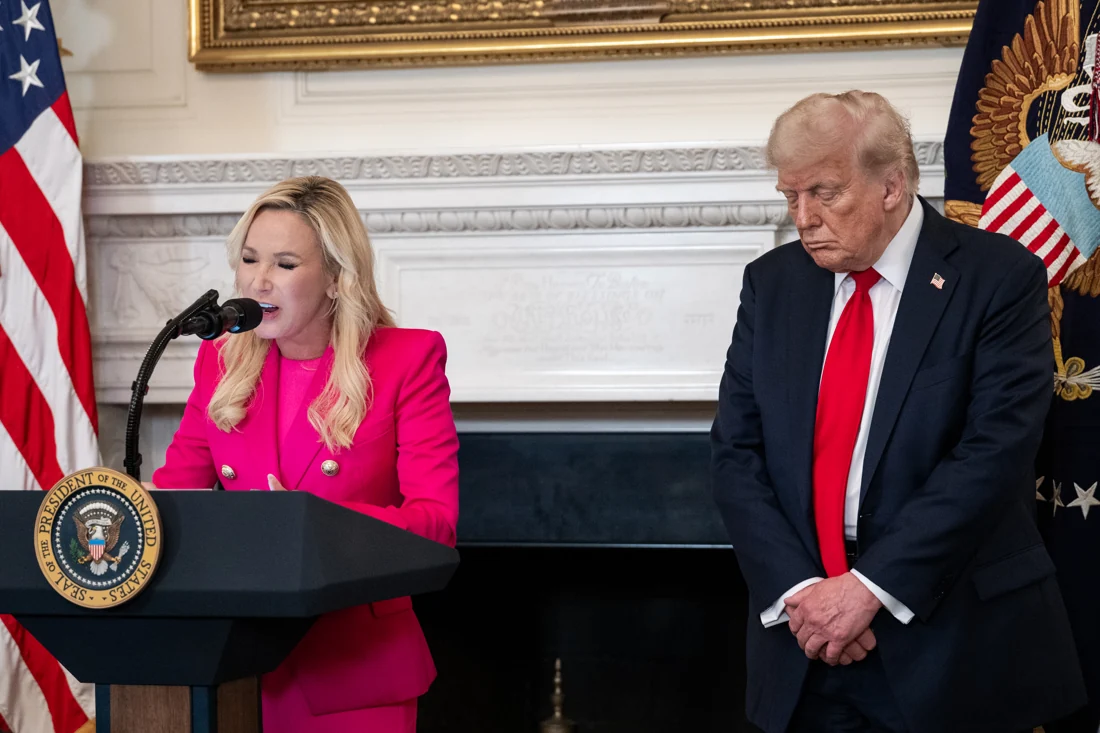
At the White House Easter lunch on April 1, 2026, White-Cain carried the comparison further. Addressing Trump, she said, “You were betrayed and arrested and falsely accused.” She drew a line from the suffering of Jesus to the president’s own experience, then told him, “because of His resurrection, you rose up.”
In the White House, before a religious audience, a spiritual adviser was giving Trump’s comeback the shape of the Christian salvation story. The president’s grievances were being folded into the most sacred account in the faith.
08 · From the pulpit
A vote against Trump became a test of faith.
Greg Locke made the threat of exclusion explicit. Preaching at Global Vision Bible Church in Mount Juliet, Tennessee, on May 15, 2022, he told his audience: “You cannot be a Christian and vote Democrat in this nation.” In the same sermon, he declared, “You ain’t seen the insurrection yet!” The pulpit was being used to police the boundary of Christian identity through party affiliation.
Locke’s political ministry also fed on confrontation over public health and conspiracy. A July 2024 PBS NewsHour report examined the church’s growth through hardline politics, including its resistance to pandemic restrictions and embrace of Trump. The attraction was not quiet persuasion. It was a leader offering certainty, conflict and a community organized around both.
Calling a political opponent wrong leaves room for argument. Calling that opponent incompatible with Christianity raises the cost of dissent inside a congregation. A church member who objects risks being treated as someone whose faith itself is suspect. That is how religious authority can become an instrument of political discipline.
Laughing at the result.
After news organizations called the 2020 election for Joe Biden, televangelist Kenneth Copeland responded with a prolonged, theatrical laugh. The audience joined him. In the recording, the declared result is treated as something too absurd to accept.
The laughter carried the same reassurance as White’s prayer: their side could remain certain even as the evidence moved against it. Viewers were invited to share the preacher’s contempt for the result, with the force of a religious gathering behind them.
A political opponent becomes a demon.
Wallnau brought a similar vocabulary into the 2024 campaign, invoking the biblical figure Jezebel against Kamala Harris. Religious-studies scholar Matthew Taylor has documented how independent charismatic leaders built networks around claims of prophecy, spiritual warfare and a duty to reclaim institutions. His work traces the involvement of more than 50 charismatic Christian leaders in Washington on January 6, 2021.
These networks are a specific part of the evangelical alliance, with their own leaders and theology. Their importance lies in the message they carried into the wider movement: political defeat could be understood as a spiritual assault, and resistance to a democratic result as an act of religious fidelity.
After the September 10, 2024, presidential debate, Wallnau reached for witchcraft to explain Harris’s performance. On Fire Power the next day, he described her ability to persuade an audience as a supernatural deception. Right Wing Watch preserved the recording.
By September 28, Republican vice-presidential nominee JD Vance was appearing at the Courage Tour event in Monroeville, Pennsylvania, associated with Wallnau’s revival and turnout campaign. Wallnau introduced him; Pastor Jason Howard conducted the interview. The language about demonic opponents was circulating in a movement close enough to the Republican ticket to put its candidate onstage.
09 · Who gets to belong
From a Christian nation to a king.
Once political authority is presented as a religious entitlement, another question follows: whose country is it? Christian nationalism supplies an answer that places Christians above their fellow citizens. In its white-nationalist forms, religious identity is fused with a racial claim about who belongs and who should rule.
The networks cross denominational lines. Nick Fuentes is Catholic; Lauren Witzke has identified with Russian Orthodoxy. Their importance to this story lies in the political world they share with parts of the evangelical right: hostility to pluralism, admiration for religiously defined state power and the demand for a leader strong enough to impose it.
Fuentes, the white nationalist and antisemitic livestreamer, made the ambition explicit. In a June 2022 broadcast, he called for “Catholic Taliban rule in America,” alongside restrictions on contraception and marriage. On November 22 of that year, he accompanied Ye, formerly known as Kanye West, to dinner with Trump at Mar-a-Lago. A figure promoting religious authoritarianism had reached the former president’s table.
Lauren Witzke wanted the restraints removed.
Witzke, the Republican nominee for Delaware’s U.S. Senate seat in 2020, supplied an especially blunt version of the message. In January 2024 broadcasts preserved by Right Wing Watch, she urged Trump to become a “full dictator” and entertained a theocratic monarchy. “King Trump, for life. Let’s go,” she said in one clip.
The language dispensed with the usual assurances about limited government. A politician who promised to punish enemies was being invited to rule without the restraints that make elections meaningful. Witzke also called for Barack Obama and Hillary Clinton to be imprisoned at Guantánamo Bay.
Her admiration extended to Vladimir Putin. NPR reported in May 2022 on Witzke’s identification with Russian Orthodoxy and her praise for Russia as a Christian nationalist country. She placed Putin’s professed Christian values above Joe Biden’s. The attraction was a state that appeared to enforce the religious and social order she wanted, even as Russia waged war on Ukraine.
A religious test for public office.
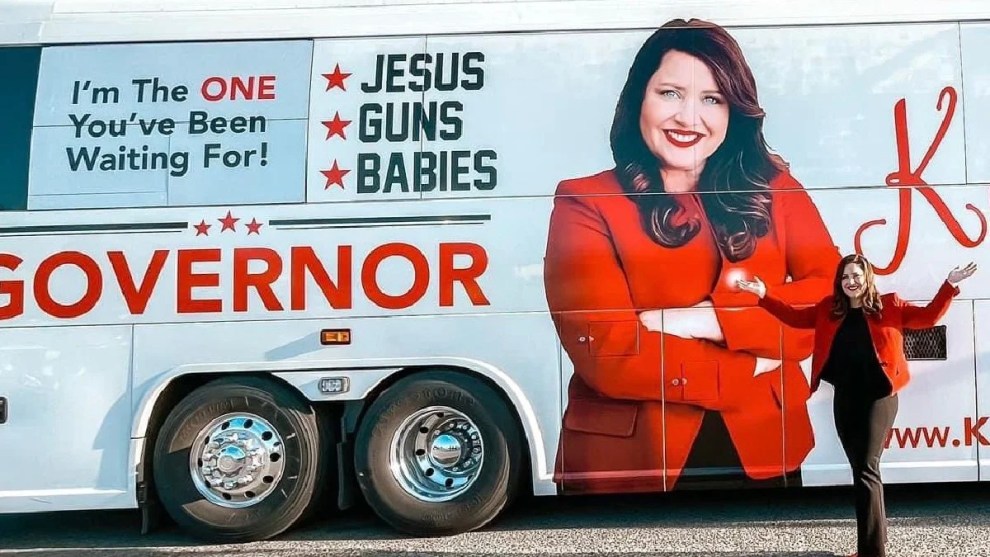
Kandiss Taylor took that politics onto the campaign trail in Georgia’s 2022 Republican primary for governor. Her bus carried a three-word slogan: “Jesus, Guns, Babies.” She finished third with about 3 percent of the vote, but kept pursuing public office, announcing a congressional bid in February 2025.
Her demands for government were explicit. During an August 17, 2024, broadcast with Stew Peters, she said: “We shouldn’t be electing anyone in government—local, state or federal—that is not a Christian.” She also challenged the idea that she had to grant others freedom of religion.
Article VI of the Constitution bars religious tests for federal office. Taylor’s proposal would replace equal citizenship with a hierarchy of belief. People outside her religion could live in the country, but should be kept from governing it.
These figures state in unusually direct terms what is at stake when national belonging is tied to a particular religious identity. The struggle is over the rights of everyone who lives under the government, including those who will never share the rulers’ faith. The claim that God has chosen a political movement leaves little room for those citizens to say no.
10 · The Bible business
A sacred text. A licensing deal.
By March 2024, Trump was selling a Bible. In a promotional video, he urged supporters to buy the God Bless the USA Bible, associated with singer Lee Greenwood. The original $59.99 edition bundled the King James Bible with America’s founding documents and the lyrics of Greenwood’s patriotic anthem. Faith, nation and the Trump brand arrived between the same covers.
Trump’s role was a paid endorsement and licensing arrangement. Buyers were not simply donating to his campaign. The transaction also enriched his private business. Financial-disclosure reporting put his Bible-licensing income at $1,306,035 for 2024 and $208,486 for 2025: $1,514,521 across those two reporting years.
The marketing completed a circle that began with the candidate who would not name a verse. He no longer needed to demonstrate familiarity with the text. His endorsement was itself the product’s selling point.
The classroom became the next battleground.
In Oklahoma, schools chief Ryan Walters tried to bring Bibles into public classrooms and sought millions of dollars for the project. The state bought about 500 Trump-endorsed Bibles for roughly $25,000. His much larger ambition—55,000 Bibles—never became a completed purchase. Parents and civil-liberties groups went to court.
The challenge put a direct question before the state: why should families fund a religious program through public schools, with a politically branded Bible at its center? In March 2025, Oklahoma’s Supreme Court blocked further purchases while the case proceeded. After Walters resigned, his replacement, Lindel Fields, rescinded the classroom mandate in October 2025.
The reversal matters. This was an attempt to put a particular religious and political project into public education, and it met resistance from parents, courts and eventually the state’s own leadership. The Bible had become a test of who was entitled to use the classroom.
11 · The protection
Moving the boundary between church and campaign.
Trump’s alliance with religious leaders also targeted the rules governing their political activity. On May 4, 2017, he signed an executive order on religious liberty at the White House. He presented himself as the president freeing clergy to speak, with the Johnson Amendment—the restriction on candidate intervention by tax-exempt charities—cast as a restraint to be broken.
The distinction was important to the bargain. A church can discuss public issues. Using its tax-exempt organization to support or oppose a candidate raises a separate legal question. Relaxing that boundary would make congregational networks more valuable to political campaigns while preserving the financial advantages attached to religious charities.
The fight continued into Trump’s second term. In 2025, the IRS proposed settling a lawsuit brought by religious broadcasters and churches with language accommodating certain political endorsements in communications to congregants. On March 31, 2026, a federal judge dismissed the case for lack of jurisdiction instead of approving the settlement. The government appealed. As of this investigation’s November 8, 2026, review, the proposed agreement had not become the sweeping permission its supporters sought.
Alongside that legal campaign stood the Faith Office’s formal access to federal agencies. One project sought more room for political activity by churches; the other offered religious organizations a stronger channel into the executive branch. Both rewarded leaders who had spent years telling their audiences that Trump was essential to their future.
12 · The result
When the vote defied the prophecy.
Lorenzo Sewell had delivered a prayer at Trump’s second inauguration. On November 4, 2026, after Republicans’ midterm defeats, he appeared on FlashPoint with a different message: “we need another January 6.” He said he was preparing to go to the Capitol and had already spoken to friends.
His suspicion that Democrats had stolen the election rested on a “Holy Ghost hunch.” He cited the number of counties Republicans had carried in Michigan, Texas and Ohio, treating a map’s red acreage as evidence against the voters’ result. Counties contain vastly different numbers of voters; winning more of them does not establish who won a statewide election.
Right Wing Watch published the recording on November 5. Sewell cast the church’s task as recovering what the devil had taken. A democratic defeat had become a spiritual theft, and another confrontation at the Capitol his proposed answer.
The congregation was never the whole story.
The spectacular clips are easy to remember: White summoning angels, Copeland laughing, Locke declaring that a Democrat cannot be a Christian, Witzke calling for a king. Behind them sit pastors’ networks, influencer businesses, voter registration, donor meetings, litigation plans, licensing revenue and access to the White House.
Trump benefited from each part. Religious leaders gave political loyalty a moral vocabulary. Organizers gave it a route to the ballot box. Online personalities carried it into family life. Lawyers and donors pursued changes that could outlast a presidency. The president returned appointments, access and a place at the table.
The price was paid inside the churches as well as outside them. A congregation that makes allegiance to a politician a test of faith leaves its members less room to question that politician. A movement that describes an election as a battle against demonic forces makes an ordinary democratic loss harder to accept. Public schools and government agencies become territory to be won for a religiously defined political project.
In 2015, Trump would not give the interviewers a Bible verse. Over the following decade, his allies supplied a much larger story about him: flawed vessel, chosen fighter, indispensable protector. The story kept him at the center. The institutions, the voters and the money followed.
The reporting
Follow the sources.
This account draws on original speeches, official orders, polling, court records and investigations by the publications credited throughout. Video captions identify the recording and its publisher.
Documents, investigations and interviews
- The 2015 Bloomberg interview, reported at the time
- Pence and the evangelical electorate
- Trump’s August 2018 dinner with evangelical leaders
- Dobbs: Supreme Court opinion
- Wallnau explains his view of Trump
- Research: the political use of the Cyrus comparison
- Turning Point Faith: its stated mission
- The church network and training
- Freedom Nights
- NPR: the 2024 turnout effort
- Alberta on evangelical extremism and its incentives
- Religion News Service: Turning Point after Charlie Kirk
- Religion News Service: Feucht’s Washington connections
- Word&Way: the CPAC prayer performance
- The sentence and the staged cell
- The speech and its church-state claim
- FFRF’s contemporary letter
- Stuckey’s description of her work and books
- Religion News Service: Christian momfluencers and the right
- Religion News Service: the June 2026 women’s summit
- Media Matters: the accounts, examples and recommendation test
- National Catholic Reporter: Owens’s conversion and political career
- The Christian Post: the Phoenix speech
- The organizers’ event record
- Right Wing Watch: the video Hegseth promoted
- Right Wing Watch: Webbon’s argument against women voting
- CNN: the Pentagon service and Hegseth’s church
- Tennessee Lookout: Hegseth’s Nashville speech
- PBS News: the March 25 Pentagon prayer service
- Documented: internal strategy and donor records
- ADF model legislation
- ProPublica and Documented: the 2024 operation
- The November 2020 prayer service
- The 2019 remark and its context
- Executive order establishing the Faith Office
- The Christian Post: White’s Easter remarks
- The May 2022 sermon
- PBS NewsHour’s reporting on Global Vision
- The tax-exemption complaint and quoted sermon
- AP: the use of Jezebel against Harris
- NPR: Matthew Taylor’s investigation
- Christian nationalism and January 6: documentary report
- Right Wing Watch: Wallnau after the debate
- Religion News Service: Vance at the Courage Tour
- Religion News Service: Fuentes and the Catholic far right
- Right Wing Watch: Witzke’s January 2024 broadcasts
- NPR: white nationalists’ attraction to Putin
- WTOC: Taylor explains her 2022 campaign slogan
- Right Wing Watch: Taylor’s August 2024 remarks
- AP: Taylor’s primary result and House campaign
- The Constitution: Article VI
- Religion News Service: the paid endorsement
- Reported income from the 2025 financial disclosure
- The two years of Bible-licensing income
- Oklahoma purchases and funding dispute
- The parents’ petition
- KGOU: the court’s March 2025 intervention
- AP: the mandate is rescinded, October 15, 2025
- Trump’s May 4, 2017, remarks
- March 31, 2026: the federal court’s order
- The appeal and the parties’ positions
- Right Wing Watch: Sewell’s post-election call to return to the Capitol