An investigation · Access, protection and the fight for the files
Trump and the Epstein files.
The promise was disclosure. The records tell a more difficult story.
An early warning, a prosecutor’s deal and years of unanswered questions led to a fight over what Trump’s administration would release—and whose information it would protect.
Follow the story ↓︎Katie Phang’s court challenge ↓︎
The story ahead
In February 2025, Attorney General Pam Bondi announced a first release of Epstein records. By July, the Justice Department and FBI were saying further disclosure was unwarranted. Congress subsequently passed a law requiring the release of covered files. Millions of pages emerged, but so did omissions, exposed survivors’ identities and a court battle over documents the government had kept back.Related passages: Pam Bondi →︎
That reversal is easier to understand through the people in the record. Trump had known Epstein socially. Maria Farmer had reported him to the FBI in 1996. A prosecutor who negotiated his federal deal later joined Trump’s cabinet. Each part of the history raises a different question about knowledge, judgment and responsibility. Together, they explain why publishing the files became a test of the institutions that had handled Epstein’s case for decades.Related passages: Maria Farmer →︎
Updated October 7, 2026 · financial reporting through September 30 · court rulings through September 24
01 · The Epstein story
The friendship that brought the files to the White House.
1992–2006 · The friendship and the warning
In the 1992 footage, Donald Trump and Jeffrey Epstein appear entirely at ease. They mingle at a Mar-a-Lago party, laugh and watch the women around them. Years before Epstein became a scandal that successive administrations would struggle to answer for, he was a familiar presence in Trump’s social world. That relationship would eventually follow Trump back to the White House, where his administration would decide what the public could see of the government’s files.
The footage establishes their familiarity. A separate record raises a more difficult question about what Trump knew. Michael Reiter, the former Palm Beach police chief, told the FBI in 2019 that Trump had called him in 2006, when police were investigating Epstein. According to Reiter, Trump welcomed the investigation, described Ghislaine Maxwell as Epstein’s operative and said he had left an occasion where teenagers were present.
ABC reported the account after the FBI interview summary was released. The Justice Department told the network it had no corroborating evidence that the call took place. Reiter’s recollection, recorded thirteen years after the alleged conversation, therefore cannot settle what Trump understood at the time. It does explain why the interview matters: it concerns what a future president may have known while authorities were pursuing a man he had socialized with. The government had already received a warning about Epstein long before that investigation.
“Thank goodness you’re stopping him, everyone has known he’s been doing this.”
02 · The Epstein story
Maria Farmer had gone to the FBI in 1996.
1996 →︎ December 2025 · Maria Farmer
On September 3, 1996, an artist reported Epstein to the FBI. The complaint described concerns about photographs of her younger sisters, his conduct and a threat to burn down her house if she spoke. When the document became public in December 2025, Maria Farmer’s lawyer identified her as the woman who had made it. Nearly three decades had passed between the warning and its public confirmation in the government’s own paperwork.
For Farmer, the release answered a question she had spent years trying to put beyond doubt: she had told the authorities. The complaint placed that warning well before Epstein’s first prosecution. It also shifted attention away from the famous people appearing in the files and toward the officials who had received information about him. The record of a report is only the beginning of that inquiry; what followed it is the part the institution must explain.
House Oversight Democrats asked the inspector general to investigate the FBI’s response, including why later internal reviews had not meaningfully addressed Farmer’s complaint. Their request made the passage of time central to the case. A warning had reached the government in 1996. When a federal investigation eventually threatened Epstein with prosecution, more than a decade later, it ended in an agreement that would itself become the subject of an internal review.Related passages: Todd Blanche →︎
03 · The Epstein story
The prosecutor who made the deal joined Trump’s cabinet.
2007–2008 →︎ 2017–2019 · Alexander Acosta
The federal investigation was handled by an office led by Alexander Acosta, then the US attorney. In 2007–2008, it was resolved through a non-prosecution agreement, with Epstein facing state charges instead. The decision spared him a federal prosecution and left lasting questions about how prosecutors had exercised their discretion in a case involving a wealthy, well-connected man.
The Justice Department’s Office of Professional Responsibility later found that Acosta had exercised poor judgment in reaching the agreement and in failing to ensure that victims were notified of the state plea hearing. It found that the victims had not been treated forthrightly and sensitively. The review did not find professional misconduct. Its criticism was nevertheless substantial: the department’s own investigators concluded that important decisions about the case and the treatment of victims had been badly handled.
By the time the agreement returned to public attention, Acosta was Trump’s labor secretary, appointed in 2017. At his resignation in July 2019, Trump stood beside him and praised his work. Trump described the controversy as an old deal that people had once accepted and were now unhappy about, and said he had told Acosta he did not have to resign. A decision made in a Florida prosecutor’s office had become a problem for the president’s cabinet. Other records would show how people around Epstein had privately discussed Trump’s relationship with him.
“You don’t have to do this.”
The prosecution’s later aftermath: Maurene Comey
October 26, 2026 · Court ruling
A Maxwell prosecutor wins her case against the Justice Department.
Maurene Comey helped bring the federal case against Jeffrey Epstein and prosecute Ghislaine Maxwell. The Maxwell team received a Justice Department award for its work. In July 2025, the same department fired her without warning.
On October 26, 2026, Judge Jesse Furman ruled that the dismissal was unlawful and ordered retroactive reinstatement and back pay. DOJ had admitted that her performance was not the reason for removing her. Comey, whose father is former FBI director James Comey, alleged that she had been targeted over her family ties or perceived political views.
Her departure removed an experienced prosecutor from the office that had brought the Epstein and Maxwell cases. The lawsuit exposes how Washington did it—and the protections it ignored.
04 · The Epstein story
In private, Trump’s connection was something to bargain with.
2011, 2015 and 2019 · Released by Congress in November 2025
The emails released by House Oversight Democrats in November 2025 opened a window into those conversations. Epstein used “dog that hasn’t barked” to describe Trump in a 2011 exchange with Maxwell. He wrote that a victim had spent hours at his house with Trump, yet Trump had not been mentioned. Maxwell replied that she had been thinking about it. This was Epstein describing an encounter and its absence from the public discussion; the email itself does not independently establish that encounter.
Four years later, Epstein and the author Michael Wolff discussed how Trump might answer questions about their relationship. Wolff suggested allowing Trump to deny visiting Epstein’s house or plane, then using a contradiction to gain political advantage. Alternatively, he suggested helping Trump avoid the problem and creating an obligation. The exchange shows Wolff proposing ways to use potentially embarrassing information, rather than simply discussing whether to publish it.
In 2019, Epstein wrote that Trump knew about the girls and had asked Maxwell to stop. That assertion, too, was Epstein’s. The emails document what he and Wolff said to each other; they do not, by themselves, prove the underlying allegations or criminal conduct by Trump. Their significance is in the private discussion they preserve. Years before Trump’s administration controlled the release of these records, his connection to Epstein was already being discussed as a source of possible pressure.
05 · The Epstein story
Blanche’s interview put Maxwell’s account back in the spotlight.
July 24–25, 2025 →︎ prison transfer
By July 2025, the administration’s position on disclosure had changed. A joint Justice Department and FBI memorandum said further release was unwarranted. Later that month, Todd Blanche—Trump’s former criminal defense lawyer, now deputy attorney general—personally interviewed Maxwell over two days. The administration was resisting demands for more files while one of its most senior officials sought a fresh account from Epstein’s longtime associate.
Asked about Trump, Maxwell spoke warmly of him, praised his election and said she had never seen him receive a massage. The transcript and audio, released in August, made those answers available to the public, along with Blanche’s questions. For an administration facing scrutiny over Trump’s relationship with Epstein, favorable statements from Maxwell were politically useful. They remained her account, to be assessed alongside the other evidence.
About a week after the interviews, Maxwell was transferred from a low-security prison in Tallahassee to a minimum-security prison camp in Bryan, Texas. Senators sought the records behind that decision: who had approved it and whether normal security requirements had been waived. The timing raised questions, but the available record does not establish a bargain linking the interview to the transfer. Elsewhere in the files, reporters were finding reasons to doubt that all the relevant paperwork had been released.
06 · The Epstein story
A reporter checked the release against its own paper trail.
February 24 →︎ March 6, 2026 · NPR’s investigation
NPR’s Stephen Fowler found omissions by comparing document numbers and references across the released collection. Records pointed to other records that were absent, including interview material concerning allegations against Trump. The scale of the release offered no answer to that problem. A collection containing millions of pages could still leave out documents that its own contents indicated should exist.
After NPR reported the gaps, the Justice Department published additional material on March 5, 2026. Fowler’s follow-up identified sixteen newly released pages: three FBI interview summaries and two intake-form pages. The department said fifteen documents had been incorrectly classified as duplicates. As of NPR’s March 6 report, thirty-seven related pages were still missing.
Those figures describe the collection at that point in March, rather than its present contents. Nor did publishing the interviews turn the allegations they contained into established facts. What the reporting demonstrated was a failure in the release process: records emerged after journalists identified omissions. The dispute over what counted as a duplicate would later reach a judge. Meanwhile, a Senate inquiry was approaching Epstein’s operation from another direction—the banks that had handled his money.
October 26 · House Judiciary Democratic report
A witness speaks. The demand for the files grows.
Beatrice Keul was 24 when she traveled from Switzerland to Trump’s American Dream pageant in 1993. A model who also worked in financial services, she expected an opportunity. At the Plaza Hotel, she says, Trump offered help with a visa and a place at New York University. He told her a friend called Paolo would handle the arrangements.
In the account published by House Judiciary Democrats on October 26, Keul says a Trump representative later brought her upstairs to a suite, where Trump raped her. The report identifies Paolo as Paolo Zampolli and describes Epstein approaching Keul at the same event, introducing himself as Trump’s friend and making his own offers of travel and accommodation.
Keul had spoken publicly before about an attempted assault. The report says this fuller account comes from several weeks of interviews with committee staff. Its photographs place her at the 1993 pageant; its footnotes identify the source of the new testimony.
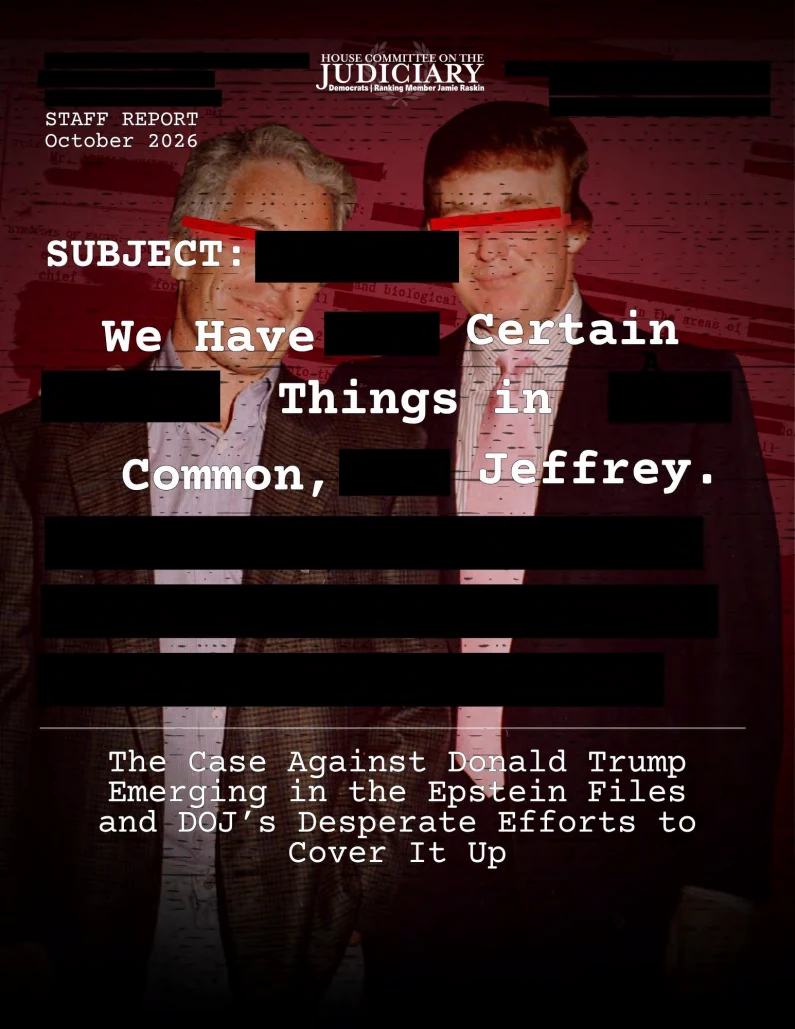
House Judiciary Democrats · Witness accounts, documentary references and a call for a criminal investigation.
Read the original document
The report assembles accounts involving eleven women and calls for a criminal investigation and a special counsel. The accounts cover different conduct and different relationships with Trump and Epstein. The report’s central challenge is to the Justice Department: why have those witnesses and the records behind their accounts not received the scrutiny their allegations demand?
That question runs through the history of the files. There are the missing files, the treatment of survivors and the Justice Department’s interview with Ghislaine Maxwell. Todd Blanche, Trump’s former criminal defense lawyer, conducted that interview after joining the administration. The new report examines how the department pursued that account while other evidence remained withheld or unexplored.
Keul’s account gives that dispute a human center. The promises she describes—immigration help, education, travel and access—were the inducements of powerful men to a young woman looking for a future. The report puts her words beside the documents and asks what the government has done with them.
07 · The Epstein story
The financial record extended beyond Epstein himself.
August →︎ September 30, 2026 · The financial investigation
Senator Ron Wyden’s August 2026 investigation examined relationships that continued for years at JPMorgan Chase, Deutsche Bank and Bank of America. His report described more than $1.4 billion in questionable transactions moving into and out of Epstein’s accounts, flagged retrospectively. These were gross movements of money, not a measure of his personal wealth or a sum that could simply be labeled criminal proceeds.
One route involved approximately $170 million paid from Leon Black’s accounts between 2012 and 2017 for purported tax and estate-planning services. The report traced payments through Bank of America to Epstein-controlled companies holding accounts at JPMorgan and Deutsche Bank. The diagram follows that route. Those payments overlap the wider transaction record, so adding the two figures would exaggerate the total.
Wyden’s report alleged serious compliance failures and called for investigations of individual bankers and other participants. Those allegations were not criminal verdicts. They widened the inquiry, however, to institutions equipped to examine unusual activity and required to report suspicious transactions. Understanding how Epstein continued to operate meant examining the decisions made inside those institutions as well as his own conduct.
On September 30, Wyden wrote to Blanche and FBI director Kash Patel about an interview with an Epstein-linked banker that his staff had learned of but could not find in the released files. He sought that report and other banking-related interview records. The letter did not publicly identify the banker or disclose what had been said. It brought the financial inquiry back to the same practical obstacle facing journalists and survivors: assessing the government’s response depended on obtaining records the government held.
08 · The Epstein story
The release exposed survivors. Bondi was asked to face them.
January–February 2026 · Privacy and accountability
For survivors, the handling of the files had consequences far beyond arguments about completeness. AP reported that the January 2026 release exposed names, identifying details and other sensitive information without adequate protection. People whose experiences were central to the investigation were left trying to limit the spread of private information published by the government.
Some were in the room when Attorney General Pam Bondi appeared before the House Judiciary Committee on February 11. Representative Pramila Jayapal asked her to turn toward them and apologize. Bondi invoked Merrick Garland, and the exchange became an argument over responsibility and who could speak. She did not give the apology Jayapal requested.
The hearing brought together two failures that are sometimes treated as competing concerns. Records needed to scrutinize official decisions had been withheld or omitted; information capable of identifying survivors had been exposed. Releasing more pages would not, on its own, remedy either problem. The disclosure law allowed protection for survivors while requiring the release of covered records. Enforcing that distinction would become a central issue in court.
“Will you turn to them now and apologize”
The documentary record
How the promise of disclosure changed.
The administration’s promise of disclosure gave way to a refusal, a congressional mandate and a contested release. As records appeared, journalists traced the gaps and a judge began examining the government’s reasons for withholding material.
The first-phase release
Attorney General Pam Bondi announced an initial declassification release. DOJ acknowledged that much of this material had previously leaked and promised further review and disclosure.Related passages: Pam Bondi →︎
DOJ and FBI say further disclosure is unwarranted
A joint memorandum said the review found no incriminating client list and no basis for investigating uncharged third parties. It concluded that further disclosure was not appropriate.Related passages: Pam Bondi →︎ · Karoline Leavitt →︎
The birthday-book page attributed to Trump
The House Oversight Committee released records supplied by Epstein’s estate, including a 2003 birthday album. One page bears Trump’s name and a suggestive drawing. Trump denies writing or drawing it; the White House disputed its authenticity.
View the disclosed birthday-book page
Page 165 of the estate collection released by Congress. Trump denies authorship.

Estate document released by House Oversight Democrats, reproduced by PBS News.
Inspect the page and surrounding documentsA disclosure law and a staged production
Trump signed the Epstein Files Transparency Act on November 19. DOJ’s December 19 letter described its production and review process under that law.
Thomas Massie: the disclosure fight and his primary defeat →︎
A prosecutor flags Trump’s flights
Record EFTA00029798, page 1, is an assistant US attorney’s email summarizing flight records. It says Trump appeared on at least eight flights between 1993 and 1996, with Maxwell on at least four. This is a prosecutor’s summary of records, not a criminal charge against Trump.
DOJ announces 3.5 million responsive pages
DOJ announced more than three million additional pages, bringing its stated total to nearly 3.5 million, plus video and image material. It identified withholding categories including victim protection, privileged material and duplicates.
The archive is not a verdict
The DOJ library displayed a last-updated date of September 11, 2026, when reviewed for this page. Its search and disclosures remain the route to original material; files may be corrected to protect victims.
September 8, 2025 · Reporting on the estate documents, the attributed page and Trump’s denial.
Watch the source recording09 · The fight for the record
The disclosure fight reached a judge.
Congress had written the disclosure requirement to address the possibility of political embarrassment. The Epstein Files Transparency Act required the covered unclassified records to be published within thirty days and expressly prohibited withholding them because of reputational harm, embarrassment or political sensitivity. It allowed survivors’ identifying information to be protected. Whether the department had followed those rules was a question a court could examine.Related passages: The Epstein release →︎
Journalist and lawyer Katie Phang brought that challenge. After a preliminary injunction in June 2026, the dispute continued over material the department had withheld. On September 16, Judge Emmet Sullivan rejected the argument that handwritten FBI interview notes could be treated as duplicates of typed summaries. He ordered the redacted and unredacted notes behind four specified reports submitted for his private review. The distinction between an original note and a later summary now required an answer from the department.
The ruling did not immediately make those notes public. Sullivan would examine them in chambers. He also required evidence supporting three disputed victim-name redactions and rejected administrative inconvenience as a reason to leave foreign-language material unreviewed. Other victim-protection redactions were upheld, and he considered a contempt finding premature. The court was testing particular withholding decisions, rather than ordering every document released without restriction.
On September 21, Sullivan temporarily paused the foreign-language deadline while the department sought relief from the appeals court; the private-review deadlines remained in place. In its September 24 answer, the government continued to deny non-compliance. Those filings capture the dispute at that stage: the department defending its decisions, and a judge requiring it to produce material and explanations that could be examined independently.
Farmer had spent years seeking recognition that she had warned the FBI. Reporters later had to identify missing pages, and a senator sought a banker’s interview absent from the release. Phang’s case put the burden back on the department to justify specific decisions about its files. None of those records alone resolves every allegation surrounding Epstein. They do make it possible to ask something more precise of the institutions involved: what information they received, what they did with it and why the public was still having to fight to see it.