
CISA and election officials
No evidence that voting systems deleted, lost or changed votes.
Examine the record ↓The January 6 record
The December 18 White House confrontation, the mobilization that followed and witness accounts of January 6, 2021. Read the evidence and hear the people who testified.
Enter the record ↓Official committee archive ↗︎January 6 began long before the first barrier fell at the Capitol. Trump had lost the election, but he kept telling his supporters that victory had been stolen from them. Officials checked the voting systems. The Justice Department investigated allegations. Courts heard challenges. None produced a basis for overturning the result. The claims kept coming anyway.
That is the thread running through this record: a defeated president’s insistence that he should remain in power, the people who supplied arguments for it, and the consequences when those arguments reached the streets. Follow it from the official checks to a furious White House meeting, through the attack itself, and into the testimony, recordings and documents that make the story possible to reconstruct.
Before the attack
No evidence that voting systems deleted, lost or changed votes.
Examine the record ↓Trump dismissed his own CISA director after the public contradiction.
Examine the record ↓Specific allegations were investigated; none supported reversing the result.
Examine the record ↓Roughly 60 challenges produced no judgment changing the presidential result.
Examine the record ↓“Most secure” was the election-infrastructure coalition’s finding, not Bill Barr’s phrase. Barr’s separate conclusion concerned the fraud allegations investigated by DOJ and the FBI.
The allegations had to do more than sound alarming in a speech or a television interview. In court, lawyers had to support them. The cases below show what happened when the campaign to reverse the election met judges, deadlines and demands for evidence. This was one of the places where the stolen-election story came apart.
The election claims in court
Some cases ended on procedural grounds. Others also examined the allegations and the material offered to support them. A filed affidavit is not automatically proof; a dismissal for lack of standing is not a finding that the allegations are true. The reasons matter, case by case.
Trump v. Boockvar
Observer restrictions and unequal-treatment allegations
Judge Matthew Brann examined the campaign’s claim that restrictions on election observers supported its equal-protection case. He checked the allegations the campaign cited and found that none said Trump’s observers had been treated differently from Biden’s. Restrictions on observation, by themselves, did not establish the unequal treatment alleged.
The opinion directly addresses the campaign’s account of observer restrictions on pages 32–34. Brann considered those allegations even though the remaining count did not seek relief on that basis. He found no plausible claim of unequal treatment and described the wider case as resting on speculative accusations unsupported by evidence. The campaign’s request to stop certification was dismissed with prejudice.
Bowyer v. Ducey
Witness accounts, statistical reports and voting-machine claims
Judge Diane Humetewa examined the declarations and expert reports submitted to support the fraud allegations. She found that anonymous accounts, hearsay and analysis of unrelated elections failed to substantiate the claims. Her opinion then addressed specific weaknesses in the purported evidence:
The court explained why the submitted material did not plausibly establish fraud or justify overturning the result. The opinion contains a direct assessment of the claims and their supporting reports, alongside the procedural grounds for dismissal. Saying the judge refused to consider any of it misrepresents the ruling.
By December 18, those setbacks had still not brought the campaign to an end. Inside the White House, the argument moved toward extraordinary ways of intervening in an election Trump had lost. The clash below matters because it shows the resistance coming from his own lawyers—and how far other people in the room were prepared to push.
December 18, 2020 · Inside the meeting
A proposal to seize voting machines. A bid to give Sidney Powell federal powers. White House lawyers demanding evidence as the room erupted into shouting and insults. The July 12 hearing reconstructed more than six hours of confrontation from participant testimony and staff accounts.
Sidney Powell, Michael Flynn and Patrick Byrne reached the Oval Office without an appointment. Powell told the committee they had roughly ten to fifteen minutes with Trump before White House advisers arrived.
Pat Cipollone joined Eric Herschmann and Derek Lyons. Cipollone said he did not understand how the group had gained access and did not believe they were giving Trump good advice. The confrontation would move through the West Wing and upstairs to the residence.
The committee presented a draft order directing the Secretary of Defense to seize voting machines and envisaging a special counsel with seizure and prosecution powers. Powell was the proposed appointee. Cipollone opposed both the seizure scheme and giving her that authority; he said there was no legal basis for federal seizure of state voting machines.
Herschmann described claims involving foreign interference, an international communications diagram and internet-connected thermostats. Cipollone pressed for facts. Lyons recalled being told that evidence not yet available would materialize. Herschmann challenged Powell’s explanation that adverse court decisions meant the judges were corrupt—including judges Trump had appointed.
Lyons described shouting and personal insults. Herschmann recalled Flynn repeatedly standing up and screaming that he was a quitter; he shouted back at Flynn to sit down. Giuliani acknowledged insulting the White House team for not being tough enough. The committee heard from staff who could hear screaming outside the Oval Office.
Lyons confirmed the account that Trump challenged his lawyers for offering no solutions while Powell and the outsiders were offering a way forward. Powell, in turn, said she would have fired the opposing advisers and had them escorted out.
Powell testified that Trump named her special counsel and granted the necessary security clearance. Cipollone said further steps and paperwork were required and, in his view, she was never appointed. The hearing preserved that disagreement rather than presenting a completed appointment as fact.
After more than six hours, the meeting broke up. Cassidy Hutchinson’s messages described the disorder and Meadows escorting Giuliani off the grounds. No machine-seizure order emerged from the meeting, and no completed Powell appointment followed.
After the participants left, Trump announced a “big protest” in Washington for January 6. The committee treated the post as a major mobilization point; sequence alone does not prove how every attendee interpreted it.
A participant-based reconstruction of who entered, what they argued over and how the meeting moved into the early hours.
Read the reconstruction ↗︎The meeting ended without the proposed seizure of voting machines. Soon afterwards, Trump called supporters to Washington for January 6. The committee examined how that invitation helped mobilize the crowd. When the day arrived, the fight to stop the transfer of power moved from arguments inside the White House to an attack on Congress. The timeline below follows the hours when Trump’s response mattered most.
January 6, 2021 · Inside the attack
Speech ends → go-home video.
Seven documented markers. All times EST.
The committee used the end of Trump’s speech as the starting point for its 187-minute examination of his response.
The committee placed Trump in the Oval Dining Room shortly after returning from the Ellipse. Witnesses described Trump watching television coverage playing there as the attack developed.
Rioters entered the building and Vice President Pence was removed from the Senate chamber. Requests for Trump to make a forceful statement were already reaching the White House.
Trump posted that Pence lacked courage while the attack was underway. Pottinger and Matthews described their reactions to this message in the July 21 hearing.
Trump asked people to support Capitol Police and stay peaceful. The message did not tell the attackers to leave the Capitol.
Trump wrote that everyone at the Capitol should remain peaceful. Aides and allies continued pressing for a direct instruction to leave.
Trump released a video directing the crowd to go home while also expressing affection for them. The attack and its consequences did not instantly end with this message.
This interval measures two public events. It does not mean there were no communications in between. The July 21 hearing examined intervening messages, requests from aides and Trump’s response.
The violence did not end the campaign to explain away Trump’s defeat. To understand why the stolen-election story had such a grip—and why it survived the official checks—we need to return to the people who built it. Allegations about voting machines offered a technical-sounding explanation for an outcome Trump’s supporters did not want to accept. The film and records below follow how those allegations acquired an audience.
How the machine myth was built
Follow the claims, the people who promoted them, and the counterevidence in the existing research record.
Availability varies by country. If YouTube reports a country restriction, try a VPN connected to a country where the video is available.
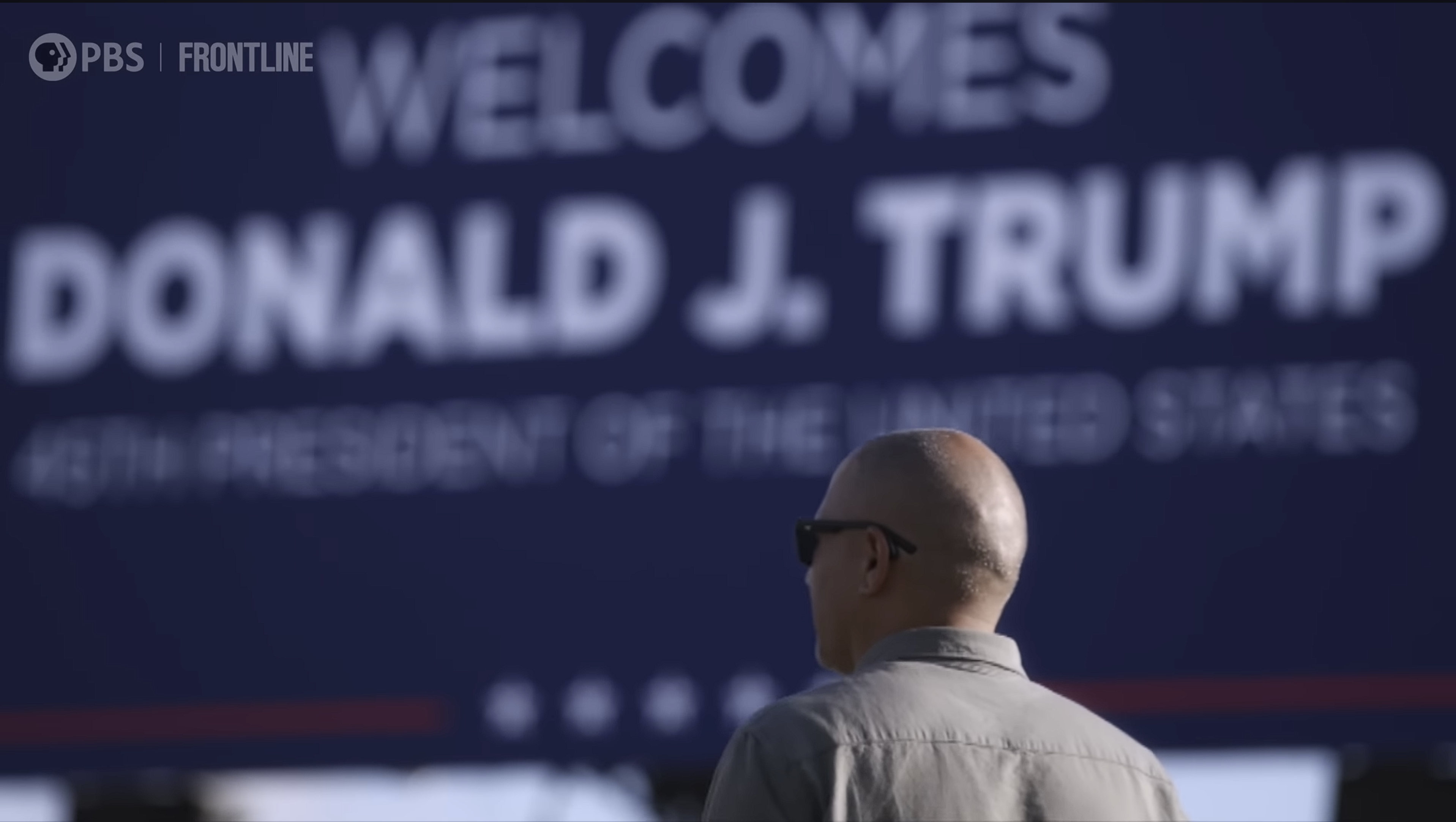
The next step is to put those stories beside the evidence they claimed to describe. Maricopa is especially revealing: the partisan review’s own hand count increased Biden’s margin, yet the county remained a focus of suspicion. Each case below follows the same essential trail: what was alleged, what was checked and what the check actually found.
Read · Inspect the sources
Claims of a stolen election spread through a network of lawyers, activists and self-styled experts. These records trace who promoted them, how they traveled, and what happened when they were tested. Follow each claim to the documents, testimony and investigations that exposed its flaws.
Sidney Powell traveled to lawyer Lin Wood’s South Carolina property, where a loose coalition including Michael Flynn, Patrick Byrne, lawyers and technical advisers worked on claims that voting machines had stolen the election.
ProPublica and FRONTLINE interviewed eight people with firsthand knowledge and reviewed internal communications. FRONTLINE also interviewed Dave Hancock, a former Navy SEAL and security consultant who had worked at the property. The documentary presents more than 1,000 emails and hundreds of text messages that helped reporters reconstruct how the operation worked.
The records show the property operating as a hub where tips were collected, lawsuits and publicity were discussed and access to voting equipment was pursued. That documented activity is stronger evidence than trying to infer the network from public appearances alone.
Podcaster Joe Oltmann said he had infiltrated an “antifa” call and heard Dominion employee Eric Coomer promise that Trump would lose. Powell and Giuliani highlighted the allegation publicly and Powell used it in court filings.
A person familiar with Powell’s investigation told ProPublica that an investigator she paid interviewed Oltmann and reported that he was, at minimum, embellishing. Oltmann never produced proof that Coomer was on the call. The allegation nevertheless appeared in later filings.
Anonymous declarations from online personality Terpsehore Maras and statistical videos by Edward Solomon were used to suggest foreign interference and an algorithm that shifted votes to Biden.
Patrick Byrne’s investigators concluded that Maras could not be relied on for factual claims, after one of her declarations had already been filed. Independent statisticians found that Solomon’s supposedly suspicious vote patterns were normal and that his method was “fishing for a finding.” Byrne still described Solomon as a renowned mathematician months later.
Powell and Giuliani publicly linked Dominion and Smartmatic to a Venezuelan scheme supposedly created to rig elections for Hugo Chávez.
An internal Trump-campaign memo found that Dominion had no ownership relationship with Smartmatic, did not use its software and had no direct ties to Venezuela. The memo was prepared before the campaign’s lawyers repeated the theory at their November 19 press conference.
A report promoted by the allied group treated an initially incorrect unofficial tally in Antrim County, Michigan, as evidence that Dominion machines could switch votes nationwide.
The county corrected a human configuration and reporting error before certification. University of Michigan computer scientist J. Alex Halderman reviewed the records and found no evidence that Dominion caused the error or that the official result was wrong. A Republican-led Michigan Senate investigation called the fraud theory baseless.
Arizona activist Staci Burk relayed a story that counterfeit ballots had arrived by aircraft and were moved by truck, and the allegation circulated among people organizing challenges to the result.
Investigators working for the group located the alleged source, who admitted fabricating the story. ProPublica reported that the internal finding was not made public at the time. Burk later said she had believed false claims and felt used as a prop.
Mary Fanning and Alan Jones of The American Report published Montgomery’s claim that a secret surveillance system called Hammer, using software called Scorecard, had been turned on the 2020 election. Fanning introduced the material to Mike Lindell, who promoted supposed packet captures as proof of foreign election manipulation.
No authenticated election packet captures were produced. Before the symposium, Lindell’s own Red Team wrote that the files were “NOT PROOF” and could have come from anywhere or been fake. Independent analysts found no source, chain of custody or valid election traffic. Texts later filed in litigation recorded Lindell saying Montgomery had supplied no PCAPs for the event.
Montgomery had previously sold the U.S. government software said to find terrorist messages in Al Jazeera broadcasts and identify targets in Predator-drone imagery; former associates later described that work as a sham, allegations Montgomery denied and which did not produce criminal charges. Salon reported that Lindell financed a luxury Florida home for him; later court-filed texts referred to a $2 million home and another $1.1 million. The payments did not validate the data.
Cyber Ninjas and allied funders pursued theories involving deleted votes, internet connections, bamboo fibres and other supposed signs of counterfeit or manipulated ballots in Arizona.
The review’s own hand count produced 99 more votes for Biden and 261 fewer for Trump, increasing Biden’s county margin by 360. Maricopa County’s detailed response later classified seven Cyber Ninjas claims as false, 23 as inaccurate and nine as misleading.
ProPublica traced about $5.7 million in private support for the review to organizations associated with Byrne, Flynn, Powell and Wood, showing how the post-election network outlived January 6.
Lindell offered $5 million to an eligible symposium attendee who could show that his data was not valid 2020 election data. Software expert Robert Zeidman concluded it was not election packet-capture data and submitted a challenge.
An arbitration panel awarded Zeidman the prize and a federal district court confirmed it. A federal appeals court later vacated the award because it found the arbitrators had interpreted the contest contract too broadly; the Supreme Court declined Zeidman’s appeal in 2026. None of those later contract rulings authenticated Lindell’s files or established that they recorded election interference.
The legal result and the technical result answer different questions. Lindell ultimately escaped the prize payment, but the data still lacked a documented source, election-network provenance and a verifiable chain of custody.
Mesa County clerk Tina Peters allowed an unauthorized person to use another employee’s identity during a trusted election-equipment process, enabling system images to be copied and circulated as supposed evidence.
The copied material did not prove that the 2020 election was altered. A Colorado jury convicted Peters in 2024 of offenses including attempting to influence a public servant and conspiracy. Her convictions were upheld on appeal in 2026; the appellate court ordered resentencing, and the governor later commuted the prison term.
The episode created a real security risk: sensitive election-system information was exposed in an effort to prove a manipulation that the copied data did not establish.
An Otero County “audit” led by election-denial activists used door-to-door canvassing and repeated suspicions about voting equipment, despite no evidence that the county’s result was manipulated.
New Mexico’s secretary of state and attorney general warned that canvassers lacked background checks and were questioning voters at their homes. The state uses paper ballots, and its tabulators are not connected to the internet. The state Supreme Court later compelled the county commission to certify the 2022 primary after it refused without evidence of a defect in the count.
Behind some of the most dramatic claims stood people presented as having exceptional technical or intelligence knowledge. Joshua Merritt’s story takes us inside that machinery of persuasion. His connection to ASOG, the anonymous “Spider” declaration and the later scrutiny of his credentials show how a supposed expert’s authority could help carry a claim far beyond the evidence supporting it.
Joshua Merritt · ASOG · the Spider declaration
Follow the credentials, the claims and the scrutiny behind one of the election-fraud campaign’s supposed experts.
Mike Giglio’s New Yorker profile identified Joshua Merritt as the anonymous “Spider” behind a declaration used by Sidney Powell. Giglio traced his Oath Keepers membership and his account of briefing conservative figures through ASOG. Merritt told him he had left the group after the Bundy ranch standoff. He still believed the election had been stolen when interviewed in 2021.
Read Mike Giglio’s profile · The New Yorker ↗︎FRONTLINE identifies Merritt as a former Allied Security Operations Group analyst. He described running its computer work, with a department consisting of himself, and said the company wanted to help Trump and would not work with clients on the left. These are his recollections of the organization.
Watch the investigation and inspect the transcript ↗︎The Arizona court separately examined voting-machine allegations. It found that descriptions of potential vulnerabilities did not plausibly establish that Arizona machines had actually been compromised. The ruling also addressed why an alleged vote spike was better explained by lawful reporting of early ballots.
Inspect the machine-claims assessment · pp. 26–27 ↗︎Alongside the stories people told about January 6, there was footage of what they actually did. Some of it came from participants’ own posts. The Parler archive gave journalists recordings they could arrange by time and, where usable metadata survived, place on a map. It brings us back from sweeping claims to scenes that can be watched and checked.
January 2021 · the digital evidence trail
Parler videos became a record of January 6 that could be watched, placed in time and, in some cases, mapped.
WIRED reported that archivists collected publicly accessible Parler material before its hosting shutdown. Predictable post addresses and missing access limits enabled large-scale collection. The organizer rejected claims that the archive included private identity documents. Images and videos could retain location metadata that Parler had not removed.
Read the account of the collection · WIRED ↗︎ProPublica reviewed thousands of archived videos and published more than 500 it considered relevant and newsworthy from January 6. Its collection orders footage by recording time and distinguishes scenes around Washington, near the Capitol and inside it.
Explore ProPublica’s chronological video archive ↗︎Inspect the scene, actions and landmarks visible in the footage.
Check whether the file contains usable time and GPS fields.
Compare the location and time with other recordings and documented events.
The Backspace map identifies 296 geolocated videos from a 500-video ProPublica selection. Its timeline links the mapped points to footage and credits the underlying GPS extraction work.
Open the video map ↗︎Inspect the metadata extraction method ↗︎Gizmodo’s contemporary analysis mapped video locations inside the Capitol.
Read the Gizmodo investigation ↗︎A coordinate is evidence about a file’s recorded location. Establishing who filmed it, who uploaded it and what any particular person did requires corroboration. An upload can be a repost; location fields can also be absent or inaccurate.
“EXIF” is often used as shorthand in accounts of this archive. Video location data can live in other metadata fields: the field, file and extraction method matter.
This chapter links published journalistic reconstructions. It does not claim that every mapped video was used in a criminal case.
Return to the attack timeline →The recordings capture moments; the witnesses help connect them. Officials, aides and other participants described what they saw, what they were told and how they responded. Their accounts take us back inside the rooms the public could not see. The archive below lets you follow those accounts to the testimony and compare them with the wider record.
Search · Read · Inspect the sources
17 of 17 records
Cassidy HutchinsonWitness account of words she overheard
Hutchinson testified that Trump knew some rally attendees had weapons and wanted people admitted past the security screening. Her account described words she said she personally overheard near the Ellipse.
This is attributed testimony, not a diagnosis of motive. It is separate from her much-discussed account of events inside the presidential vehicle, which she did not witness; that secondhand story is not used here as an established fact.
June 28 hearing · Ellipse security / magnetometers testimony
The subsequent attempt to prosecute Hutchinson reached a grand jury in October 2026. Follow the outcome in Retribution
Caroline EdwardsFirsthand testimony
Edwards described the violence she encountered while defending the Capitol, including injured colleagues and blood on the ground. Her account brings the physical consequences of the attack into a record often dominated by White House politics.
Her testimony concerns what she saw and experienced. It does not by itself establish what Trump knew at every moment. Hearing footage includes distressing descriptions of violence.
June 9 hearing · Caroline Edwards testimony
Matthew PottingerFirsthand account of his own decision
Pottinger, Trump’s deputy national security adviser, said the 2:24 p.m. tweet attacking Pence led him to decide to resign. He described the attack as damaging to national security.
This establishes Pottinger’s stated reason for his decision. His assessment of national-security damage is an attributed judgment, not a numerical measurement.
July 21 hearing · Pottinger testimony
Sarah MatthewsFirsthand account + witness interpretation
Matthews characterized Trump’s attack on Pence as “pouring gasoline on the fire.” She described pressure for a stronger presidential response and also resigned after January 6.
Her metaphor is her assessment of the tweet’s effect. It should be read alongside the tweet itself and the hearing’s documented sequence, not substituted for evidence about each individual rioter.
July 22 report carrying Matthews’s July 21 testimony
Donald Trump Jr. · Ivanka Trump · Eric Herschmann · Kayleigh McEnanyTexts + firsthand and attributed testimony
Donald Trump Jr. texted Mark Meadows that his father had to condemn the violence. Herschmann sought Ivanka Trump as a calming influence; the committee report says she went to the dining room more than once as aides pressed for a forceful message.
Donald Trump Jr.—not Mark Meadows’s son—sent the text to Meadows. Ivanka Trump was the president’s daughter and White House adviser. Some descriptions of repeated visits rely on testimony and reporting assembled by the committee rather than a continuous recording of the room.
Final report · Chapter 7, “187 Minutes of Dereliction” · July 21 hearing
Kevin McCarthy · Donald Trump · Jaime Herrera BeutlerAttributed contemporary account
House Republican leader Kevin McCarthy called Trump seeking help as the Capitol was attacked. Representative Jaime Herrera Beutler later said McCarthy told her that Trump initially blamed antifa and then responded that the rioters appeared more upset about the election than McCarthy was.
The quoted exchange is Herrera Beutler’s account of what McCarthy told her, not an audio recording or her firsthand hearing of the call. It is retained as attributed evidence and should not be silently converted into a verbatim recording.
Final report · Chapter 7 · McCarthy call and corroborating accounts
White House employees · Pat Cipollone · Cassidy HutchinsonCommittee reconstruction from witness testimony and records
The committee reconstructed Trump’s afternoon in the Oval Dining Room, where witnesses said he watched television coverage. The presidential call log showed no calls between 11:06 a.m. and 6:54 p.m.; the committee therefore used testimony, messages, photographs and other records rather than treating the log as a complete account.
An empty call log does not prove there were no calls: the report says Trump used aides’ phones and personal phones. The established point is that numerous allies and staff urged a public intervention before the 4:17 p.m. video.
Final report · Chapter 7 · television viewing, calls and requests for action
Cassidy Hutchinson · Donald TrumpContemporaneous messages + public post
The committee displayed Hutchinson’s messages describing the meeting as “unhinged.” At 1:42 a.m. Eastern on December 19, Trump posted his invitation to a January 6 protest, ending “Be there, will be wild!”
The messages were contemporaneous observations, not a verbatim meeting transcript. The committee argued that the tweet helped mobilize supporters. Sequence alone does not establish that the White House meeting caused every later participant’s actions.
July 12 hearing · Hutchinson messages and 1:42 a.m. tweet
Sidney Powell · Patrick Byrne · Michael FlynnParticipant testimony + committee account
Powell said the group saw Trump without an appointment and had roughly 10–15 minutes before White House advisers arrived. The committee identified former Overstock CEO Patrick Byrne and former national security adviser Michael Flynn among the visitors.
Powell’s testimony establishes her own account of access. Byrne’s presence does not mean every statement made in the room was his proposal. The hearing reconstructs events from multiple interviews, not a recording of the entire meeting.
July 12 hearing · Raskin presentation · Powell: “without an appointment”
Pat Cipollone · outside advisersCommittee finding about a proposed action
The committee presented a draft executive order proposing military seizure of voting machines. Cipollone described the proposal as a terrible idea. The committee said the meeting ended after midnight with the military-seizure proposal apparently rejected.
A draft proposal is not an implemented executive order. Do not confuse discussion of seizure with evidence that the military actually seized machines.
July 12 hearing · draft executive order and Cipollone excerpts
Pat Cipollone · Derek Lyons · Eric HerschmannFirsthand participant accounts
Cipollone recalled repeatedly asking for evidence supporting the election-fraud theories. Lyons described shouting and insults; Herschmann described challenging claims about foreign involvement and the response that judges were corrupt.
These are recollections given in interviews and played at the hearing. Their descriptions of the confrontation overlap, but that does not independently prove every recalled sentence. The broader fraud claims require their own documentary checks.
July 12 hearing · Cipollone: “Where is the evidence?” · Lyons and Herschmann excerpts
Sidney Powell · Pat CipolloneDisputed interpretation of an appointment
Powell recalled Trump naming her special counsel and granting a security clearance. Cipollone said she ultimately was not appointed because necessary additional steps were never completed. The committee acknowledged ambiguity about Trump’s precise words and actions.
The distinction matters: an alleged verbal announcement is different from a completed appointment. This entry preserves both accounts rather than presenting Powell as an installed special counsel.
July 12 hearing · Powell appointment discussion immediately before December 19 tweet
Michael Flynn · Rudy Giuliani · Eric HerschmannParticipant testimony; unanswered questions
Herschmann recalled Flynn shouting that he was a quitter. Giuliani recalled rebuking White House advisers for not being tough enough. When investigators asked Flynn about foreign-election-fraud claims discussed in the meeting, he invoked the Fifth Amendment.
Herschmann’s account of Flynn is attributed testimony. Invoking the Fifth Amendment is not an admission of guilt or an answer confirming the question’s premise. Giuliani’s presence does not establish that he endorsed every proposal from Powell’s group.
July 12 hearing · Flynn, Herschmann and Giuliani interview montage
State and federal judges · Trump campaign lawyersCourt-record synthesis
Trump and his allies brought roughly 60 post-election cases. An American Bar Association review found one narrow Pennsylvania trial-court victory concerning a small category of ballots; the challenges failed in every other case and produced no order changing the presidential result.
Cases failed for different reasons, including standing, delay, jurisdiction, legal insufficiency and lack of evidence. It would be inaccurate to say every judge held a full trial on fraud; it is equally inaccurate to present the litigation as judicial validation of a stolen election.
ABA court-record review · committee hearing two
Attorney General William BarrContemporary DOJ conclusion + recorded testimony
After authorizing prosecutors to pursue substantial allegations, Barr said U.S. attorneys and FBI agents had followed up specific complaints but had found no fraud on a scale that could have produced a different result. He said DHS and DOJ found nothing substantiating claims that machines were programmed to skew the vote.
Barr did not declare that no fraud of any kind had occurred. His conclusion was narrower and consequential: investigated allegations did not support overturning the election. He later testified that he repeatedly told Trump the major claims were false or unsupported.
DOJ records · pages 10–12 · June 13 hearing deposition excerpts
Christopher Krebs · Trump-appointed CISA directorDocumented dismissal after public contradiction
Trump dismissed Christopher Krebs by tweet five days after the election-security statement. Trump called the statement inaccurate and repeated claims about dead voters, blocked observers and machines changing votes.
Krebs did not certify the winner and did not run state counts. CISA coordinated protection of election infrastructure and rebutted claims about compromised systems; states certified their own results.
November 17, 2020 · dismissal announcement and CISA remit
CISA · state election officials · voting-system industry representativesJoint government and industry assessment
CISA and its election-infrastructure partners called the November 3 election the most secure in American history. They said there was no evidence that any voting system deleted or lost votes, changed votes or was compromised.
This was an assessment of election infrastructure and voting systems, not a claim that no isolated mistake or offense occurred anywhere. It directly contradicted claims that machines secretly switched or destroyed votes.
November 12, 2020 · joint statement and contemporary CISA reporting
The hearings brought these strands together: the failed challenges, the pressure inside the White House, the mobilization, the violence and the president’s response. They are where you can hear the testimony in its fuller setting, rather than relying on an isolated clip. Watch them alongside the documents and timelines above to see how the committee assembled its account.
Keep investigating
Caroline Edwards, documentary footage and the committee’s opening account.
Watch & read ↗︎June 13, 2022Bill Barr, campaign lawyers, election officials and claims rejected by Trump’s own advisers.
Watch & read ↗︎June 16, 2022Greg Jacob and Judge J. Michael Luttig on the plan to reject electoral votes.
Watch & read ↗︎June 21, 2022Republican state officials and election workers describe pressure and threats.
Watch & read ↗︎June 23, 2022Jeffrey Rosen, Richard Donoghue and Steven Engel describe efforts to enlist DOJ.
Watch & read ↗︎June 28, 2022Cassidy Hutchinson distinguishes what she saw from what others told her.
Watch & read ↗︎July 12, 2022Cipollone, Herschmann, Powell and others reconstruct the White House confrontation.
Watch & read ↗︎July 21, 2022Matthew Pottinger, Sarah Matthews and White House evidence on the delayed response.
Watch & read ↗︎