Twenty claims used to sell a stolen election. The footage that spread them, the investigations that disproved them, and the courtroom consequences for the people who promoted them.Related passages: The myths that sold the lie. →︎
They claimed fraud. The evidence exposed the claims.
Trump lost the 2020 election. What followed was a campaign to turn that defeat into a story of stolen votes. Paper counts confirmed the result. Investigators dismantled the State Farm “suitcases” allegation. Courts rejected unreliable witnesses and ruled specific voting-machine accusations false. A documentary portrayed lawful voters as criminals, then its distributor withdrew it. The claims below trace that campaign from the footage and figures used to sell it to the investigations and courtroom consequences that followed.
01The claimThe accusation, in the promoters’ own footage.
02The actual eventsFull recordings, ballots and investigated records.
03The debunkCompleted expert work and judicial findings.
04The consequencesFalse-statement rulings, corrections and settlements.
Dominion, Smartmatic and the machine-switching story
What was alleged
Trump allies alleged that voting software switched Trump votes to Biden. Sidney Powell and others joined Dominion, Smartmatic, foreign servers, Venezuela and Hugo Chávez into a single conspiracy narrative. The story falsely conflated separate businesses and invoked Chávez, who died in 2013, as part of a supposed 2020 operation.Related passages: The campaign’s own memo contradicted the Venezuela story →︎
Why it mattered
The machine allegation went to the heart of the result: Trump’s allies said the equipment had changed voters’ choices. Paper ballots offered a direct way to check their story.
What the record shows
Georgia’s statewide hand audit counted paper ballots and upheld the presidential result. Michigan’s hand-check program likewise affirmed the outcome, including an audit in Antrim County. Smartmatic says its 2020 US operation was limited to Los Angeles County. The Delaware court separately found the challenged Fox statements about Dominion false.
What exposed the claim
The paper ballots exposed the central lie. Georgia counted them by hand statewide and confirmed Biden’s win; Michigan’s paper checks also affirmed the result. A tabulator that secretly changed enough votes to produce a different winner would not match those independently counted paper choices. Dominion and Smartmatic were also falsely conflated: Smartmatic’s US work in 2020 was confined to Los Angeles County. The Dominion judge ruled the challenged statements false before Fox paid $787.5 million to settle.Related passages: Dominion and Fox →︎ · Smartmatic →︎
The finding
False. The alleged machine-switching conspiracy was contradicted by paper counts and rejected in the Dominion court ruling.
The judge’s words
“none of the Statements relating to Dominion about the 2020 election are true.”“noneoftheStatementsrelatingtoDominionaboutthe2020electionaretrue.”
Judge Eric Davis · Dominion v. Fox · March 31, 2023 · p. 43Read the ruling
The technical and litigation trail: Montgomery, Zeidman and Solomon
HAMMER / SCORECARD: the cyber evidence was bogus
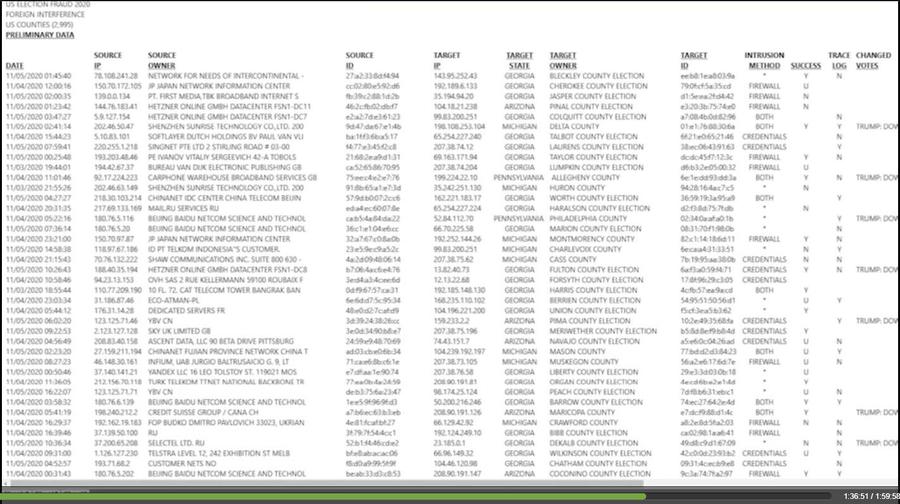
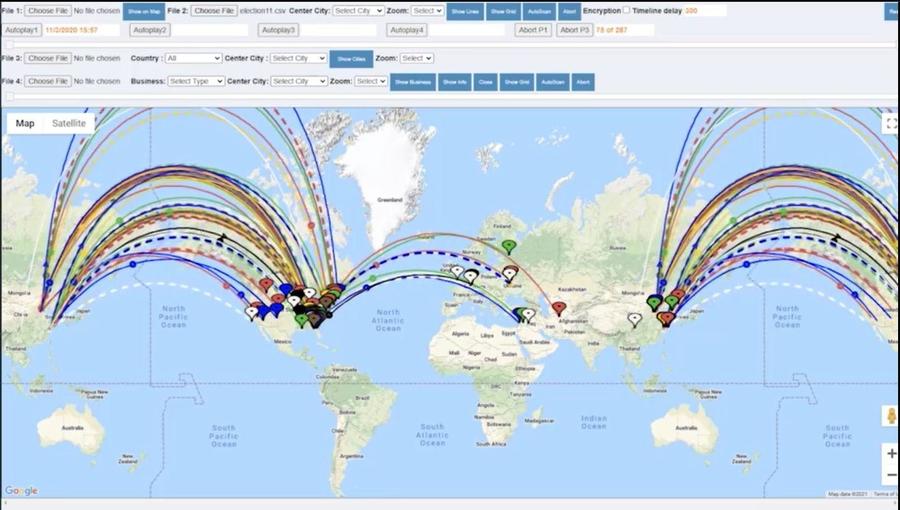
The same machine-switching story acquired a supposedly technical explanation through Dennis Montgomery, whose claims were promoted by Mary Fanning and Mike Lindell. Cybersecurity researcher Matthew Garrett found that the material failed basic forensic checks: public county websites appeared as election targets, text was presented as captured network traffic, and MAC addresses were used as though they traveled across the internet.
The purported data · 1:36:51. The table presents public website addresses as election-system targets. Technical analysis exposed that mismatch.The visual claim · 1:44:44. The animation sells a hacking story that the displayed data does not demonstrate. It is not a forensic recording of votes changing.
Evidence stills from Absolute Proof, as reproduced and examined by Lead Stories . Shown for criticism and comparison, not as authenticated attack records.
Four technical failures behind the spectacle
Websites presented as voting machines. Garrett traced purported targets to public county websites, including Delta County’s web server. A county website address does not identify its vote-counting equipment.
Text disguised as packet captures. The supposed encrypted hex display decoded to readable text resembling a voter roll, without packet headers. Schenk reproduced the effect from a spreadsheet: hexadecimal presentation does not turn text into intercepted traffic.
MAC addresses misused. MAC addresses identify interfaces on a local network link. They do not travel end to end across internet routers. Garrett identified a dataset using them as if they identified remote source and destination devices.
No demonstrated vote changes. The displays supplied no authenticated connection from network traffic to changed ballots. Unexplained claims to decrypt traffic and count altered votes were assertions, not forensic results.
The independent examination of Lindell’s contest files
Software expert Robert Zeidman examined the files supplied for Lindell’s 2021 challenge. The arbitration panel reviewed them individually and found that the material did not establish the promised November 2020 election data. Text, spreadsheets and unrelated content were no substitute for the real-time network evidence Lindell advertised. In July 2025 the Eighth Circuit overturned the $5 million award on contract interpretation; that decision did not authenticate the files or establish hacked votes.Related passages: The “Prove Mike Wrong” challenge did not prove Mike right →︎
OANN’s “expert mathematician” did not prove fraud with his math.
On January 27, 2021, One America News Network’s Christina Bobb featured Edward “Ed” Solomon as a mathematician. He claimed repeating Trump vote shares in Fulton County, Georgia, exposed an algorithm changing votes to Biden. OANN turned a spreadsheet pattern into an accusation of a stolen election.
The credentials behind the television billing
OANN’s introduction gave Solomon an authority his verified education did not support. Stony Brook University told FactCheck.org that he had attended classes as a math major during various terms from 2008 to 2015 but had not earned a degree. Dominion’s August 2021 complaint described his job at the time of the broadcast as an installer for a swing-set construction company on Long Island.
Berkeley statistician Philip Stark explained that repeated vote shares across precincts and multiple reporting times are unsurprising. FactCheck.org could not establish the source of the Georgia numbers: Edison Research said they were not its data, and they did not match Georgia’s published results. Former federal voting-system testing official Ryan Macias pointed to the decisive check: Georgia’s hand tally of paper ballots confirmed the outcome.
The New York Times feed and the Pennsylvania claim
Solomon also used New York Times live election updates to allege vote manipulation in Philadelphia. Andrew C. Eggers, Haritz Garro and Justin Grimmer examined that analysis in the supporting appendix to their peer-reviewed PNAS study. It was a separate claim from the one aired on OANN about Georgia, where the source of his figures could not be established.
He picked out ratios involving prime numbers and declared them suspicious without showing why those patterns would be unusual in a fair election. The researchers found that his supposedly identical ratios differed once the remainders were included: the precincts had different vote shares. Their checks of the voting equipment and historical results also failed to support his account. The newspaper’s feed recorded updates to reported totals. Solomon had treated patterns in those updates as evidence that an algorithm was changing ballots, but his analysis never established that connection.
The allegation traveled from television into legal filings. A March 2021 plaintiffs’ brief in O’Rourke v. Dominion in Colorado cited the OANN segment in footnote 8 on page 7, linking directly to the Rumble interview. The plaintiffs offered the broadcast to support their allegations.
Solomon’s report resurfaced in Nevada’s 2022 Republican primary for governor. Joey Gilbert claimed that an algorithm had handed victory to Joe Lombardo and that Solomon’s “restoration” of the figures would reverse it. The Nevada Supreme Court’s 2023 sanctions decision recorded that Solomon had not been listed as an expert or made available for deposition. None of the three witnesses recruited to support him replicated his calculations. The court upheld sanctions: the contest lacked evidence that the alleged manipulation had changed the winner.
The court’s words
“falls far short of being ‘legitimate.’”“fallsfarshortofbeing‘legitimate.’”
The earlier Arizona case Bowyer v. Ducey belongs to the broader history of rejected machine and statistical allegations. The December 2020 opinion explains why the court dismissed that challenge. It preceded Solomon’s January 2021 OANN interview.
Pandemic expansion of postal voting supposedly opened the way for enough fabricated or unlawful ballots to reverse the election. This umbrella claim often bundled together late counting, envelope procedures, drop boxes and unfamiliar voter turnout.
Why it mattered
The attack on mail voting reached far beyond the machines. Millions of Americans had voted by mail during the pandemic; casting suspicion on the entire process put those lawful votes at risk without identifying the ballots supposedly fabricated.
What the record shows
States used voter records, ballot tracking, acceptance rules and reconciliation; the details differed by jurisdiction. Pennsylvania’s official explanation describes its mail-ballot safeguards. Georgia’s paper audit checked the count, while its Cobb County envelope audit examined a different question: signatures. The count and signature checks addressed the fraud mechanisms the campaign alleged.
What exposed the claim
The campaign treated the existence of millions of lawful postal votes as evidence against those voters. Investigators instead checked ballots, envelopes and counting records. Georgia’s hand count confirmed the result; the Cobb signature investigation found no fraudulent absentee ballots in its 15,118-envelope sample. The campaign never produced evidence for its alleged mass fabrication.
The finding
The mass mail-ballot fraud story was false. Large-scale lawful participation was recast as a conspiracy without evidence of the alleged operation.
Lists matching voter names with death records were presented as evidence that ballots had been cast in the names of large numbers of dead people.
Why it mattered
The dead-voter story gave the broader fraud claim names and numbers. Casting a ballot in a dead person’s name is a crime, but the lists circulated as proof also accused living voters and inflated the scale of the offenses.
What the record shows
FactCheck.org’s review distinguishes actual criminal cases from sweeping numerical claims. Name matches can involve relatives, different people with the same name, incorrect database information, or someone who voted lawfully before dying. Giuliani’s disciplinary record also examines unsupported claims about deceased voters.Related passages: Giuliani’s election discipline →︎
What exposed the claim
The lists did not establish that the named people were both dead before voting and had a ballot fraudulently counted. They included mistaken identities, living voters and registration entries mistaken for votes. New York’s disciplinary court examined Giuliani’s inflated Pennsylvania dead-voter claim and found his public account false. A handful of actual offenses cannot rescue a claim about thousands of invented ballots.
The finding
The claim of significant numbers of dead voters was debunked. Inflated lists and false public statements did not identify the alleged mass fraudulent vote.
Viral calculations claimed turnout exceeded the voting population, often using a registration figure from another date or a mismatched jurisdiction.
Why it mattered
Other claims relied on arithmetic that appeared to make the result impossible. The comparisons used mismatched registration figures, creating an apparent excess of votes that disappeared when the correct electorate was counted.
What the record shows
Pennsylvania reports 6,945,045 participating registered voters and 6,915,283 presidential votes: some participants did not cast a valid presidential vote. Wisconsin claims used an outdated registration count and failed to account for election-day registration. These figures are not interchangeable with total adult population, earlier registrations or the number voting in a different contest.
What exposed the claim
The arithmetic used the wrong electorate. Wisconsin’s viral claim compared votes with an outdated registration figure and omitted election-day registrations. Pennsylvania’s official figures show fewer presidential votes than participating registered voters. Once the dates, boundaries and categories are matched, the claimed excess disappears.
The finding
False. These viral calculations manufactured impossible turnout by comparing incompatible numbers.
Multiple voting and ineligible or nonexistent voters
What was alleged
Alleged duplicate names, changed addresses and copied ballots were treated as evidence of people voting twice or ballots being created for nonexistent voters.
Why it mattered
The same confusion spread to election paperwork. A copied ballot could be portrayed as a second vote even when officials had made a replacement so a damaged original could be read by a scanner.
What the record shows
Pennsylvania’s explanation addresses tracking and the distinction between voting methods. Maricopa County’s court-ordered inspection included original and duplicate ballots: duplication itself was a recorded election procedure, not automatically an extra vote. Address discrepancies may concern students, military voters or an outdated database rather than an ineligible voter.Related passages: Maricopa’s review →︎
What exposed the claim
The cited records did not show two counted votes from the same person. Election staff can create a scannable copy of a damaged ballot while retaining its original; that is one vote represented by two documents. Maricopa’s court-ordered inspection compared originals with duplicates rather than assuming every copy was a second vote. Address and name matches likewise failed to establish the alleged mass impersonation.Related passages: Maricopa’s review →︎
The finding
The mass double-voting and phantom-voter claim failed. Administrative records and lawful ballot duplication were misrepresented as extra votes.
Trump allies said officials stopped checking signatures, accepted mismatches or adopted standards that let fraudulent postal votes pass.
Why it mattered
The signature allegation shifted attention from the count to the envelopes used to verify mail voters. Those envelopes required a separate check: the anonymous ballots in a recount could not answer every question about who had submitted them.
What the record shows
The Cobb County audit reviewed 15,118 absentee envelopes and reported no fraudulent ballots in the sample. Investigators followed up on questioned signatures rather than declaring every variation a forgery. Pennsylvania describes its own verification rules; a procedure lawful in one state should not be judged by another state’s requirements.
What exposed the claim
Georgia investigators actually inspected the envelopes: 15,118 in Cobb County, with follow-up on questioned signatures. They found no fraudulent absentee ballots in the sample. In Detroit, the court rejected the claim that missing checks at the counting center meant no checks had occurred: eligibility checks had already been performed at election headquarters. The alleged wholesale abandonment of verification was not what happened.
The finding
The claim that officials simply stopped verifying voters was contradicted by the investigations and court evidence.
Some counties helped voters correct defective mail ballots while others did not. The campaign argued that different treatment invalidated the result.
Why it mattered
The dispute moved from allegations of fabricated ballots to differences in how counties helped voters fix paperwork. The campaign used that unequal-treatment argument to seek the rejection of millions of votes.
What the record shows
In Trump v. Boockvar, the Third Circuit examined the campaign’s allegations and the remedy it wanted. The court found that the complaint failed to state a viable legal claim warranting the rejection of millions of votes. In court, Giuliani acknowledged that the amended Pennsylvania complaint did not allege fraud. Outside court, he continued promoting the fraud story.
What exposed the claim
The campaign’s Pennsylvania case challenged unequal treatment of defective ballots. It did not identify millions of forged votes. The Third Circuit rejected the attempt to discard the state’s result, finding the complaint and requested remedy legally deficient. Giuliani’s courtroom position—that the complaint did not plead fraud—was a striking departure from the fraud campaign he promoted outside court.
The finding
A failed ballot-curing challenge was sold to the public as proof of a stolen election. It supplied no such proof.
Ballot harvesting produced large numbers of illegal votes
What was alleged
Anyone seen delivering several envelopes was portrayed as an illegal ballot collector, sometimes without identifying the state law or the voters involved.
Why it mattered
Drop-box footage gave the allegation an immediate visual appeal. But states had different rules for delivering someone else’s ballot, and the images used to accuse voters did not establish that they had broken those rules.
What the record shows
One of those voters was Mark Andrews, shown depositing ballots in Georgia in 2000 Mules. The case record identifies the ballots as his own and those of his wife and three adult children living at the same address. Georgia permitted that family delivery. Salem later apologized for portraying him as an illegal participant.
What exposed the claim
The 2025 court opinion records that the defendants no longer disputed that he voted legally. Salem withdrew the film and book and apologized for falsely portraying him as a criminal.
The finding
The film’s accusation against Andrews was false. Lawful family ballot delivery was turned into a criminal narrative.
The film built a larger conspiracy around images like those of Andrews. Cellphone-location data supplied an air of technical certainty, while the footage exposed identifiable voters to accusations the evidence did not support.
Watch the record · Salem Media trailer · reproduced by Matt’s Movie Reviews
2000 Mules: the trailer and its drop-box footage
The film’s own promotional footage, including its drop-box and tracking claims. Compare what it claims with the Andrews ruling immediately below; lawful family delivery was falsely portrayed as criminal. Open on YouTube
What the record shows
Phone-location proximity does not identify a ballot, prove payment or demonstrate an unlawful delivery. The Andrews litigation exposed a lawful family delivery portrayed as wrongdoing. In 2024 Salem withdrew the film and book and apologized to Andrews. D’Souza later acknowledged inaccurate information about the footage and apologized to him, while continuing to defend the broader theory.
What exposed the claim
The film’s geolocation story collapsed when its accusation against an identifiable voter reached court. The defendants had no evidence that Andrews was paid, visited multiple drop boxes, collected ballots from a nonprofit or attended a violent riot. True the Vote had never geotracked his phone. Its claim to have matched that voter’s footage with cellphone tracking was therefore false. Georgia’s investigation cleared his lawful family delivery, and the federal judge held the criminal accusation false and defamatory.
The finding
2000 Mules did not expose the alleged paid ballot-trafficking network. Its portrayal of a lawful voter as a tracked criminal was disproved, the distributor withdrew it, and the court ruled against that accusation.
The judge’s words
“Nor did the TTV Defendants ever geotrack Andrews’s cell phone or any other device linked to him.”“NordidtheTTVDefendantsevergeotrackAndrews’scellphoneoranyotherdevicelinkedtohim.”
Judge Steven D. Grimberg · Andrews v. D’Souza · September 30, 2025 · pp. 16–17Read the ruling
Georgia’s demand for supporting evidence exposed another gap. In 2024, True the Vote told investigators it did not possess the requested source identities and evidence. The state dropped the evidence-production case in 2025, ending the effort to compel that material without a finding that the alleged trafficking had occurred.
Reporting on the apology for inaccurate information about the footage. D’Souza did not withdraw the entire trafficking theory. Open on YouTube
Inspect the film’s own claims
Salem withdrew the film and book in 2024. The trailer, original website and Rumble upload preserve the allegations that prompted the apologies and court case.
Large batches reported overnight in Michigan, Wisconsin and Pennsylvania were described as newly manufactured votes because they changed the apparent lead.
Why it mattered
The television graphics supplied another version of the story: an early Trump lead, followed by a sharp Biden gain. Those changing totals reflected the order in which counties reported their counts, not a completed result being overturned.
What the record shows
Milwaukee reported its large centrally counted absentee batch together. A Michigan viral spike originated in a clerical reporting error that was corrected. Pennsylvania’s mail-ballot processing rules help explain why its postal votes arrived in reported totals later than election-day votes. Reporting time does not establish when a voter cast a ballot.
What exposed the claim
The spikes were reporting events, not evidence that votes materialized out of nowhere. Large batches of already-cast absentee votes were reported together, and those ballots favored Biden. Michigan’s supposed one-sided gain also included a clerical error that was corrected. The paper ballots and certified returns survived audits; a jump on a television graph did not establish a fraudulent ballot.
The finding
The late-night vote-dump story confused the timing of reporting with the creation of votes.
State Farm Arena: the “suitcases of ballots” video
What was alleged
Giuliani’s presentation depicted containers retrieved from beneath a table as secret fraudulent ballots counted after observers were sent away. Ruby Freeman and Shaye Moss became targets of the allegation.Related passages: Ruby Freeman and Shaye Moss →︎
Why it mattered
In Georgia, the fraud campaign moved from graphs to surveillance video. A short excerpt made ordinary ballot containers and a change in counting instructions look like evidence of a crime, with Freeman and Moss cast as its perpetrators.
Watch the record · Donald J Trump · original campaign-channel upload
The actual “suitcases” claim clip
This is the short surveillance excerpt used to make the allegation. The full sequence and Georgia investigation disproved its interpretation: these were ordinary ballot containers holding lawful ballots. Open on YouTube
What the record shows
The full sequence shows ballots being packed for an intended overnight stop, then retrieved after management decided counting should continue. Investigators from Georgia’s Secretary of State, the GBI and FBI reviewed the unedited footage and interviewed participants. Their investigation found no support for the alleged fraudulent conduct by Freeman and Moss.
What exposed the claim
The full surveillance sequence showed election staff packing ordinary ballot containers for an intended stop, then retrieving them after being told to continue counting. The ballots had not been secretly brought in from elsewhere. Investigators reviewed the unedited footage and interviewed staff and observers; they found no evidence of the alleged fraud. The short excerpt hid the packing sequence, making standard containers labeled “suitcases” appear sinister.
The finding
False. The video showed lawful ballot counting, not suitcases of fabricated votes. Freeman and Moss were falsely accused and subjected to threats.
Watch the record · 11Alive · second Georgia Senate election hearing
The footage as it was presented
The hearing records how the surveillance excerpt was presented as evidence of fraud. Georgia’s investigation later reconstructed the full sequence and rejected that account. Open on YouTube
Watch the record · Fulton County Government · special board meeting
The county’s response
Fulton County officials respond at their December 4, 2020, meeting. Their account forms part of the record alongside the later investigation of the footage and witness testimony. Open on YouTube ↑︎ Back to claim index
12 · Examine the claim
Detroit’s TCF Center: affidavits and counting allegations
What was alleged
Witnesses alleged duplicate counting, late arrivals, improper ballot processing and obstructed observation at Detroit’s absentee counting center.
Why it mattered
In Detroit, witness accounts played the role that the video had played in Georgia. Allegations about unfamiliar counting procedures reached a national audience, even after a judge had examined and rejected key claims.
Watch the record · Michigan House hearing · December 2, 2020 · Joseph Morris review
The viral exchange from the actual hearing, with commentary around the excerpt. It is not the SNL recreation. The comic interruption came during a serious campaign to overturn the result. Open on YouTube
Watch the record · Michigan House hearing · December 2, 2020 · TBH upload
Mellissa Carone beside Rudy Giuliani
Mellissa Carone’s confrontational delivery drew attention and questions about whether she had been drinking, which she denied. Judge Kenny had already rejected her allegations in the November 13 Costantino decision. Her testimony appears at 23:45. Open on YouTube
What the record shows
In Costantino, Judge Timothy Kenny examined accounts from Mellissa Carone, Jessy Jacob and Andrew Sitto, testing their credibility and firsthand knowledge against the counting procedures they described. The opinion is available as a transcription with scans of the original court document. Michigan’s later audits checked election administration and the result.
What exposed the claim
Judge Timothy Kenny examined the witnesses’ accounts in Costantino. Carone’s claims of repeated counting were inconsistent with other accounts and unsupported by corroboration. Jessy Jacob misunderstood where signature checks took place and what a receipt-date field recorded. Andrew Sitto’s inference about a late truck delivery lacked a factual foundation for the alleged quantity or wrongdoing. Michigan’s later audits confirmed the election result.
The finding
The Detroit allegations were examined and rejected. The judge found Carone’s allegations not credible; the audits confirmed the result.
The judge’s words
“The allegations simply are not credible.”“Theallegationssimplyarenotcredible.”
Judge Timothy Kenny, assessing Carone’s account · Costantino · November 13, 2020 · p. 9Read the ruling
Carone’s appearance beside Giuliani became a spectacle, with contemporary coverage questioning her sobriety and recording her denial. The ruling had come first: Kenny rejected her account because it lacked credibility and corroboration. Read the contemporary coverage
Philadelphia and Pennsylvania: counting and observer access
What was alleged
Campaign representatives said they could not meaningfully observe counting, and that postal-ballot practices made the state result unlawful.
Why it mattered
As in Detroit, complaints about observation became part of the fraud narrative in Pennsylvania. The campaign sought to turn disputes over access into grounds for discarding the state’s votes.
What the record shows
Two cases addressed different parts of that argument. The Pennsylvania Supreme Court considered how close observers were entitled to stand and what the observation law required. The Third Circuit considered the campaign’s separate challenge to unequal treatment of mail voters. Neither case established that every Philadelphia ballot had been counted unlawfully or without observers.
What exposed the claim
The courts examined what access observers actually had and what the law required. The Pennsylvania Supreme Court rejected the claimed entitlement to the campaign’s preferred viewing distance. The separate federal case failed to establish a viable basis for throwing out the result. Neither proceeding proved hidden ballot stuffing; the campaign inflated disputes about procedure into claims of mass fraud.
The finding
The Philadelphia fraud narrative was not supported by the court record. Observer-distance disputes did not prove fabricated votes.
“Hundreds of sworn affidavits prove widespread fraud”
What was alleged
The number of sworn statements was presented as proof in itself. Promoters often treated any allegation inside an affidavit as an established event.
Why it mattered
The campaign leaned on the volume of sworn statements to give its accusations weight. When judges examined individual accounts, firsthand knowledge and corroboration mattered more than the size of the pile.
What the record shows
The Detroit judge tested representative witness accounts. In Arizona, a court ordered inspection of ballots and envelopes. New York’s disciplinary proceedings examined Giuliani’s public statements against the underlying evidence. Across those proceedings, the claims met checks they had escaped on television.
What exposed the claim
The opinions show courts examining the statements and the records behind them. Costantino explains why the witnesses’ accounts failed to establish the alleged fraud; Arizona’s court-ordered inspection checked actual ballots and envelopes. Rumor and misunderstandings of counting procedures did not survive that scrutiny merely because they had been put in sworn statements.
The finding
The affidavit count was a publicity argument, not proof. Representative allegations failed when checked against records, procedures and other witnesses.
Representative affidavits: what the judge actually examined
Jessy Jacob alleged missing signature checks and backdating. The court accepted the explanation that eligibility checks had already occurred elsewhere and that the date field recorded receipt. Andrew Sitto inferred wrongdoing from a late delivery; the opinion addressed the city’s use of a rental truck and his speculative estimate of its contents. Mellissa Carone alleged repeated jams and lost data. The judge found her account inconsistent with other witnesses and uncorroborated. Each conclusion rested on an examination of what that witness had actually seen and could substantiate.
Trump’s losses were explained away as nothing but standing or procedural dismissals, implying that the factual case for a stolen election remained untouched.
Why it mattered
After those defeats, Trump’s allies offered a new explanation: judges had refused to look. Some cases did end on procedural grounds, but the blanket claim erased the proceedings in which witnesses, ballots and allegations had been examined.
What the record shows
Texas v. Pennsylvania ended for lack of standing, without a decision on the fraud allegations. Other cases went further. The Third Circuit examined the Pennsylvania complaint, the Detroit judge assessed witnesses, and an Arizona court allowed inspection of ballots and signatures. The January 6 court chapter brings together those opinions and their page references.
What exposed the claim
Detroit’s judge assessed witness credibility. Arizona permitted inspection of ballots and envelopes. The Third Circuit examined the Pennsylvania complaint and explained why it failed. Texas’s Supreme Court case ended on standing, but that one procedural dismissal cannot erase substantive examination elsewhere. The promoters’ blanket claim that nobody looked at the evidence is contradicted by the opinions themselves.Related passages: “The courts never looked at the evidence.”“The courts never looked at the evidence.”Read what the judges actually decided. →︎
The finding
False. Judges did examine evidence and allegations. The campaign’s claim that the entire factual case was left untouched is contradicted by the judicial record.
The judge’s words
“Charges require specific allegations and then proof. We have neither here.”“Chargesrequirespecificallegationsandthenproof.Wehaveneitherhere.”
Judge Stephanos Bibas · Trump v. Boockvar · November 27, 2020 · p. 2Read the ruling
Officials who certified results or contradicted Trump were accused of betrayal, concealment or participation in the conspiracy, including Georgia’s Republican leadership.
Why it mattered
The theory insulated itself against contrary findings by turning investigators and certifiers into suspects whenever they did not endorse it.
What the record shows
Georgia conducted a full hand audit and investigated the State Farm allegations. The June 21 committee hearing records officials’ accounts of the pressure placed on them and testimony from the targeted election workers. The June 13 hearing records campaign and DOJ accounts of claims that did not hold up.Related passages: context →︎
What exposed the claim
Republican officials did investigate: Georgia conducted a statewide hand count and the State Farm inquiry. Campaign and Justice Department witnesses described allegations that failed scrutiny. When those findings contradicted Trump, the accusation shifted from fraud by Democrats to betrayal by Republicans. That shift supplied no missing evidence; it attacked the people who refused to change the result.Related passages: Georgia: “find 11,780 votes.” →︎
The finding
The cover-up claim was unsupported. The record shows investigations confirming the result and pressure on officials to overturn it.Related passages: An election result becomes something to fight. →︎
Zuckerberg and Chan’s funding of local election administration through nonprofit grants supposedly purchased the result or created a partisan election operation.
Why it mattered
The grants supplied a different target: the money behind election administration. Trump’s allies treated objections about private influence, allocation and accountability as evidence that the vote itself had been bought.
What the record shows
The Center for Tech and Civic Life describes the grants as support for local election administration during the pandemic. That is the organization’s own account of the program. The grants’ distribution raised questions about who was funding public election work, but the fact that a recipient county voted Democratic did not establish that the money changed its votes.
What exposed the claim
Private election-administration grants existed. That does not demonstrate purchased votes, altered tabulator totals or fabricated ballots. The allegation substituted a political objection to funding for proof that the certified count was false. Paper audits checked the result directly; the funding accusation did not overturn their findings.
The finding
The grants were real; the claim that they proved ballot fraud was false. Questions about private funding belong in an account of election governance, not a fictitious vote-switching operation.
Hunter Biden’s laptop: information suppression, not ballot fraud
What was alleged
Restrictions on the New York Post’s laptop story were said to constitute election interference and, sometimes, folded into claims that the vote count itself was fraudulent.
Why it mattered
The laptop controversy pushed the stolen-election argument beyond ballots altogether. The allegation now concerned what voters had been allowed to read before they voted.
What the record shows
Twitter blocked sharing of the New York Post story, then reversed the restriction. Former executives testified about that decision and denied government direction. DOJ later confirmed the laptop’s authenticity. That confirmation concerned the device; it did not settle the provenance of every circulating copy or the claims made about every file.
What exposed the claim
Twitter’s restriction on the story was real and was reversed. The laptop’s later authentication does not make the certified vote totals fraudulent. Arguments that different coverage might have persuaded different voters are arguments about campaigning and information, not evidence that ballots were forged or Trump won the count. Folding this controversy into ballot fraud changes the subject.
The finding
Information suppression is a separate controversy. It does not establish that the 2020 ballot count was fraudulent or that Trump won.
Observers were excluded or counting continued after they left
What was alleged
Absence, distance or removal of some observers was presented as proof that secret illegal counting occurred.
Why it mattered
The claim returned to a theme running through the Georgia and Pennsylvania disputes: that counting outside an observer’s view must have concealed fraud. The investigations reconstructed what observers could see, when they left and why work continued.
What the record shows
Pennsylvania’s courts examined proximity and the observation law. In Georgia, investigators traced the instructions for an intended overnight stop at State Farm Arena, followed by the decision to continue counting. The departures and resumed work belonged to that sequence; the ballots had not been secretly introduced after observers left.
What exposed the claim
The Pennsylvania opinions document the observation dispute and the rules that applied. Georgia’s investigation established the chronology of the planned stop and resumed work; departure of observers did not turn lawful ballots into fabricated ones. The campaign’s narrative relied on omitting that chronology and equating an observation complaint with a proven criminal count.
The finding
The cited examples did not show secret fraudulent counting. The State Farm claim was disproved; the Pennsylvania dispute did not establish the alleged ballot fraud.
After audits confirmed the result, promoters argued that recounts could not detect the kind of fraud they alleged and therefore provided no meaningful reassurance.
Why it mattered
As checks confirmed the result, the fraud story shifted again. Trump’s allies dismissed the audits for failing to answer every allegation, overlooking the different checks used to investigate different claims.
What the record shows
A paper hand count tests whether recorded ballot choices match tabulator totals. An envelope audit tests a different part of authentication. Procedural audits review administration; court-ordered inspection can examine originals and duplicates. Georgia and Michigan used multiple kinds of checks, not just a repeat of the same electronic total.
What exposed the claim
The response moved the goalposts. A hand count directly tested machine switching; envelope review addressed signatures; procedural audits and court inspections checked other allegations. Georgia and Michigan used more than one method. After the machine claim failed, asserting that the paper itself must also be fake supplied no evidence for a new conspiracy.
The finding
The audits mattered because they tested the alleged mechanisms. Dismissing every contrary check did not rescue the stolen-election story.
The allegations did not end with certification. Election workers and voting-system companies sued the people and broadcasters who had accused them. Lawyers faced disciplinary proceedings, and criminal cases followed. The record includes rulings that statements were false, jury awards, guilty pleas, corrections and settlements—consequences that reached well beyond a failed campaign lawsuit.
Falsity rulingA judicial decision that specified statements were false.
Default liabilityLiability entered without a full merits trial, including for discovery failures.
Damages verdictA jury’s assessment of compensation, sometimes after a judge has already established liability.
Settlement or apologyAn agreement resolving a dispute or a correction of particular claims; its scope depends on the terms.
Falsity ruling · settlement
Dominion v. Fox
Judge Eric Davis ruled the challenged statements about Dominion false in March 2023. Fox then paid $787.5 million to settle the case in April, avoiding a trial on actual malice. The machine conspiracy was not merely an unpopular opinion: its falsity had been established by the court.
Newsmax’s August 2025 SEC filing records a $67 million settlement of Dominion’s lawsuit, payable in three installments. It was another substantial bill for a broadcaster that had amplified the voting-machine story, separate from its settlement with Smartmatic.
Smartmatic v. Fox: the case survives another challenge
On May 7, 2026, the appellate court declined to pause Smartmatic’s defamation case for a separate criminal proceeding and allowed limited additional discovery into business losses. The judges distinguished allegations concerning the 2016 Philippines election from the claims that Smartmatic had rigged the 2020 U.S. vote. The appeal left the defamation case proceeding toward a decision on its merits.
Smartmatic announced settlements with OANN in April 2024 and Newsmax in September 2024. The company’s linked chronology records the two agreements. Smartmatic and Dominion were different businesses, falsely folded into the same conspiracy and pursuing separate defamation cases.Related passages: Smartmatic →︎
Giuliani stipulated to the falsity of his accusations for purposes of the litigation. After he failed to comply with discovery, the judge entered default liability; a jury then awarded Freeman and Moss approximately $148 million in December 2023. A permanent injunction barred repetition of the false claims, and an enforcement settlement followed in January 2025. The women he accused were lawful election workers, not ballot fraudsters.
After presenting a supposedly factual international vote-rigging conspiracy, Powell defended herself by arguing that reasonable listeners would not treat her political statements as factual assertions. The federal court rejected that route to dismissal in August 2021. The people who sold the story as election evidence could not simply relabel it political rhetoric to escape the lawsuit.
Newsmax acknowledged it had no evidence that Coomer manipulated machines or election results and apologized to him and his family. He dropped Newsmax from his suit. The correction concerns its allegations about Coomer; it is distinct from Newsmax’s later Dominion and Smartmatic settlements.
Giuliani: the public claims and the courtroom pleading
New York suspended Giuliani in 2021 and disbarred him in 2024 over false election statements. The disciplinary decisions set his public accusations against the evidence. His acknowledgment in the Pennsylvania courtroom that the amended complaint did not allege fraud exposed the gulf between the legal case he had filed and the story he was selling outside court.
Georgia: four guilty pleas in the election-interference case
Three lawyers—Jenna Ellis, Sidney Powell and Kenneth Chesebro—and bail bondsman Scott Hall pleaded guilty to criminal offenses in the Georgia election-interference case. Ellis admitted aiding the false election-fraud statements presented to Georgia legislators on December 3, 2020. At her plea hearing she said: “I failed to do my due diligence.” Chesebro’s plea concerned false elector documents; Powell’s and Hall’s concerned interference with election duties connected to the Coffee County voting-system breach. The agreements specified those offenses rather than the original racketeering charge, and did not retract every public claim. The remaining prosecution against Trump and other defendants was dismissed on November 26, 2025, without a trial verdict against them. The four earlier guilty pleas remain a separate part of that record.
2025 falsity ruling · settlement reported July 2026
2000 Mules: a false accusation, withdrawal and settlement
Salem withdrew the film and book in 2024 and apologized to Mark Andrews. D’Souza’s later apology acknowledged incorrect information about the footage while retaining his wider theory. In 2025 the Andrews litigation produced summary judgment on the falsity of the portrayal of his lawful ballot delivery. Democracy Docket records a settlement agreement on July 30, 2026; it does not publish settlement terms on the linked case page.
Asked to substantiate its Georgia allegations, True the Vote said it did not possess the requested evidence and source identities. The state ended the evidence-production proceeding in 2025. That closed the attempt to compel the material; the proceeding ended without a finding that ballot trafficking had occurred.
Eric Coomer’s defamation case against Mike Lindell
A Colorado jury found Lindell liable for defaming former Dominion employee Eric Coomer and awarded damages in June 2025. The case centered on Lindell’s attacks on Coomer. The jury did not find MyPillow liable.
News coverage of the jury’s findings in the Coomer case. Open on YouTube
Separate settlements
Freeman and Moss: other publishers
OANN and Gateway Pundit also settled litigation with Freeman and Moss. OANN broadcast a correction acknowledging that its Georgia fraud claims were false. The false “suitcases” narrative had consequences for the publishers who spread it, as well as the election workers whose lives it upended.
For Ruby Freeman and Shaye Moss, a false story about ballot counting brought threats and years of litigation. Mark Andrews was turned into a character in a conspiracy film for delivering his family’s ballots legally. The court decisions and retractions documented here came after the accusations had already reached their audiences.
The campaign to overturn the result also left a record inside Trump’s own administration. The January 6 hearings brought together testimony from officials, campaign staff and election workers. Alongside the original claim videos, their accounts show how the allegations spread, how they were checked and how they fed the wider effort to keep Trump in power.
Watch the record · PBS NewsHour · January 6 committee
Why Barr rejected the fraud claims
Barr’s testimony, shown at the June 13, 2022, hearing. The full hearing is linked below. Open on YouTube

 The “suitcases” footage ▶
 The 2000 Mules trailer ▶
 Carone beside Giuliani ▶